
Head-to-head comparison
Flashforge AD5X vs Bambu Lab P1S: which multicolor wins?
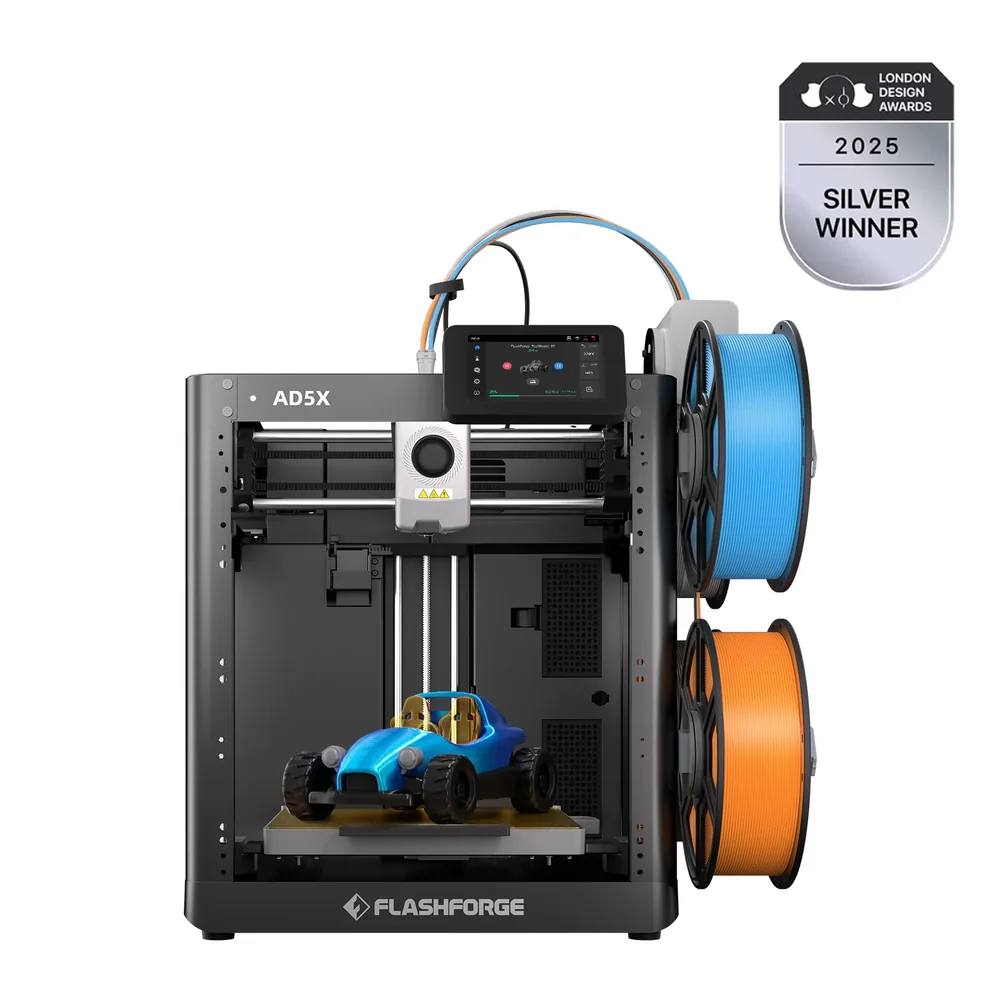
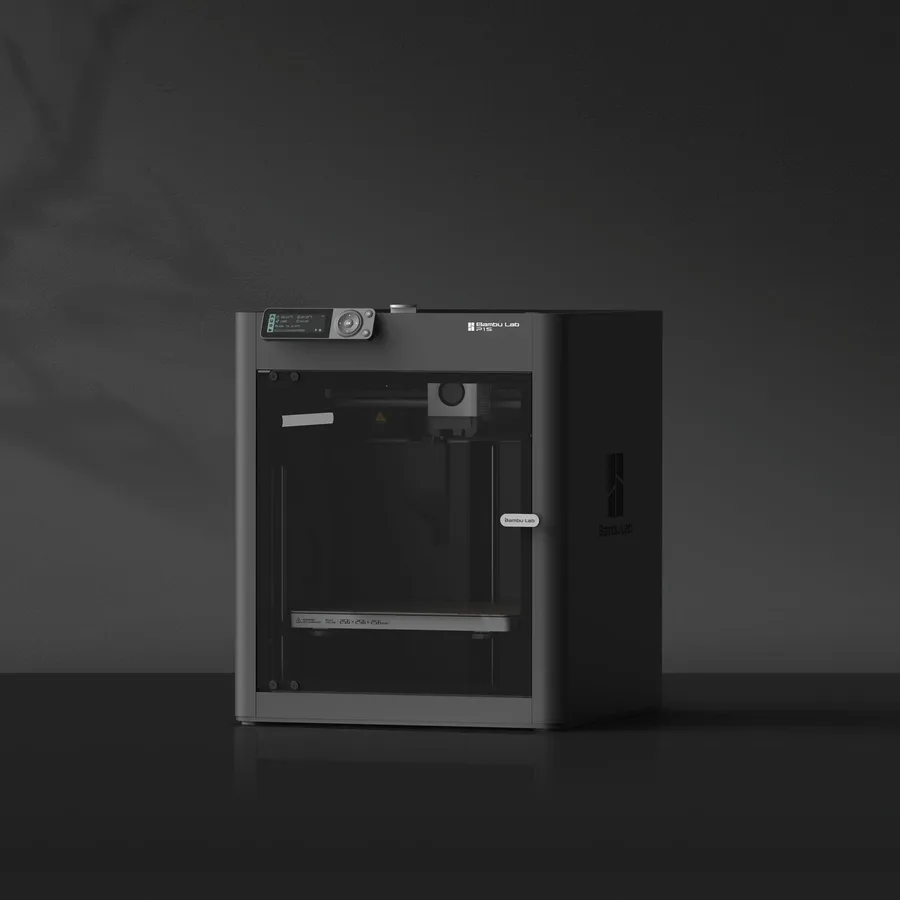
The short answer
Pick the AD5X for a built-in 4-color IFS system with no external box, a bed advertised at 110°C, and Ethernet connectivity, on a 220 mm open frame. Pick the P1S for an enclosed frame compatible with ABS and ASA, a monitoring camera, an activated carbon filter, and a larger 256 mm nominal volume, with an optional AMS for multicolor.
Documentary comparison of manufacturer specifications. Not personally tested.
Choose the Flashforge AD5X if…
- A built-in IFS multicolor system from the start, up to 4 colors or materials per Flashforge, with no external box to add like an AMS.
- A bed heated up to 110°C versus 100°C on the P1S, plus Wi-Fi, Ethernet, and USB connectivity per Flashforge.
- A travel speed advertised up to 600 mm/s (300 mm/s for printing per Flashforge), with auto bed leveling built in.
- Compatible with TPU95A and TPU64D-75D alongside PLA, PETG, and fiber-filled composites (PLA-CF, PETG-CF) per Flashforge.
Choose the Bambu Lab P1S if…
- An enclosed frame that widens material compatibility to ABS and ASA, with PLA, PETG, TPU, PET, and PVA rated 'Ideal' per Bambu Lab.
- A 256 × 256 × 256 mm nominal volume versus 220 × 220 × 220 mm for the AD5X, for larger parts.
- A monitoring camera and an activated carbon filter per Bambu Lab, with an AMS compatible with up to 16 colors across 4 units.
- An enclosed frame that stabilizes temperature around the part, a real advantage for materials that shrink while cooling.
Specifications side by side
| Specification | Flashforge AD5X | Bambu Lab P1S |
|---|---|---|
| Technology | Filament (FDM) | Filament (FDM) |
| Build volume | 220 × 220 × 220 mm (8.7 × 8.7 × 8.7 in) | 256 × 256 × 256 mm (10.1 × 10.1 × 10.1 in) |
| Enclosure | Open frame | Enclosed |
| Claimed top speed | 600 mm/s | 500 mm/s |
| Claimed acceleration | 20,000 mm/s² | 20,000 mm/s² |
| Max nozzle temperature | 300 °C (572 °F) | 300 °C (572 °F) |
| Max bed temperature | 110 °C (230 °F) | 100 °C (212 °F) |
| Multicolor | Built-in IFS (Intelligent Filament System), no external box, for up to 4 colors or materials per Flashforge. | AMS compatible; AMS 2 Pro configurations require the appropriate accessories. |
| Materials | PLA, PETG, TPU95A, TPU64D-75D, PLA-CF, and PETG-CF per Flashforge. | PLA, PETG, ABS and ASA, subject to manufacturer profiles and setup requirements. |
| Screen | 4.3-inch touchscreen | — |
| Connectivity | Wi-Fi, Ethernet, USB | — |
| Listed features | Auto bed leveling, filament runout sensor, filament cutter | Auto bed leveling, filament runout sensor, built-in air filtration |
| Printer dimensions | — | 389 × 389 × 458 mm (15.3 × 15.3 × 18 in) |
| Weight | — | 13 kg (28.5 lb) |
| Built-in camera | — | Yes |
— : not listed by the manufacturer on the pages we reviewed.
Build volume and footprint
The AD5X advertises a 220 × 220 × 220 mm nominal volume versus 256 × 256 × 256 mm for the P1S per both manufacturers, a real gap that limits part size on the AD5X, especially for objects combining several colors in one piece.
Flashforge doesn't publish the AD5X's footprint or net weight on its official spec sheet. The P1S advertises 389 × 389 × 458 mm at 12.95 kg per Bambu Lab, a useful reference for judging the space needed, even without a matching figure for the AD5X.
Speed and motion
Flashforge advertises a maximum travel speed of 600 mm/s for the AD5X, with a separate maximum print speed of 300 mm/s specified by the manufacturer. Bambu Lab advertises 500 mm/s for the P1S without that travel-versus-print distinction. Both machines share the same advertised maximum acceleration of 20,000 mm/s².
These numbers remain manufacturer ceilings: actual print time depends mostly on the slicer profile, part geometry, and material used. Both printers advertise automatic bed leveling, which simplifies setup before each print.
Materials, temperatures and enclosure
Both hotends reach 300°C per the manufacturers, but the bed differs: 110°C advertised for the AD5X versus 100°C for the P1S. Flashforge lists PLA, PETG, TPU95A, TPU64D-75D, PLA-CF, and PETG-CF for the AD5X, with no ABS or ASA on this open frame.
Bambu Lab lists PLA, PETG, TPU, PET, ABS, and ASA as 'Ideal' for the P1S, with PA and PC rated 'Capable.' Its enclosed frame stabilizes temperature around the part, which benefits ABS and ASA, prone to warping in an open frame like the AD5X's. For an enclosed Flashforge frame, the Adventurer 5M Pro shares the same base without IFS multicolor. The PLA vs PETG guide helps frame the two most common materials before choosing a machine.
Multicolor
The AD5X builds its IFS (Intelligent Filament System) directly into the chassis, for up to 4 simultaneous colors or materials per Flashforge, with no external box to set up beside the machine. Each filament change consumes and purges some material, worth factoring in for highly detailed parts.
The P1S works with an optional AMS, compatible with up to 16 colors across 4 units per Bambu Lab, though the exact version included depends on the bundle chosen. The multicolor buying guide covers the difference between a built-in system like the IFS and an external box like the AMS before you choose.
Everyday features
Flashforge documents a 4.3-inch touchscreen for the AD5X, Wi-Fi, Ethernet, and USB connectivity, a filament sensor and cutter, and automatic bed leveling. On its official spec sheet, Remote Monitoring is listed as an expandable feature rather than included by default, with no built-in camera advertised.
The P1S has a low-rate monitoring camera (1280 × 720 at 0.5 fps, for monitoring and timelapses), an activated carbon filter, a filament sensor, and automatic bed leveling per the official store; its other features (screen, connectivity) are less detailed on its sheet. Before buying, compare the exact bundle each retailer lists rather than the product photo alone.
Sources
- Flashforge — fiche technique AD5X (flashforge.com)
- Bambu Lab — fiche technique P1S (eu.store.bambulab.com)
- How we compare printers
Published 2026-09-28, updated 2026-09-28.