
Head-to-head comparison
Creality K1C 2025 vs Bambu Lab P1S: which enclosed printer wins?
The short answer
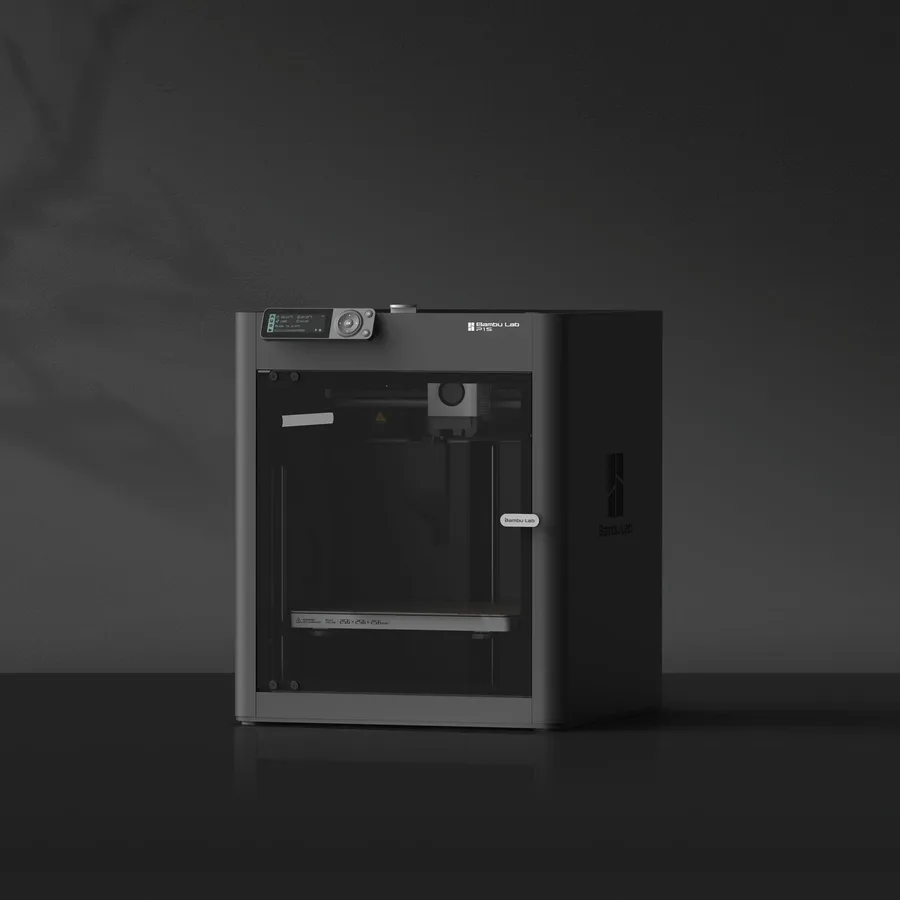
Pick the K1C 2025 for a smaller floor footprint, a top speed advertised at 600 mm/s, and documented PA-CF compatibility per Creality. Pick the P1S for a 256 mm cubic volume, an AMS rated up to 16 colors, and PVA compatibility for soluble supports per Bambu Lab.
Documentary comparison of manufacturer specifications. Not personally tested.
Choose the Creality K1C 2025 if…
- A smaller floor footprint (355 × 355 mm versus 389 × 389 mm for the P1S) and a slightly lighter machine (12.4 kg versus 12.95 kg).
- A top speed advertised at 600 mm/s versus 500 mm/s for the P1S, with the same maximum acceleration of 20,000 mm/s² per both manufacturers.
- Documented PA-CF compatibility per the 2025 manual, for reinforced functional parts.
- A 4.3-inch touchscreen and Wi-Fi plus USB connectivity specified right on Creality's spec sheet.
Choose the Bambu Lab P1S if…
- A cubic 256 × 256 × 256 mm nominal volume, versus 220 × 220 × 250 mm for the K1C 2025: more room in width and depth.
- AMS compatibility up to 16 colors with 4 units per Bambu Lab, in a Combo version or as an add-on.
- PVA compatibility rated 'Ideal' per Bambu Lab, useful for soluble supports on complex parts.
Specifications side by side
| Specification | Creality K1C 2025 | Bambu Lab P1S |
|---|---|---|
| Technology | Filament (FDM) | Filament (FDM) |
| Build volume | 220 × 220 × 250 mm (8.7 × 8.7 × 9.8 in) | 256 × 256 × 256 mm (10.1 × 10.1 × 10.1 in) |
| Printer dimensions | 355 × 355 × 482 mm (14 × 14 × 19 in) | 389 × 389 × 458 mm (15.3 × 15.3 × 18 in) |
| Weight | 12.4 kg (27.3 lb) | 13 kg (28.5 lb) |
| Enclosure | Enclosed | Enclosed |
| Claimed top speed | 600 mm/s | 500 mm/s |
| Claimed acceleration | 20,000 mm/s² | 20,000 mm/s² |
| Max nozzle temperature | 300 °C (572 °F) | 300 °C (572 °F) |
| Max bed temperature | 100 °C (212 °F) | 100 °C (212 °F) |
| Multicolor | Single-color base machine; verify any CFS setup and required accessories separately. | AMS compatible; AMS 2 Pro configurations require the appropriate accessories. |
| Materials | PLA, TPU, PETG, ASA, ABS, PET, PLA-CF and PA-CF subject to the 2025 manual and exact profiles. | PLA, PETG, ABS and ASA, subject to manufacturer profiles and setup requirements. |
| Screen | 4.3-inch touchscreen | — |
| Built-in camera | Yes | Yes |
| Connectivity | Wi-Fi, USB | — |
| Listed features | Auto bed leveling, filament runout sensor, built-in air filtration | Auto bed leveling, filament runout sensor, built-in air filtration |
— : not listed by the manufacturer on the pages we reviewed.
Build volume and footprint
The K1C 2025 advertises a 220 × 220 × 250 mm nominal volume per the 2025 manual, versus a 256 × 256 × 256 mm cube for the P1S per Bambu Lab: the P1S offers more room in width and depth, while the K1C 2025 stays close in height despite a smaller base.
On the floor, the K1C 2025 takes up 355 × 355 × 482 mm at 12.4 kg, versus 389 × 389 × 458 mm and 12.95 kg for the P1S: the K1C 2025 is narrower but a bit taller, with both machines close in weight.
Speed and motion
Creality advertises a top speed of 600 mm/s for the K1C 2025 versus 500 mm/s for the P1S per Bambu Lab, with the same maximum acceleration of 20,000 mm/s² on both machines: a real gap on paper, worth weighing against your actual use.
These numbers remain manufacturer ceilings: actual print time depends mostly on the slicer profile, part geometry, and material used. Both printers advertise automatic bed leveling, which simplifies setup before each print.
Materials, temperatures and enclosure
Both hotends reach 300°C and both beds 100°C per the manufacturers: on this specific point, the K1C 2025 and P1S are tied. The K1C's 2025 manual lists PLA, TPU, PETG, ASA, ABS, PET, PLA-CF, and PA-CF, a compatibility geared toward functional parts and fiber-filled composites.
Bambu Lab lists PLA, PETG, TPU, PET, ABS, and ASA as 'Ideal' for the P1S, with PA and PC rated 'Capable,' plus PVA for soluble supports. Both enclosed frames stabilize temperature around the part, which benefits ABS and ASA on either machine. The PLA vs PETG guide helps frame the two most common materials before choosing between these enclosed frames.
Multicolor
The K1C 2025 remains a single-color base machine per Creality: any CFS setup for multicolor needs to be checked and added separately, with no color count or unit number specified for this model on the sheet checked.
The P1S works with an optional AMS, compatible with up to 16 colors across 4 units per Bambu Lab, with the exact version depending on the bundle chosen. The multicolor buying guide helps you judge whether this accessory is worth it for your use.
What to check before buying
Don't confuse the original K1C with this 2025 version: specs, manual, and compatible accessories differ per Creality. Both machines include a camera per their respective manufacturers; the P1S specifies a low-rate resolution of 1280 × 720 at 0.5 fps, while the K1C 2025's resolution isn't specified on the sheet checked. Both advertise air filtration, but only the P1S details an activated carbon filter.
For a Bambu Lab machine with higher temperatures and a 1920 × 1080 camera, the P2S remains an alternative worth comparing. Before buying, compare the exact bundle each retailer lists (accessories, nozzles, CFS or AMS setup included or not) rather than the product photo alone.
Sources
- Creality — fiche technique K1C 2025 (creality.com)
- Bambu Lab — fiche technique P1S (eu.store.bambulab.com)
- How we compare printers
Published 2026-09-28, updated 2026-09-28.