
Metal 3D Printing: What Actually Works Outside a Factory
Search for a metal 3D printer and you would think a desktop machine can melt steel or titanium. It cannot: laser powder-bed fusion is still an industrial process. This page walks through the paths that are actually available to a hobbyist or a small shop, and when each one makes sense.
Find My 3D Printer editorial team·Published September 10, 2026·Manufacturer documentation, no hands-on tests claimed

The short answer
Direct metal printing by laser powder-bed fusion (SLM/DMLS) or binder jetting remains an industrial process, out of reach for a desktop printer. For a hobbyist or small shop, the realistic paths are metal-filled filament for looks and weight, sinterable metal filament like BASF Forward AM's Ultrafuse 316L for a genuinely metal part made through a sintering service partner, online metal printing services that outsource the whole process, and lost-wax casting from a printed pattern. The right choice depends on precision, quantity, and what the part actually needs to do.
Why direct metal printing is still an industrial process
Technologies that produce a solid metal part straight from a 3D file, like laser powder-bed fusion (SLM), direct metal laser sintering (DMLS), or binder jetting, handle fine metal powder under a controlled atmosphere before fusing or bonding it with a laser. Per Formlabs' materials guide, these processes mainly serve materials like titanium, stainless steel, or aluminum, for industries such as aerospace or medical, with equipment, safety requirements, and powder handling well beyond a home setup.
No consumer FDM or resin printer performs this process, including the ones covered in our printer finder. What is actually available are workarounds, each with its own trade-off: giving a plastic part a metallic look or weight, getting a genuinely metal part made through an outside service, or reproducing a metal part through classic foundry casting from a printed pattern.
Metal-filled filament: a metallic look, not a metal part
A metal-filled filament, copper, bronze, steel, or brass, is still more than 80% a polymer like PLA with fine metal powder mixed in for weight, texture, and, after sanding and polishing, a look close to raw metal. The printed part keeps the mechanical behavior of a filled plastic: it has neither the strength, the conductivity, nor the temperature resistance of a solid metal part.
These filaments are abrasive on a standard brass nozzle because of the suspended metal particles, and need a hardened nozzle, the same requirement as carbon-fiber-filled filament. The Centauri Carbon spec sheet, for instance, lists a hardened steel nozzle rated up to 320 °C for this kind of demanding material, and the K1C 2025 one rated up to 300 °C. Always check the exact compatibility with the filament manufacturer before buying, since metal loading varies between products.
Sinterable metal filament like Ultrafuse 316L: the closest path to real metal
Ultrafuse 316L from BASF Forward AM is a metal-polymer composite, roughly 90% refined metal particles bound with a thermoplastic binder, printable on a standard open-material FFF printer with a Bowden or direct-drive extruder and a hardened nozzle. It is the only filament path that ends with an actual metal part, in this case 316L stainless steel.
The part that comes off the printer is only an intermediate step, called a green part. Per Forward AM's quick start guide, it then goes through debinding, which removes the polymer binder, and sintering, which fuses the metal particles together into the final metal part. Both steps follow Metal Injection Molding (MIM) standards and run through a partner in Forward AM's debind-and-sinter service network rather than at home: you book a slot instead of buying a dedicated furnace.
One design detail matters here: the same Forward AM documentation lists dimensional shrinkage of roughly 16% in X and Y and roughly 20% in Z after sintering, which you need to compensate for by scaling the model up before printing, plus size and wall-thickness limits to respect. Typical uses stay in tooling, jigs, small functional runs, and jewelry rather than critical structural parts.
Online metal printing services: outsourcing the whole process
Sending a 3D file to a service that runs SLM, DMLS, or binder jetting is the most direct way to get a solid metal part without investing in industrial equipment yourself. The service picks the material, handles the powder, and ships the finished or near-finished part. Cost swings widely with material, volume, and finish, so scope your need with the startup budget tool before comparing quotes, rather than trusting a generic price you saw online.
Always ask for the material's technical data sheet and the tolerances the service guarantees for your specific part. No general claim found online replaces that check, especially for a mechanical or regulated application.
Lost-wax casting from a printed pattern
Investment casting, also called lost-wax or lost-pattern casting, is a classic metallurgy process adapted here with a printed model instead of a hand-carved or machined one: the pattern sits inside a mold that gets heated to burn it out before molten metal is poured in. A castable resin, or a filament like PLA that burns cleanly, serves as the sacrificial pattern.
Per the Prusa Knowledge Base, resin printers go down to layer heights of 25 to 100 microns, which is why resin is a common choice for jewelry or small figure patterns meant for casting, where detail matters. The actual pour is a foundry or specialist shop's job, not something you improvise with 3D printing gear alone: see our resin page to pick the right machine for the modeling side.
What to weigh for your specific part
The decision comes down to four questions. Does the part actually need to be metal for its function, strength, conductivity, temperature, or would a metallic look and weight be enough? Is it a one-off, a prototype, or a small run? What dimensional tolerance can you live with, given that sintering shrinks the part in a predictable but specific way and casting has its own margins? And finally, do you have the time and budget to book a debind-and-sinter partner, or would you rather outsource the whole thing to an online service? Our printer finder helps with the machine side of that decision, but the answer mostly comes down to what the part has to do. Answering these four questions before ordering a spool or a quote saves a second round of prototyping once the first result turns out to be the wrong fit for the part.
What none of these paths guarantee
None of these routes automatically makes a part food-safe, compliant with a safety standard, or fit for a critical mechanical load: check that with the material manufacturer and, for professional or regulated use, with dedicated validation rather than an assumption. For a business context with repeatability and technical-material requirements, our professional 3D printer guide covers the criteria specific to that setting, beyond the choice of technology alone.
Creality K1C 2025
220 × 220 × 250 mm
An enclosed format with different dimensions from 256 mm printers; manufacturer-specified hotend up to 300°C.
Distinguish the original K1C from K1C 2025. Check accessories and regional delivery before ordering; check the exact bundle in the manufacturer’s US listing.
Specifications and seller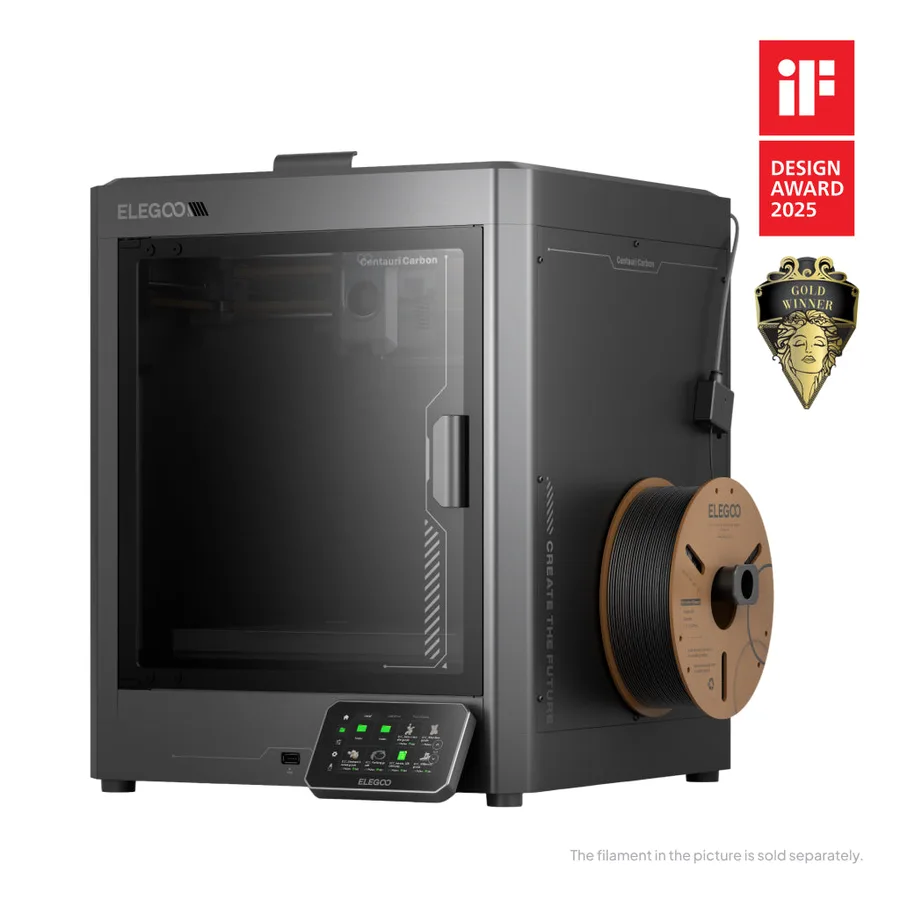
Elegoo Centauri Carbon
256 × 256 × 256 mm
Manufacturer specifications include a 320°C hotend, 110°C bed and automatic calibration.
Do not confuse the original Carbon with Carbon 2. Confirm the exact model and any CANVAS compatibility with the seller.
Specifications and sellerSources and limits
- Forward AM (BASF) — Ultrafuse 316L
- Forward AM (BASF) — Ultrafuse Metal Solution, Quick Start Guide
- Formlabs — Guide to 3D Printing Materials
- Prusa Knowledge Base — Types of printers and their differences
We organize manufacturer and community documentation; we have not measured these products ourselves. The manual for your exact model takes precedence over general guidance.
A clearer shortlist starts with your projects.
Use the free buying checklist and budget worksheet before comparing offers.