
Head-to-head comparison
Creality K1C 2025 vs K1 Max: which enclosed format fits your prints?
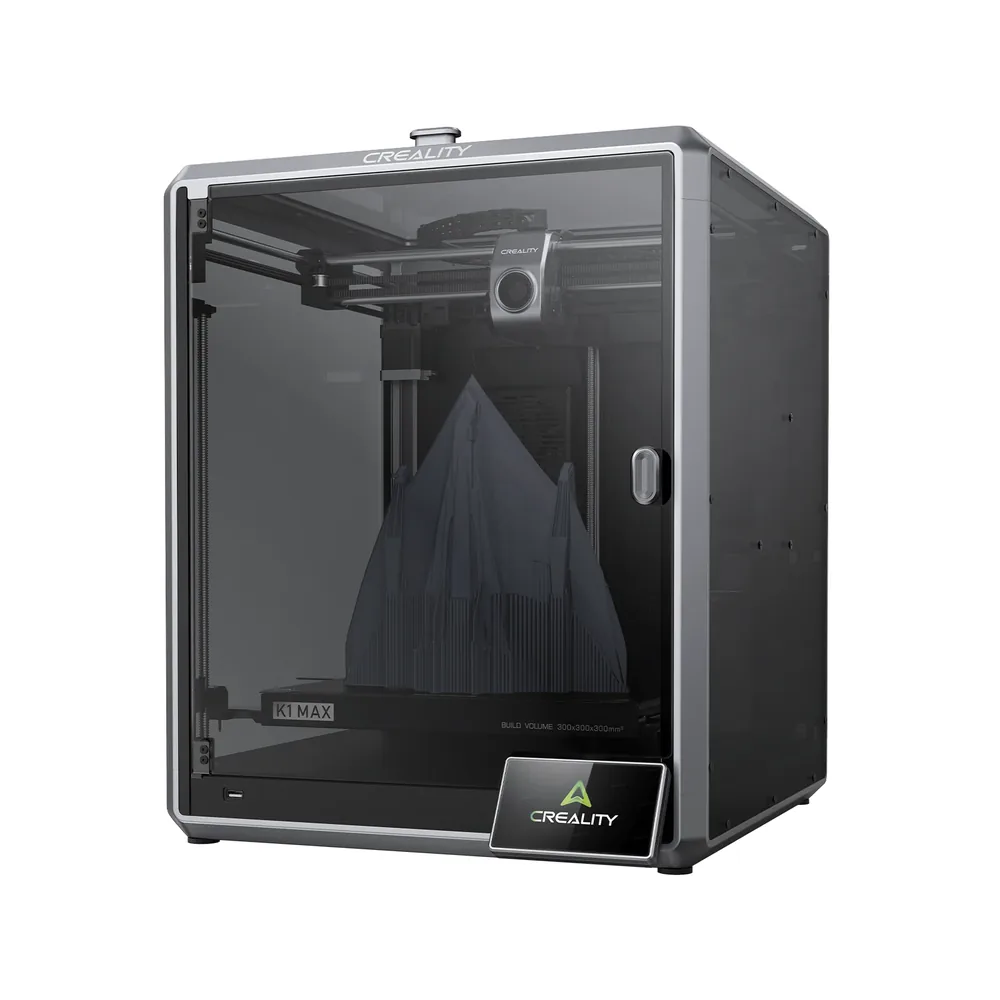
The short answer
Pick the K1C 2025 for a compact format (220 × 220 × 250 mm, 12.4 kg) and an advertised materials list that includes TPU and PET per the 2025 manual. Pick the K1 Max for a 300 × 300 × 300 mm volume, and LiDAR leveling advertised at 1 μm, at the same 600 mm/s top speed per Creality.
Documentary comparison of manufacturer specifications. Not personally tested.
Choose the Creality K1C 2025 if…
- A more compact format (220 × 220 × 250 mm) and lighter weight (12.4 kg), for a tighter workspace.
- An advertised materials list including TPU and PET per the 2025 manual, on top of PLA-CF and PA-CF.
- A 355 × 355 × 482 mm footprint, noticeably smaller than the K1 Max's.
- The same advertised top speed as the K1 Max (600 mm/s) in a more compact format.
Choose the Creality K1 Max if…
- A 300 × 300 × 300 mm nominal volume versus 220 × 220 × 250 mm for the K1C 2025, for noticeably larger parts.
- LiDAR leveling advertised at 1 μm resolution per Creality.
- Ethernet connectivity on top of Wi-Fi and USB.
- The same nozzle and bed temperature as the K1C 2025 (300°C and 100°C), despite a much larger bed.
Specifications side by side
| Specification | Creality K1C 2025 | Creality K1 Max |
|---|---|---|
| Technology | Filament (FDM) | Filament (FDM) |
| Build volume | 220 × 220 × 250 mm (8.7 × 8.7 × 9.8 in) | 300 × 300 × 300 mm (11.8 × 11.8 × 11.8 in) |
| Printer dimensions | 355 × 355 × 482 mm (14 × 14 × 19 in) | 435 × 462 × 526 mm (17.1 × 18.2 × 20.7 in) |
| Weight | 12.4 kg (27.3 lb) | 18 kg (39.7 lb) |
| Enclosure | Enclosed | Enclosed |
| Claimed top speed | 600 mm/s | 600 mm/s |
| Claimed acceleration | 20,000 mm/s² | 20,000 mm/s² |
| Max nozzle temperature | 300 °C (572 °F) | 300 °C (572 °F) |
| Max bed temperature | 100 °C (212 °F) | 100 °C (212 °F) |
| Multicolor | Single-color base machine; verify any CFS setup and required accessories separately. | No stock multicolor system; a monochrome base machine per Creality. |
| Materials | PLA, TPU, PETG, ASA, ABS, PET, PLA-CF and PA-CF subject to the 2025 manual and exact profiles. | PLA, PETG, ABS, ASA, PA, and carbon-fiber reinforced filaments per Creality's listing. |
| Screen | 4.3-inch touchscreen | 4.3-inch touchscreen |
| Built-in camera | Yes | Yes |
| Connectivity | Wi-Fi, USB | Wi-Fi, Ethernet, USB |
| Listed features | Auto bed leveling, filament runout sensor, built-in air filtration | Auto bed leveling, filament runout sensor, built-in air filtration |
— : not listed by the manufacturer on the pages we reviewed.
Build volume and footprint
The K1C 2025 advertises a 220 × 220 × 250 mm nominal volume versus 300 × 300 × 300 mm for the K1 Max per Creality, a real gap that directly affects the size of parts you can print in one piece. The large-format buying guide covers what to check before choosing a bed this size.
Floor footprint follows the same gap: 355 × 355 × 482 mm for the K1C 2025 versus 435 × 462 × 526 mm for the K1 Max, with an advertised weight of 12.4 kg versus 18.0 kg. In a tight workspace, those extra centimeters and kilograms can matter as much as the build volume itself.
Speed and motion
Creality advertises the same 600 mm/s top speed and the same 20,000 mm/s² maximum acceleration for both the K1C 2025 and the K1 Max: on paper, neither machine leads the other here, despite the volume gap.
That figure stays a manufacturer ceiling shared by both models: actual print time depends mostly on the slicer profile, part geometry, and material used. On a larger bed like the K1 Max's, though, the first layer takes longer to heat and stabilize.
Materials, temperatures and enclosure
Both hotends reach 300°C and both beds reach 100°C per Creality: on temperature, the K1C 2025 and the K1 Max are an exact match. The advertised materials list differs slightly: PLA, TPU, PETG, ASA, ABS, PET, PLA-CF, and PA-CF for the K1C 2025 per the 2025 manual.
The K1 Max advertises PLA, PETG, ABS, ASA, PA, and carbon-fiber reinforced filaments per Creality, without detailing TPU or PET in its list. The PLA vs PETG guide helps you choose between the two most common materials before moving to more technical filaments on either machine.
Multicolor
The K1C 2025 prints single-color out of the box per Creality, which states that any CFS multicolor setup needs to be checked and added separately, along with the accessories specific to this model.
The K1 Max ships with no stock multicolor system per Creality, which presents it as a single-color base machine. Neither sheet documents a multicolor kit included in the box, so that isn't what separates these two machines.
Everyday features
The K1C 2025 and the K1 Max share a 4.3-inch touchscreen, a camera, a filament sensor, an air filter, and auto-leveling per Creality. The K1 Max specifies LiDAR leveling advertised at 1 μm resolution and a 1080p AI camera, details the K1C 2025 sheet doesn't give.
On connectivity, the K1 Max adds Ethernet to the Wi-Fi and USB already on the K1C 2025. For an even more compact frame in the same family, the K1 shares the same enclosed architecture with a smaller volume than both models compared here.
Sources
- Creality — K1C 2025 tech specs (creality.com)
- Creality — K1 Max tech specs (creality.com)
- How we compare printers
Published 2026-09-28, updated 2026-09-28.