
Head-to-head comparison
Creality K2 vs Bambu Lab P1S: which enclosed printer fits you?
The short answer
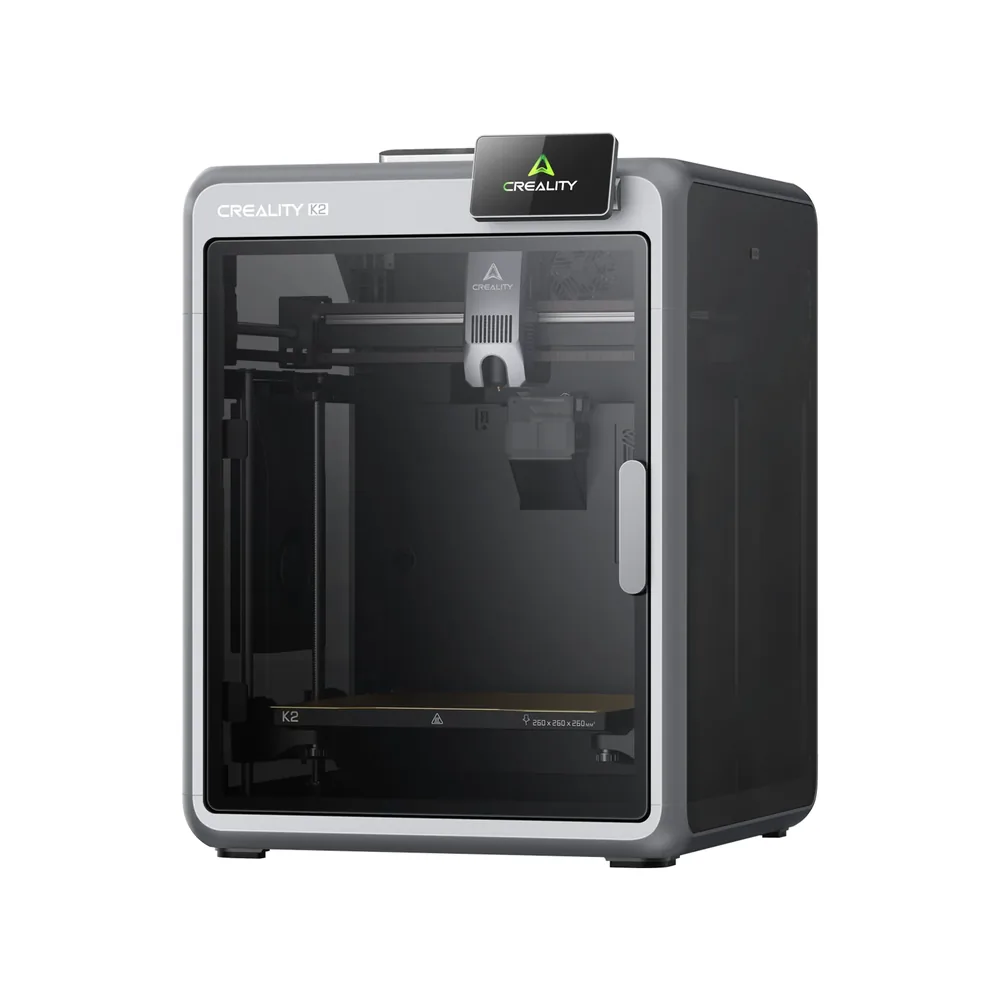
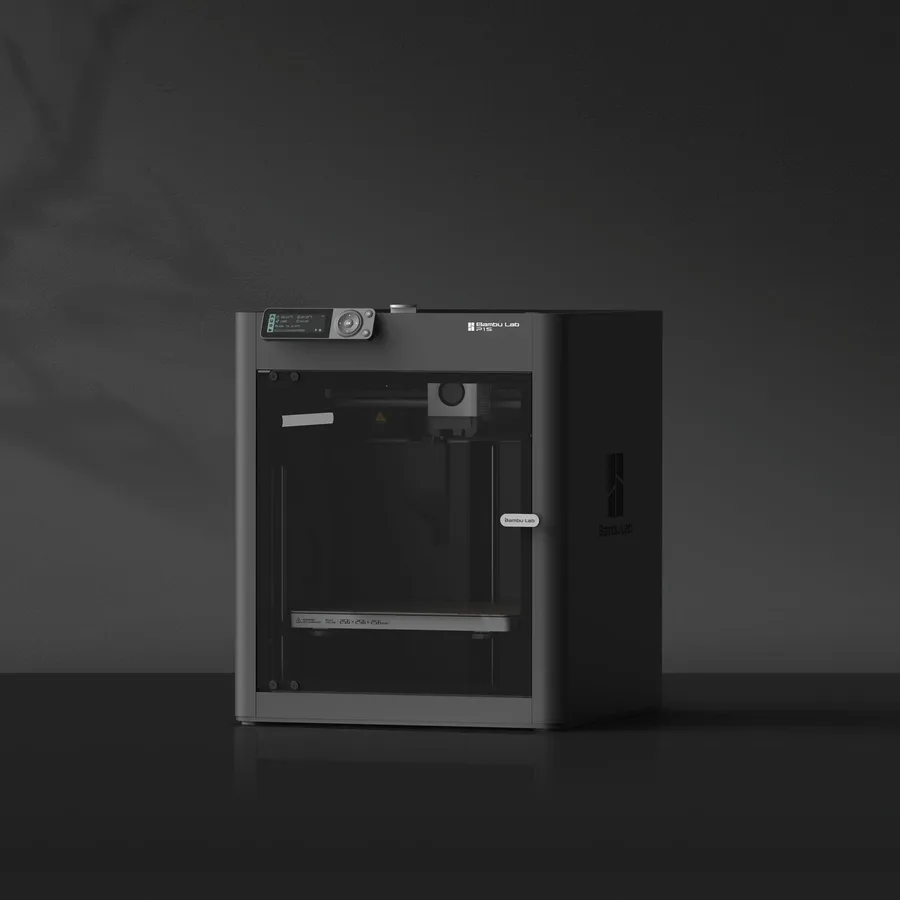
Pick the K2 for a higher advertised top speed (600 mm/s versus 500 mm/s), a chamber camera at 30 frames per second, and Creality's CFS: it stays 5.35 kg heavier and 87 mm taller on the floor than the P1S. Pick the P1S if ASA or TPU are among your target materials: its sheet lists them, while the base K2 stops at PLA, PETG, PET, ABS, and PLA-CF per Creality.
Documentary comparison of manufacturer specifications. Not personally tested.
Choose the Creality K2 if…
- A top speed advertised at 600 mm/s versus 500 mm/s for the P1S, with the same maximum acceleration of 20,000 mm/s² per both sheets.
- A chamber camera documented at 1280 × 720 and 30 frames per second, versus 0.5 frames per second in timelapse mode on the P1S per the official store.
- Step-servo motors on the X/Y axes and the extruder per Creality.
- A 260 mm per side nominal volume versus 256 mm for the P1S.
Choose the Bambu Lab P1S if…
- ASA listed among compatible materials per Bambu Lab, while the base K2 excludes it, reserved at Creality for the K2 Pro and K2 Plus.
- A broader advertised material list overall: PLA, PETG, TPU, ABS, ASA, plus compatibility presented as possible with PA and PC per the official store.
- A notably lighter machine, 12.95 kg versus 18.3 kg for the K2, and a smaller footprint (389 × 389 × 458 mm versus 404 × 436 × 545 mm).
Specifications side by side
| Specification | Creality K2 | Bambu Lab P1S |
|---|---|---|
| Technology | Filament (FDM) | Filament (FDM) |
| Build volume | 260 × 260 × 260 mm (10.2 × 10.2 × 10.2 in) | 256 × 256 × 256 mm (10.1 × 10.1 × 10.1 in) |
| Printer dimensions | 404 × 436 × 545 mm (15.9 × 17.2 × 21.5 in) | 389 × 389 × 458 mm (15.3 × 15.3 × 18 in) |
| Weight | 18.3 kg (40.3 lb) | 13 kg (28.5 lb) |
| Enclosure | Enclosed | Enclosed |
| Claimed top speed | 600 mm/s | 500 mm/s |
| Claimed acceleration | 20,000 mm/s² | 20,000 mm/s² |
| Max nozzle temperature | 300 °C (572 °F) | 300 °C (572 °F) |
| Max bed temperature | 100 °C (212 °F) | 100 °C (212 °F) |
| Multicolor | Optional CFS, not included on the standalone K2: up to 4 units for an advertised 16 colors, same as the rest of the K2 lineup. | AMS compatible; AMS 2 Pro configurations require the appropriate accessories. |
| Materials | PLA, PETG, PET, ABS, and PLA-CF per Creality; no ASA or PPA-CF, reserved for the actively heated K2 Pro and K2 Plus. | PLA, PETG, ABS and ASA, subject to manufacturer profiles and setup requirements. |
| Screen | 4-inch touchscreen | — |
| Built-in camera | Yes | Yes |
| Connectivity | Wi-Fi, USB | — |
| Listed features | Auto bed leveling, filament runout sensor, filament cutter, built-in air filtration | Auto bed leveling, filament runout sensor, built-in air filtration |
— : not listed by the manufacturer on the pages we reviewed.
Build volume and footprint
The K2 advertises a 260 × 260 × 260 mm nominal volume versus 256 × 256 × 256 mm for the P1S per both manufacturers, a 4 mm gap per axis with no practical effect on part size. The floor footprint diverges far more: 404 × 436 × 545 mm for the K2 versus 389 × 389 × 458 mm for the P1S, 87 mm less in height and 47 mm less in width on the Bambu Lab side.
Weight follows the same gap: 18.3 kg advertised for the K2 versus 12.95 kg for the P1S, a 5.35 kg difference that matters most if the printer needs to change rooms regularly. For an enclosed chassis closer in size to the K2, the K2 Pro stays in the same family while adding active chamber heating.
Speed and motion
Creality advertises a top speed of 600 mm/s for the K2 versus 500 mm/s for the P1S, with the same maximum acceleration of 20,000 mm/s² on both sheets. Creality does add a 'typical' speed of 300 mm/s for the K2, a benchmark the P1S sheet doesn't give for itself.
That figure stays a manufacturer ceiling: actual print time depends mostly on the slicer profile, part geometry, and material used, on both machines.
Materials, temperatures and enclosure
Both hotends reach 300°C and both beds heat up to 100°C per the manufacturers, an exact match between the K2 and the P1S on these two values. Neither documents active chamber heating: that feature stays reserved for higher-tier models in both lineups.
The gap is in the material list: the base K2 advertises PLA, PETG, PET, ABS, and PLA-CF per Creality, no ASA or PPA-CF. The P1S advertises PLA, PETG, TPU, ABS, and ASA per Bambu Lab, with compatibility presented as possible for PA and PC. The ABS and ASA page covers the settings specific to these materials before printing them.
Camera and everyday features
Both cameras share the same documented resolution, 1280 × 720, but not the same frame rate: 30 frames per second for the K2 versus 0.5 frames per second for the P1S, a low-rate camera built for timelapse rather than live monitoring per the official store.
Both machines list air filtration (one filter on the K2 per Creality, an activated carbon filter on the P1S per the Bambu Lab store) and automatic bed leveling. The K2 also specifies a 4-inch touchscreen, 2.4 GHz Wi-Fi with no Ethernet, and an automatic filament cutter.
Multicolor
The K2 is offered with or without CFS on the same product page per Creality, with up to 4 units connecting for an advertised 16 colors. The P1S takes the AMS in a Combo version or as an add-on, up to 16 colors with 4 units per Bambu Lab; the store doesn't mention a drying function, unlike the P2S's AMS 2 Pro.
In both cases, the multicolor accessory remains a purchase to verify precisely on the chosen listing rather than assume included. The multicolor buying guide covers what a CFS or an AMS genuinely adds before you choose.
Sources
- Creality — K2 tech specs (creality.com)
- Bambu Lab — P1S tech specs (eu.store.bambulab.com)
- How we compare printers
Published 2026-09-28, updated 2026-09-28.