
Head-to-head comparison
Creality K2 vs K2 Plus: is the heated-chamber upgrade worth it?
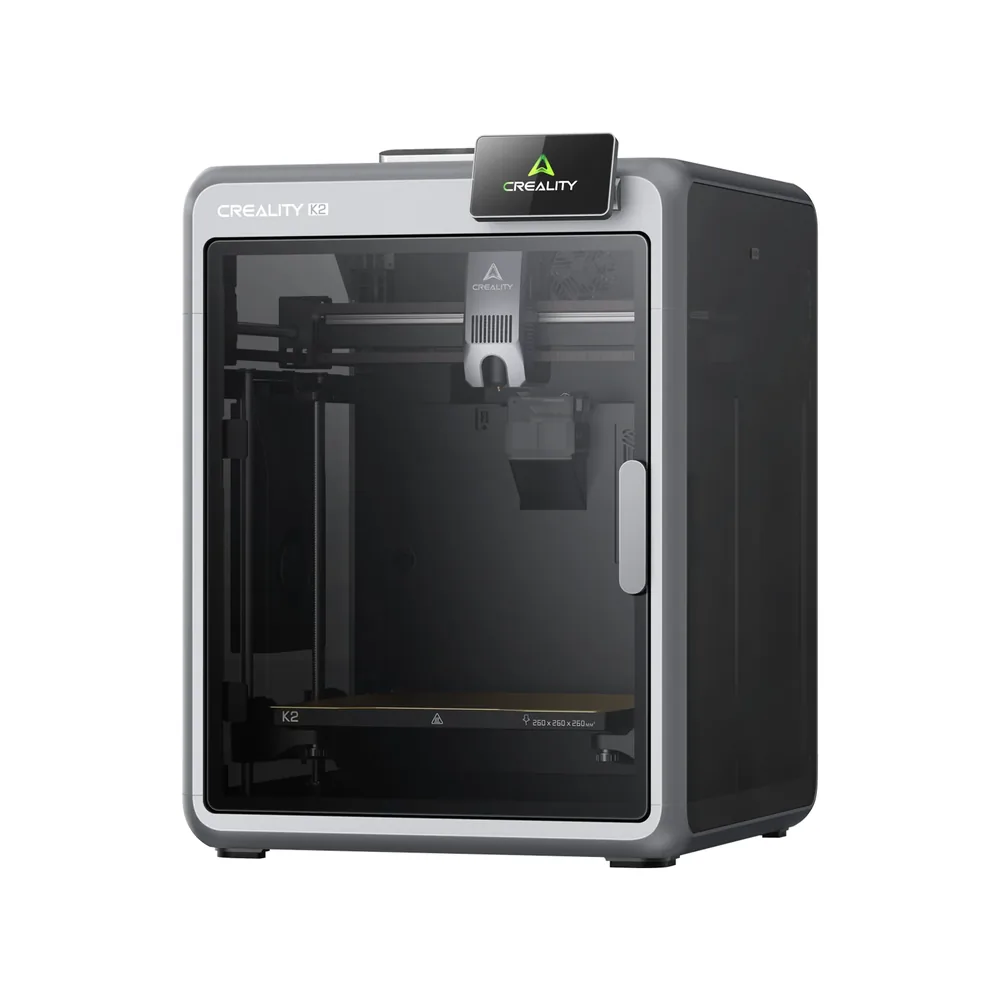
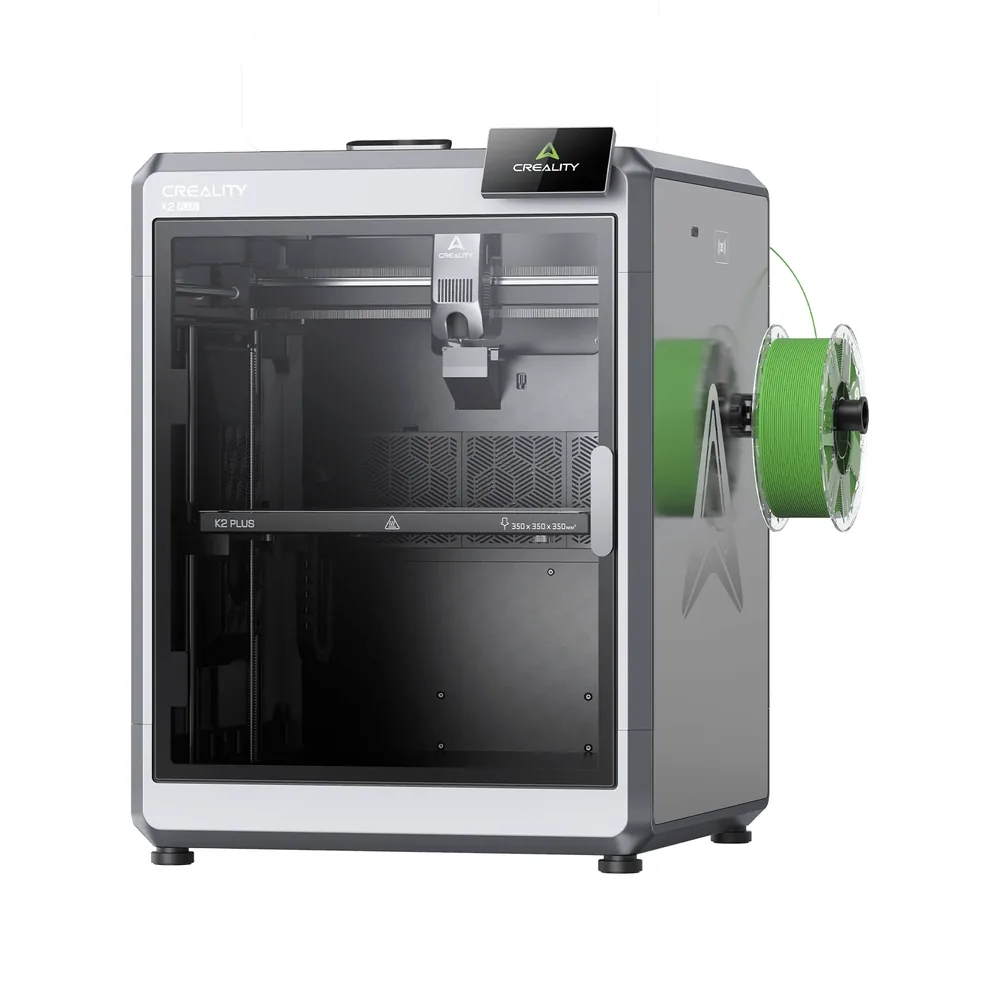
The short answer
Pick the K2 for a compact, affordable enclosed CoreXY chassis in the lineup: 260 × 260 × 260 mm, a nozzle up to 300°C, with no actively heated chamber. Pick the K2 Plus for large format and technical materials: 350 × 350 × 350 mm, a chamber heated up to 60°C, a nozzle up to 350°C, step-servo motors on the X/Y/Z axes and the extruder, dual-band Wi-Fi, and Ethernet per Creality.
Documentary comparison of manufacturer specifications. Not personally tested.
Choose the Creality K2 if…
- A more compact, lighter enclosed CoreXY chassis (18.3 kg, 404 × 436 × 545 mm) than the K2 Plus (35 kg, 495 × 515 × 640 mm).
- The same top speed advertised at 600 mm/s as the K2 Plus, with a maximum acceleration of 20,000 mm/s² that's plenty for everyday use.
- Common materials well covered per Creality: PLA, PETG, PET, ABS, and PLA-CF, without the cost of an actively heated chamber.
Choose the Creality K2 Plus if…
- A notably larger nominal volume (350 × 350 × 350 mm versus 260 × 260 × 260 mm) for bulky parts or several objects on one plate.
- A chamber actively heated up to 60°C by an 800 W system, which opens the material list to ASA, PC, and composites like PA-CF or PPA-CF per Creality.
- A top acceleration advertised at 30,000 mm/s² versus 20,000 mm/s² on the K2, with FOC step-servo motors on the X/Y/Z axes and the extruder (X/Y and the extruder only on the K2).
- Dual-band Wi-Fi and an Ethernet port alongside 2.4G Wi-Fi, a 1080p chamber camera with AI-camera flow calibration at the nozzle, and an RFID reader the K2 lacks.
Specifications side by side
| Specification | Creality K2 | Creality K2 Plus |
|---|---|---|
| Technology | Filament (FDM) | Filament (FDM) |
| Build volume | 260 × 260 × 260 mm (10.2 × 10.2 × 10.2 in) | 350 × 350 × 350 mm (13.8 × 13.8 × 13.8 in) |
| Printer dimensions | 404 × 436 × 545 mm (15.9 × 17.2 × 21.5 in) | 495 × 515 × 640 mm (19.5 × 20.3 × 25.2 in) |
| Weight | 18.3 kg (40.3 lb) | 35 kg (77.2 lb) |
| Enclosure | Enclosed | Enclosed, active heating up to 60 °C (140 °F) |
| Claimed top speed | 600 mm/s | 600 mm/s |
| Claimed acceleration | 20,000 mm/s² | 30,000 mm/s² |
| Max nozzle temperature | 300 °C (572 °F) | 350 °C (662 °F) |
| Max bed temperature | 100 °C (212 °F) | 120 °C (248 °F) |
| Multicolor | Optional CFS, not included on the standalone K2: up to 4 units for an advertised 16 colors, same as the rest of the K2 lineup. | CFS optional, up to 4 units for an advertised 16 colors; not included on the standalone machine. |
| Materials | PLA, PETG, PET, ABS, and PLA-CF per Creality; no ASA or PPA-CF, reserved for the actively heated K2 Pro and K2 Plus. | PLA, PETG, ABS, PC, and technical composites per Creality, thanks to the actively heated chamber. |
| Screen | 4-inch touchscreen | 4.3-inch touchscreen |
| Built-in camera | Yes | Yes |
| Connectivity | Wi-Fi, USB | Wi-Fi, Ethernet, USB |
| Listed features | Auto bed leveling, filament runout sensor, filament cutter, built-in air filtration | Auto bed leveling, filament runout sensor, filament cutter, built-in air filtration |
— : not listed by the manufacturer on the pages we reviewed.
Build volume and footprint
The K2 advertises a 260 × 260 × 260 mm nominal volume versus 350 × 350 × 350 mm for the K2 Plus per Creality's own comparison table, a clear gap that directly shapes what you can print: batches of small objects or one bulky part on the K2 Plus, a tighter format on the K2.
Footprint and weight follow the same gap: 404 × 436 × 545 mm and 18.3 kg for the K2, versus 495 × 515 × 640 mm and 35 kg for the K2 Plus, nearly double. The K2 Plus needs a reinforced stand and dedicated space, while the K2 stays easier to fit on a standard shelf. For a volume in between, the K2 Pro keeps a footprint close to the K2 while adding an actively heated chamber.
Speed and motion
Both machines advertise the same top speed of 600 mm/s per Creality, but maximum acceleration differs: 20,000 mm/s² for the K2 versus 30,000 mm/s² for the K2 Plus. That figure stays a manufacturer ceiling, since actual print time depends mostly on the slicer profile and part geometry.
The K2 Plus adds FOC step-servo motors on all three X/Y/Z axes and the extruder per Creality, versus servo motors limited to the X/Y axes and the extruder on the K2. It's the brand's first desktop printer to extend this technology to the Z axis, aimed at keeping precision on bulkier parts.
Materials, temperatures and enclosure
The nozzle reaches 300°C on the K2 versus 350°C on the K2 Plus, and the bed 100°C versus 120°C per Creality. The most structural difference is the chamber: not actively heated on the K2, heated up to 60°C by an 800 W system on the K2 Plus.
That gap shows directly in the advertised materials: PLA, PETG, PET, ABS, and PLA-CF for the K2, with no ASA or more technical composites. The K2 Plus adds ASA, PC, and composites like PA-CF or PPA-CF per Creality, thanks to its heated chamber that limits shrinkage and warping on these more demanding materials.
Multicolor and everyday features
Both machines are offered with or without CFS per Creality: up to 4 units can connect for an advertised 16-color use on both the K2 and the K2 Plus, the system staying a separate accessory from the base machine in both cases. The multicolor buying guide covers what adding a CFS involves before you choose one.
Elsewhere, the K2 Plus documents a 4.3-inch touchscreen versus 4 inches on the K2, a 1080p chamber camera at 30 frames per second with an extra AI camera at the nozzle for flow calibration (versus a 720p camera with no AI camera on the K2), two air filters versus one, an RFID reader the K2 lacks, and dual-band Wi-Fi with an Ethernet port where the K2 is limited to 2.4G Wi-Fi and USB. With a weight and feature gap this size, the startup budget tool helps price out the full setup before choosing between the two.
Sources
- Creality — fiche technique K2 (creality.com)
- Creality — fiche technique K2 Plus (creality.com)
- How we compare printers
Published 2026-09-28, updated 2026-09-28.