
Head-to-head comparison
Creality K2 Plus vs Bambu Lab H2D: which large-format printer wins?
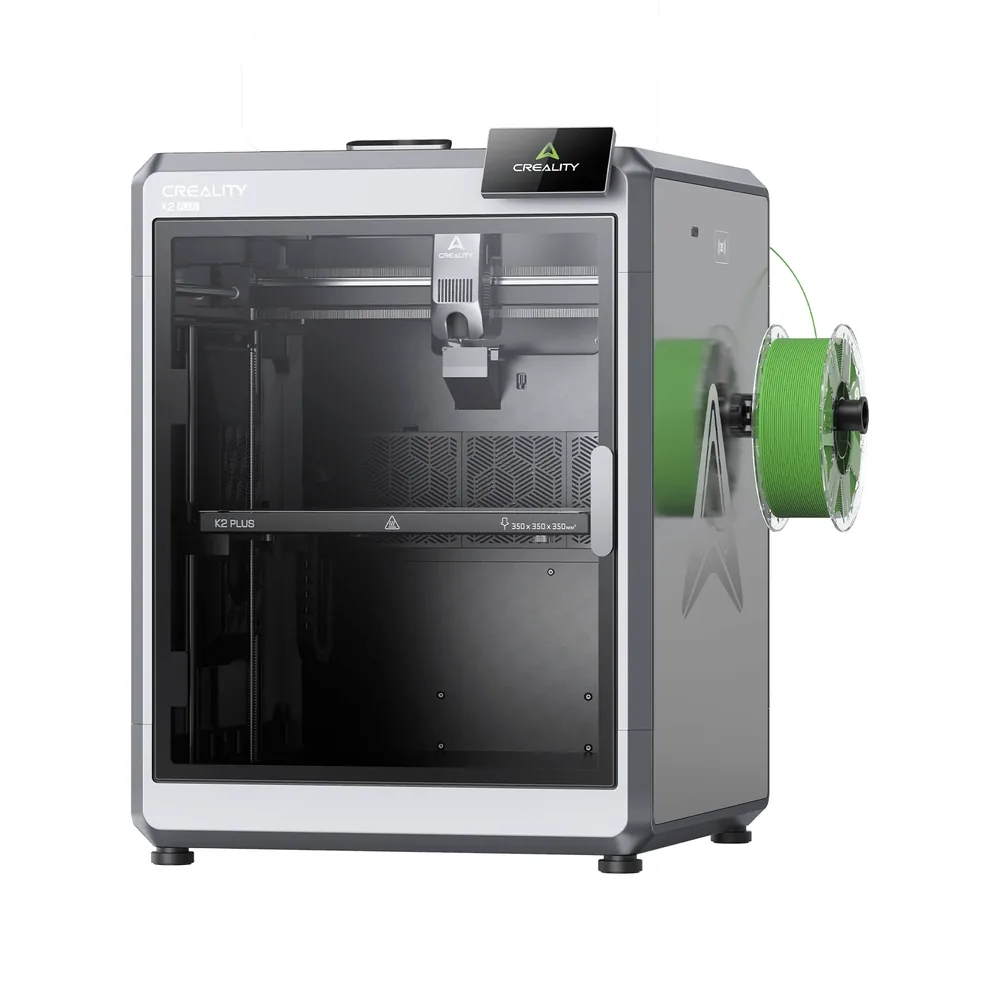
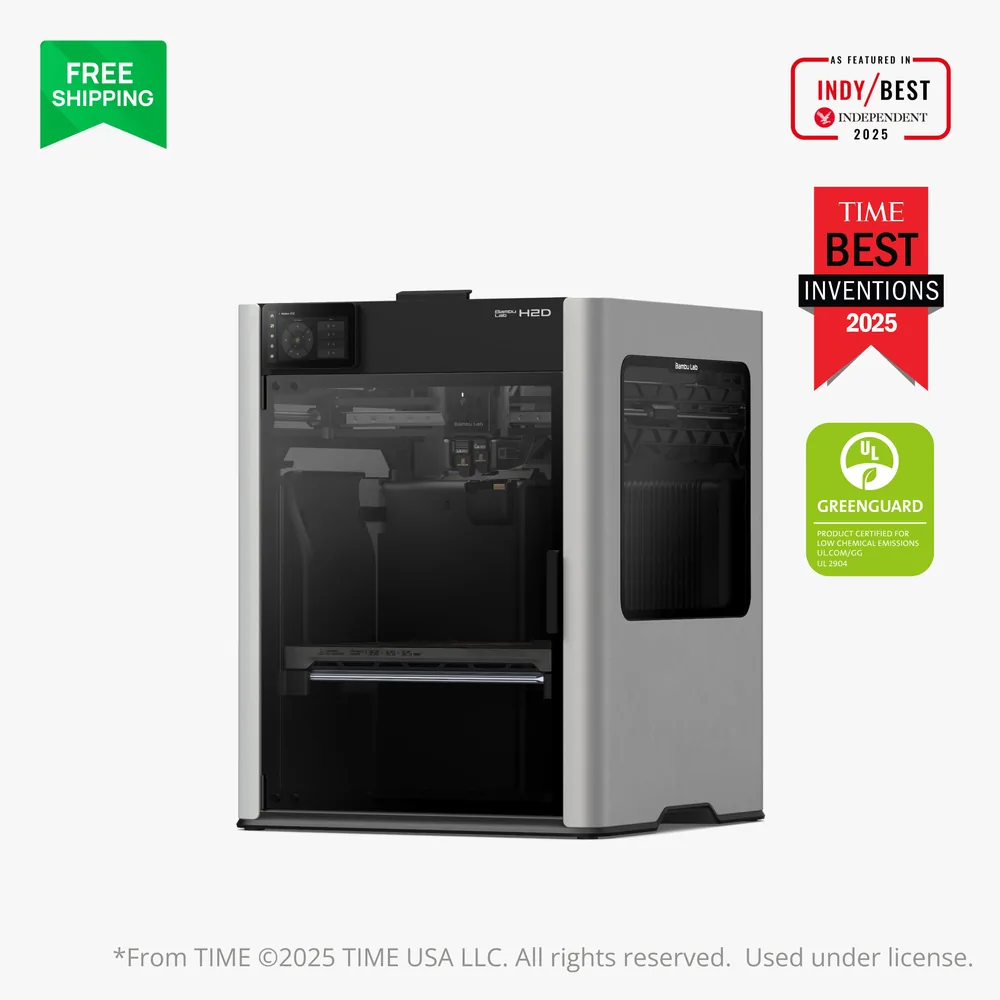
The short answer
Pick the K2 Plus for its 350 mm cubic volume, step-servo motors on all four axes, and a CFS advertised for up to 16 colors per Creality. Pick the H2D for its top speed advertised at 1000 mm/s, a dual nozzle that combines two materials without an AMS, a chamber heated to 65°C, and an optional laser module per Bambu Lab.
Documentary comparison of manufacturer specifications. Not personally tested.
Choose the Creality K2 Plus if…
- A 350 × 350 × 350 mm cubic volume, larger than the H2D's 350 × 320 × 320 mm total volume per both manufacturers.
- FOC step-servo motors on the X, Y, Z axes and the extruder, mechanics Creality presents as a first for its desktop printers.
- CFS for up to 4 units and an advertised 16 colors, with a Combo version that bundles it directly per Creality.
- A top acceleration advertised at 30,000 mm/s² versus 20,000 mm/s² on the H2D, useful for parts with tight detail.
- Ethernet (RJ45) connectivity on top of dual-band Wi-Fi, per Creality's own spec sheet.
Choose the Bambu Lab H2D if…
- A top speed advertised at 1000 mm/s versus 600 mm/s on the K2 Plus, per Bambu Lab's spec sheet.
- A quick-swap dual nozzle that combines two materials or colors without going through an AMS system.
- A chamber actively heated up to 65°C versus 60°C on the K2 Plus, plus TPU and PC compatibility alongside the shared materials.
- An optional 10W or 40W laser module (Laser edition), for engraving or cutting on the same base per Bambu Lab.
- A 5-inch touchscreen versus 4.3 inches on the K2 Plus per both manufacturers' spec sheets.
Specifications side by side
| Specification | Creality K2 Plus | Bambu Lab H2D |
|---|---|---|
| Technology | Filament (FDM) | Filament (FDM) |
| Build volume | 350 × 350 × 350 mm (13.8 × 13.8 × 13.8 in) | 350 × 320 × 320 mm (13.8 × 12.6 × 12.6 in) |
| Printer dimensions | 495 × 515 × 640 mm (19.5 × 20.3 × 25.2 in) | 492 × 514 × 626 mm (19.4 × 20.2 × 24.6 in) |
| Weight | 35 kg (77.2 lb) | 31 kg (68.3 lb) |
| Enclosure | Enclosed, active heating up to 60 °C (140 °F) | Enclosed, active heating up to 65 °C (149 °F) |
| Claimed top speed | 600 mm/s | 1,000 mm/s |
| Claimed acceleration | 30,000 mm/s² | 20,000 mm/s² |
| Max nozzle temperature | 350 °C (662 °F) | 350 °C (662 °F) |
| Max bed temperature | 120 °C (248 °F) | 120 °C (248 °F) |
| Multicolor | CFS optional, up to 4 units for an advertised 16 colors; not included on the standalone machine. | Compatible with the AMS 2 Pro for multicolor printing, sold separately or bundled in a Combo. |
| Materials | PLA, PETG, ABS, PC, and technical composites per Creality, thanks to the actively heated chamber. | PLA, PETG, ABS, ASA, TPU, PC, and PA per Bambu Lab, hardened nozzles for CF/GF composites, chamber actively heated to 65°C. |
| Screen | 4.3-inch touchscreen | 5-inch touchscreen |
| Built-in camera | Yes | Yes |
| Connectivity | Wi-Fi, Ethernet, USB | Wi-Fi, USB |
| Listed features | Auto bed leveling, filament runout sensor, filament cutter, built-in air filtration | Filament runout sensor, filament cutter, built-in air filtration |
| Nozzles | — | 2 (multi-nozzle) |
— : not listed by the manufacturer on the pages we reviewed.
Build volume and footprint
The K2 Plus advertises a 350 × 350 × 350 mm cubic volume per Creality. The H2D's volume varies by use: 325 × 320 × 325 mm with a single nozzle, 300 × 320 × 320 mm when printing with both nozzles at once, and a 350 × 320 × 320 mm total volume per Bambu Lab. The K2 Plus wins on depth (350 mm versus 320 mm), while the H2D comes close on total width.
Both machines sit heavy on a scale and on the floor: 35 kg and 495 × 515 × 640 mm for the K2 Plus versus 31 kg and 492 × 514 × 626 mm for the H2D per both manufacturers, similar footprints despite different architectures.
Speed and motion
Bambu Lab advertises a top speed of 1000 mm/s for the H2D versus 600 mm/s for the K2 Plus per Creality, a clear edge on paper. The K2 Plus answers back on acceleration: an advertised 30,000 mm/s² versus 20,000 mm/s² for the H2D, a figure that matters as much as top speed for parts with tight detail.
Creality highlights FOC step-servo motors on the X, Y, Z axes and the extruder for the K2 Plus, presented as a first for the brand's desktop printers. These manufacturer numbers stay ceilings: actual print time depends mostly on the slicer profile and part geometry on both machines.
Materials, temperatures and enclosure
Both hotends reach 350°C and both beds heat up to 120°C per both manufacturers. The chamber barely differs: 60°C advertised for the K2 Plus versus 65°C for the H2D, two close values aimed at the same technical materials.
On materials, Creality lists PLA, PETG, PET, ABS, ASA, and PLA-CF, PA-CF, and PPA-CF composites for the K2 Plus per its own comparison table. Bambu Lab adds TPU and PC to a similar list for the H2D (PLA, PETG, ABS, ASA, PA), with hardened nozzles for carbon- or glass-fiber composites.
Multicolor and everyday features
The K2 Plus relies on the CFS, up to 4 units connected for an advertised 16 colors, an optional system with a Combo version that bundles it per Creality. The H2D natively combines two materials or colors through its dual nozzle, no extra accessory needed; reaching up to 16 colors still means adding the AMS 2 Pro per Bambu Lab. The multicolor buying guide compares these approaches before you choose.
The K2 Plus documents a 1080p chamber camera at 30 frames per second, two air filters, and dual-band Wi-Fi with Ethernet (RJ45) per Creality. The H2D also includes a camera and air filtration per its sheet, with a 5-inch touchscreen versus 4.3 inches on the K2 Plus, but no Ethernet port listed, only Wi-Fi and USB.
What to check before buying
On the K2 Plus, don't confuse the standalone machine with the 'Combo' pack that includes the CFS: the base spec sheet doesn't count that accessory. On the H2D, the listing separates the standalone machine, the 'AMS Combo' pack, and the 'Laser Full Combo' pack with the 10W or 40W laser module, three very different bundles per Bambu Lab.
Check exactly what a given retailer's listing includes before comparing two configurations, especially for the CFS, the AMS 2 Pro, and the laser module, all sold separately from the base machine. For a single-nozzle H2D without the laser, the H2S shares the same 65°C heated chamber per Bambu Lab; on the Creality side, the K2 Pro offers a more compact 300 mm footprint in the same family.
Sources
- Creality — K2 Plus tech specs (creality.com)
- Bambu Lab — H2D tech specs (bambulab.com)
- How we compare printers
Published 2026-09-28, updated 2026-09-28.