
Head-to-head comparison
Creality K2 Plus vs K2 Pro: Large Format or Dual AI Camera?
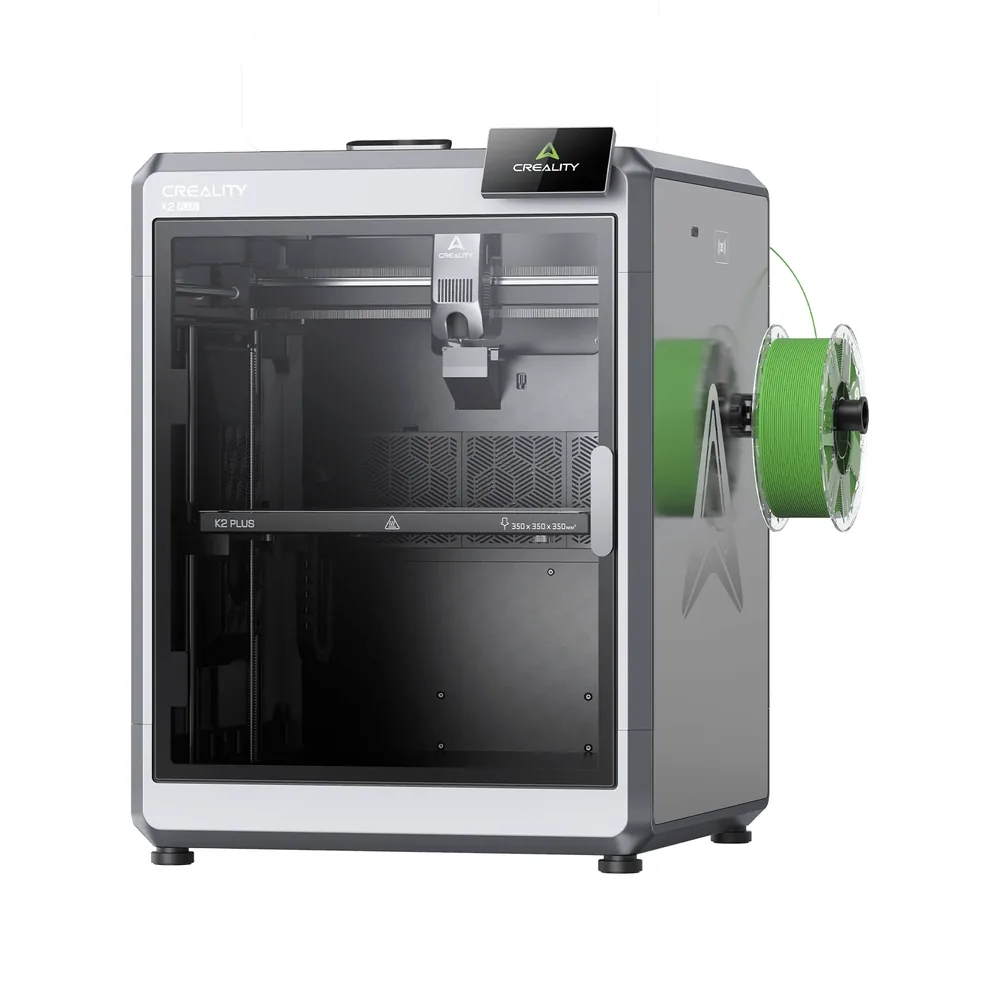
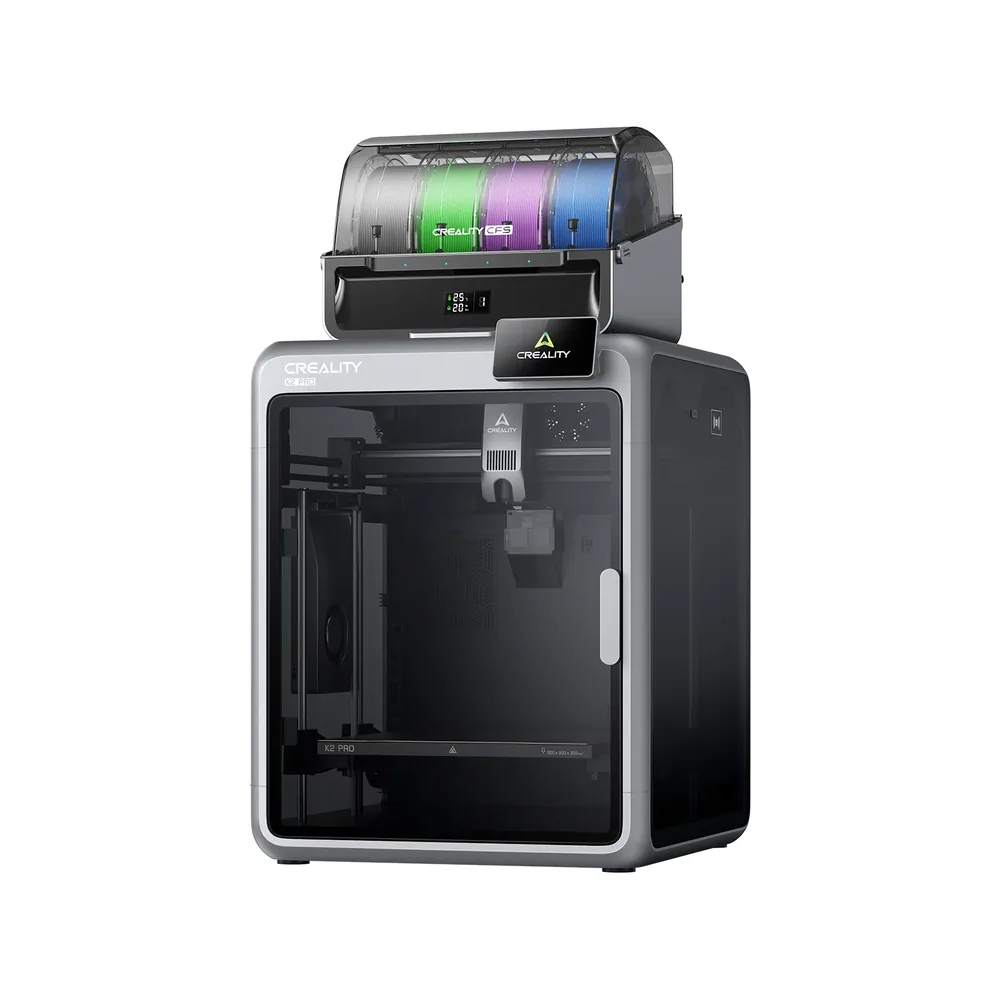
The short answer
Pick the K2 Plus if you're targeting bulky parts up to 350mm per side, with a nozzle advertised up to 350°C and a bed up to 120°C. Pick the K2 Pro if you'd rather have a more compact 300mm footprint with dual AI cameras, in the chamber and at the nozzle, for failure detection, at the cost of a slightly cooler nozzle and bed.
Documentary comparison of manufacturer specifications. Not personally tested.
Choose the Creality K2 Plus if…
- An advertised 350 × 350 × 350 mm volume, versus 300 × 300 × 300 mm on the K2 Pro, for bulkier parts.
- A nozzle advertised up to 350°C and a bed up to 120°C, versus 300°C and 110°C on the K2 Pro.
- FOC step-servo motors on the XYZ axes and extrusion, with acceleration advertised up to 30,000 mm/s² versus 20,000 on the K2 Pro.
- A 4.3-inch touchscreen and dual-band WiFi per Creality.
Choose the Creality K2 Pro if…
- Two AI cameras, in the chamber and at the nozzle, for real-time failure detection and flow adjustment.
- A more compact 300 × 300 × 300 mm footprint than the K2 Plus.
- The same actively heated chamber as the K2 Plus, advertised up to 60°C, with PPA-CF compatibility alongside PLA, PETG, ABS, and ASA.
- The Combo pack includes the CFS (up to 16 colors advertised) while the printer alone does not, so you can start multicolor printing right away.
Specifications side by side
| Specification | Creality K2 Plus | Creality K2 Pro |
|---|---|---|
| Technology | Filament (FDM) | Filament (FDM) |
| Build volume | 350 × 350 × 350 mm (13.8 × 13.8 × 13.8 in) | 300 × 300 × 300 mm (11.8 × 11.8 × 11.8 in) |
| Printer dimensions | 495 × 515 × 640 mm (19.5 × 20.3 × 25.2 in) | — |
| Weight | 35 kg (77.2 lb) | 23.7 kg (52.2 lb) |
| Enclosure | Enclosed, active heating up to 60 °C (140 °F) | Enclosed, active heating up to 60 °C (140 °F) |
| Claimed top speed | 600 mm/s | 600 mm/s |
| Claimed acceleration | 30,000 mm/s² | 20,000 mm/s² |
| Max nozzle temperature | 350 °C (662 °F) | 300 °C (572 °F) |
| Max bed temperature | 120 °C (248 °F) | 110 °C (230 °F) |
| Multicolor | CFS optional, up to 4 units for an advertised 16 colors; not included on the standalone machine. | Optional 4-bay CFS, up to an advertised 16 colors; the Combo pack includes it, the standalone machine doesn't. |
| Materials | PLA, PETG, ABS, PC, and technical composites per Creality, thanks to the actively heated chamber. | PLA, PETG, ABS, ASA, and PPA-CF per Creality, thanks to the actively heated chamber. |
| Screen | 4.3-inch touchscreen | 4-inch touchscreen |
| Built-in camera | Yes | Yes |
| Connectivity | Wi-Fi, Ethernet, USB | Wi-Fi, Ethernet, USB |
| Listed features | Auto bed leveling, filament runout sensor, filament cutter, built-in air filtration | Auto bed leveling, filament runout sensor, filament cutter, built-in air filtration |
— : not listed by the manufacturer on the pages we reviewed.
Build volume and footprint
The K2 Plus advertises a 350 × 350 × 350 mm nominal volume per Creality, versus 300 × 300 × 300 mm for the K2 Pro. That 50mm-per-axis gap matters most for bulky parts: brackets, long mechanical pieces, or batches printed in one go on a larger plate.
The K2 Plus also weighs more, 35 kg, against a lighter K2 Pro at 23.7 kg, with a chassis to match. On a shelf or workbench, the K2 Plus's larger footprint is felt as much as its advertised build volume.
Speed and motion
Both machines share a top speed advertised at 600 mm/s per Creality, but the K2 Plus claims higher acceleration, up to 30,000 mm/s² versus 20,000 mm/s² for the K2 Pro. Creality presents the K2 Plus as its first desktop printer to use FOC step-servo motors on the XYZ axes and extrusion.
On bulky parts, higher acceleration limits ringing and visible artifacts on large flat surfaces, provided the slicing and print profile keep up. The K2 Pro still advertises the same top speed for smaller parts.
Materials, temperatures and enclosure
The K2 Plus advertises a nozzle up to 350°C and a bed up to 120°C per Creality, with an 800W AC heated chamber targeting ABS, PC, or composites. The K2 Pro sits one notch below, a nozzle up to 300°C and a bed up to 110°C.
The K2 Pro compensates with a chamber actively heated up to an advertised 60°C and listed compatibility with PPA-CF alongside PLA, PETG, ABS, and ASA. The ABS and ASA page covers the settings specific to those materials before printing.
Everyday features
The K2 Pro stands out with its two AI cameras, one in the chamber and one at the nozzle per Creality, for failure detection (spaghetti, detachment, filament runout) and real-time flow adjustment. The K2 Plus advertises a single camera, without listing an equivalent AI function on its spec sheet.
The K2 Plus wins on screen size, 4.3 inches versus 4 inches for the K2 Pro, and advertises dual-band WiFi. Both share Ethernet, USB, a filament sensor, a filament cutter, and an air filter per their respective listings.
Sources
- Creality — K2 Plus tech specs (creality.com)
- Creality — K2 Pro tech specs (creality.com)
- How we compare printers
Published 2026-09-28, updated 2026-09-28.