
Head-to-head comparison
Creality K2 Plus vs Bambu Lab H2S: which large enclosed printer wins?
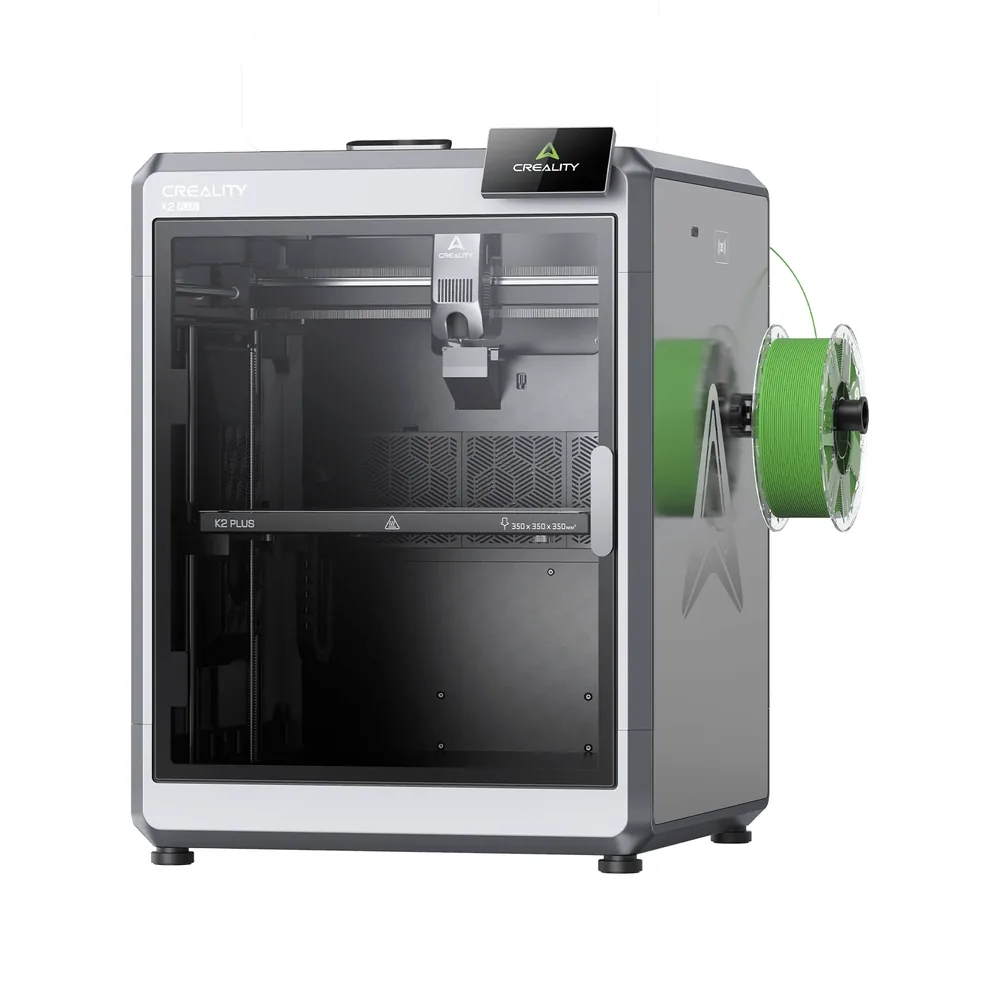
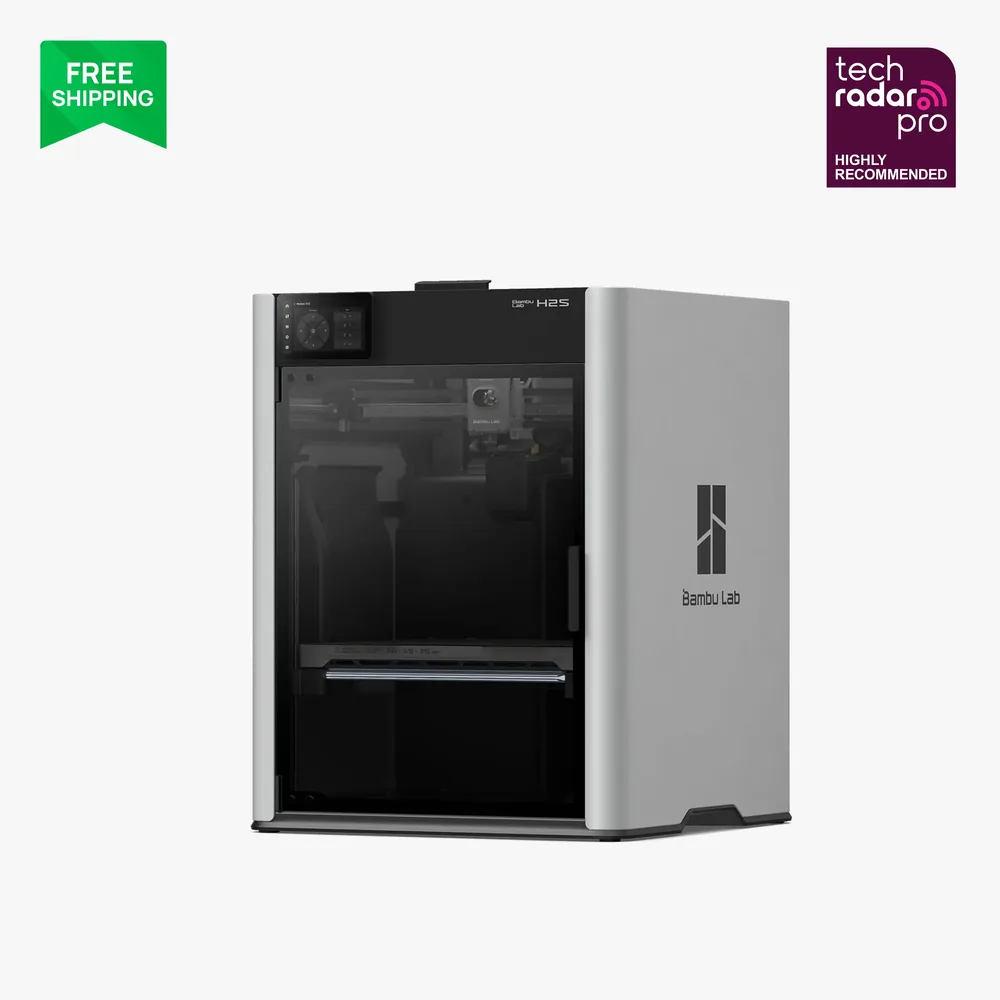
The short answer
Pick the K2 Plus for a slightly larger volume on all three axes, an advertised 30,000 mm/s² acceleration, and a CFS good for up to 16 colors per Creality. Pick the H2S for an advertised top speed of 1,000 mm/s, a chamber heated to 65°C, and a 5-inch screen per Bambu Lab.
Documentary comparison of manufacturer specifications. Not personally tested.
Choose the Creality K2 Plus if…
- A 350 × 350 × 350 mm nominal volume, larger than the H2S's 340 × 320 × 340 mm on all three axes, including 30 mm more in depth.
- An advertised maximum acceleration of 30,000 mm/s², versus 20,000 mm/s² for the H2S, despite a lower top speed.
- FOC step-servo motors on the X, Y, Z axes and the extruder per Creality.
- A CFS advertised for up to 4 units and 16 colors, with dual-band Wi-Fi, RJ45 Ethernet, and USB.
Choose the Bambu Lab H2S if…
- An advertised top speed of 1,000 mm/s, versus 600 mm/s for the K2 Plus per both manufacturers.
- A chamber actively heated up to 65°C versus 60°C for the K2 Plus.
- A 5-inch touchscreen versus 4.3 inches on the K2 Plus.
Specifications side by side
| Specification | Creality K2 Plus | Bambu Lab H2S |
|---|---|---|
| Technology | Filament (FDM) | Filament (FDM) |
| Build volume | 350 × 350 × 350 mm (13.8 × 13.8 × 13.8 in) | 340 × 320 × 340 mm (13.4 × 12.6 × 13.4 in) |
| Printer dimensions | 495 × 515 × 640 mm (19.5 × 20.3 × 25.2 in) | 492 × 514 × 626 mm (19.4 × 20.2 × 24.6 in) |
| Weight | 35 kg (77.2 lb) | 30 kg (66.1 lb) |
| Enclosure | Enclosed, active heating up to 60 °C (140 °F) | Enclosed, active heating up to 65 °C (149 °F) |
| Claimed top speed | 600 mm/s | 1,000 mm/s |
| Claimed acceleration | 30,000 mm/s² | 20,000 mm/s² |
| Max nozzle temperature | 350 °C (662 °F) | 350 °C (662 °F) |
| Max bed temperature | 120 °C (248 °F) | 120 °C (248 °F) |
| Multicolor | CFS optional, up to 4 units for an advertised 16 colors; not included on the standalone machine. | Compatible with the AMS 2 Pro for multicolor printing, sold separately or bundled in a Combo. |
| Materials | PLA, PETG, ABS, PC, and technical composites per Creality, thanks to the actively heated chamber. | PLA, PETG, ABS, ASA, PC, and PA per Bambu Lab, with a hotend up to 350°C and a chamber actively heated to 65°C. |
| Screen | 4.3-inch touchscreen | 5-inch touchscreen |
| Built-in camera | Yes | Yes |
| Connectivity | Wi-Fi, Ethernet, USB | Wi-Fi, USB |
| Listed features | Auto bed leveling, filament runout sensor, filament cutter, built-in air filtration | Filament runout sensor, filament cutter, built-in air filtration |
— : not listed by the manufacturer on the pages we reviewed.
Build volume and footprint
Creality advertises a 350 × 350 × 350 mm nominal volume for the K2 Plus versus 340 × 320 × 340 mm for the H2S per Bambu Lab, a gap present on all three axes and especially notable in depth (30 mm more for the K2 Plus). The large-format buying guide covers what this kind of volume changes for single large parts.
Floor footprint stays close: 495 × 515 × 640 mm for the K2 Plus versus 492 × 514 × 626 mm for the H2S, with an advertised weight of 35 kg versus 30 kg. The K2 Plus is therefore both a bit larger and a bit heavier, despite an almost identical outer footprint.
Speed and motion
Bambu Lab advertises a top speed of 1,000 mm/s for the H2S versus 600 mm/s for the K2 Plus per Creality, a clear gap on paper. The K2 Plus flips that on acceleration: an advertised 30,000 mm/s² versus 20,000 mm/s² for the H2S.
Both manufacturer numbers stay theoretical ceilings: actual print time depends mostly on the slicer profile, part geometry, and material used. Creality highlights FOC step-servo motors on the X, Y, Z axes and the extruder for the K2 Plus, a mechanical feature specifically called out for this model.
Materials, temperatures and enclosure
Both hotends reach 350°C and both beds reach 120°C per the manufacturers. The K2 Plus chamber heats up to 60°C versus 65°C for the H2S, both actively heated enclosures rather than simple passive stabilization.
The materials list diverges a little: PLA, PETG, PET, ABS, ASA, PLA-CF, PA-CF, and PPA-CF for the K2 Plus per Creality. Bambu Lab adds PC to its list for the H2S, missing from the K2 Plus's list, but doesn't detail fiber-filled composites like PLA-CF or PA-CF the way the K2 Plus does.
Multicolor and everyday features
The K2 Plus is offered with an optional CFS, up to 4 units for an advertised 16 colors, with an RFID reader for identifying spools per Creality. The H2S relies on the AMS 2 Pro, available separately or in a Combo bundle per Bambu Lab, with no maximum color count specified on its sheet. The multicolor buying guide covers what these two systems change before you choose.
The K2 Plus adds a 1080p chamber camera at 30 frames per second, two air filters, a 4.3-inch touchscreen, and dual-band Wi-Fi, RJ45 Ethernet, and USB connectivity per Creality. The H2S offers a 5-inch screen, a camera, a filament sensor, and a filament cutter, with Wi-Fi and USB connectivity per Bambu Lab. For a dual-nozzle alternative, the H2D is Bambu Lab's closest comparison.
Sources
- Creality — K2 Plus tech specs (creality.com)
- Bambu Lab — H2S tech specs (bambulab.com)
- How we compare printers
Published 2026-09-28, updated 2026-09-28.