
Head-to-head comparison
Bambu Lab P2S vs H2D: is the dual nozzle worth it?
The short answer
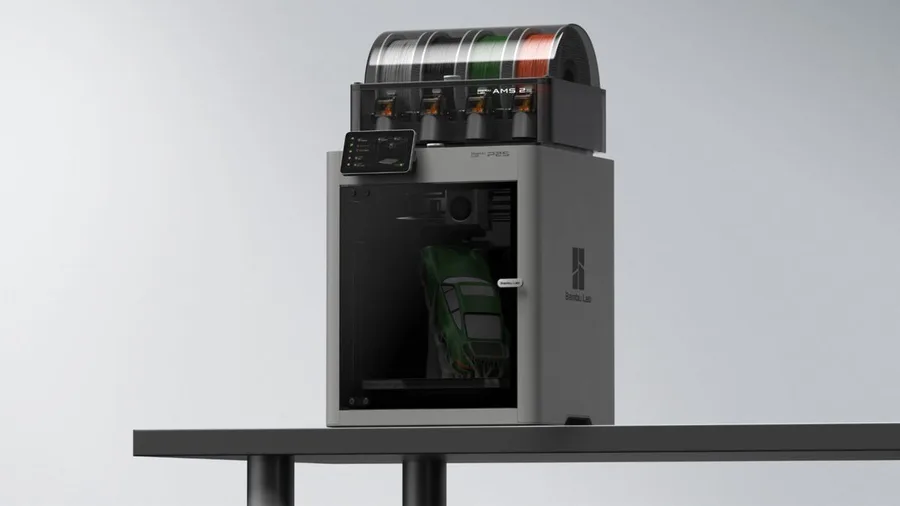
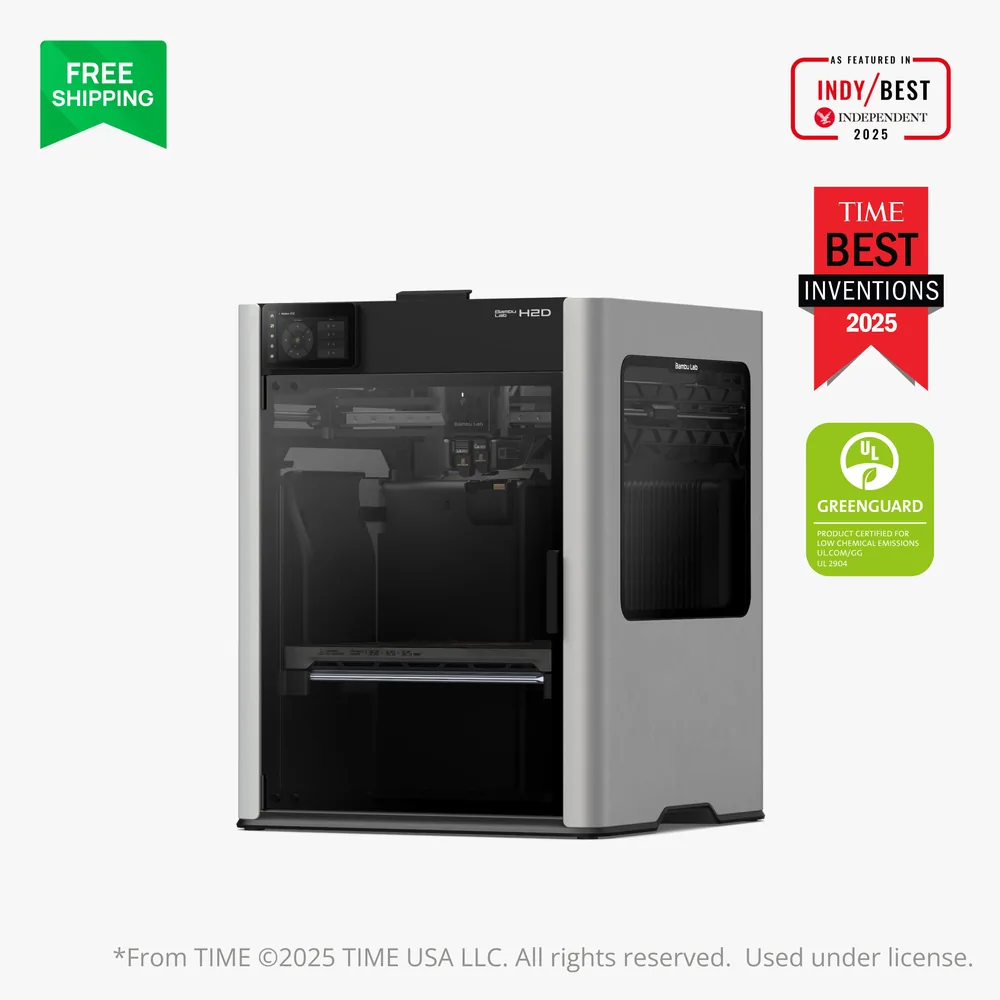
Pick the P2S for a compact 256 mm enclosed frame that's notably lighter and easier to set up, with a 1920 × 1080 camera and AMS 2 Pro compatibility. Pick the H2D if your projects need a much larger volume (up to 350 × 320 × 320 mm combined), a dual nozzle for two colors or materials without an AMS, a chamber actively heated to 65°C for technical materials, or an optional laser module.
Documentary comparison of manufacturer specifications. Not personally tested.
Choose the Bambu Lab P2S if…
- A 256 × 256 × 256 mm enclosed frame that's far more compact and roughly half the weight (14.9 kg versus 31 kg advertised for the H2D), easier to fit on a desk or shelf.
- AMS 2 Pro compatibility for automated multicolor with a documented drying function, without investing in a dual-nozzle setup.
- A single quick-swap nozzle: simpler day-to-day maintenance than a dual-nozzle system.
Choose the Bambu Lab H2D if…
- A build volume advertised up to 350 × 320 × 320 mm combining both nozzles, versus 256 mm per side for the P2S: notably larger parts become possible.
- A quick-swap dual nozzle to combine two colors or two materials on one part without adding an AMS, with hardened nozzles available for CF/GF composites.
- A chamber actively heated up to 65°C per Bambu Lab, useful for technical materials like PC or PA that warp in a passively heated frame.
- A top speed advertised at 1000 mm/s versus 600 mm/s for the P2S, plus an optional 10W or 40W laser module for engraving or cutting.
Specifications side by side
| Specification | Bambu Lab P2S | Bambu Lab H2D |
|---|---|---|
| Technology | Filament (FDM) | Filament (FDM) |
| Build volume | 256 × 256 × 256 mm (10.1 × 10.1 × 10.1 in) | 350 × 320 × 320 mm (13.8 × 12.6 × 12.6 in) |
| Printer dimensions | 392 × 406 × 478 mm (15.4 × 16 × 18.8 in) | 492 × 514 × 626 mm (19.4 × 20.2 × 24.6 in) |
| Weight | 14.9 kg (32.8 lb) | 31 kg (68.3 lb) |
| Enclosure | Enclosed | Enclosed, active heating up to 65 °C (149 °F) |
| Claimed top speed | 600 mm/s | 1,000 mm/s |
| Claimed acceleration | 20,000 mm/s² | 20,000 mm/s² |
| Max nozzle temperature | 300 °C (572 °F) | 350 °C (662 °F) |
| Max bed temperature | 110 °C (230 °F) | 120 °C (248 °F) |
| Multicolor | AMS 2 Pro compatible; check the Combo contents. | Compatible with the AMS 2 Pro for multicolor printing, sold separately or bundled in a Combo. |
| Materials | PLA, PETG, ABS, ASA, TPU, PET, PA, PC, PVA and composites (PLA-CF, PETG-CF, ABS-GF, ASA-CF, PA6-CF, PPA-CF, PET-CF…) per Bambu Lab's spec sheet; check the right profile and nozzle for each material. | PLA, PETG, ABS, ASA, TPU, PC, and PA per Bambu Lab, hardened nozzles for CF/GF composites, chamber actively heated to 65°C. |
| Screen | 5-inch touchscreen | 5-inch touchscreen |
| Built-in camera | Yes | Yes |
| Connectivity | Wi-Fi, USB | Wi-Fi, USB |
| Listed features | Filament runout sensor, filament cutter, built-in air filtration | Filament runout sensor, filament cutter, built-in air filtration |
| Nozzles | — | 2 (multi-nozzle) |
— : not listed by the manufacturer on the pages we reviewed.
Build volume and footprint
The P2S keeps the 256 × 256 × 256 mm nominal volume common to the P lineup. The H2D goes further with a volume advertised at 325 × 320 × 325 mm using a single nozzle, 300 × 320 × 320 mm when printing with both nozzles at once, and a total envelope of 350 × 320 × 320 mm per Bambu Lab: usable width shrinks slightly once both nozzles work together.
The gap holds on the floor and the scale too: 392 × 406 × 478 mm and 14.9 kg for the P2S, versus 492 × 514 × 626 mm and 31 kg advertised for the H2D, more than double the weight. On an already loaded desk or shelf, that gap matters as much as the volume difference.
Speed and motion
Bambu Lab advertises a top speed of 600 mm/s for the P2S versus 1000 mm/s for the H2D, with the same maximum acceleration of 20,000 mm/s² on both machines. These remain manufacturer ceilings: actual print time depends mostly on the slicer profile, part geometry, and material used.
The P2S relies on a single quick-swap nozzle, simpler to maintain day to day. The H2D adds a second quick-swap nozzle, which slightly complicates maintenance but lets you combine two materials without an extra accessory.
Materials, temperatures and enclosure
The P2S nozzle reaches 300°C and its bed 110°C per Bambu Lab, for PLA, PETG, ABS, ASA, TPU, PET, PA, PC, PVA and a range of composites (PLA-CF, PETG-CF, ABS-GF, ASA-CF, PA6-CF, PPA-CF…). The H2D goes further with a nozzle advertised up to 350°C and a 120°C bed, for PLA, PETG, ABS, ASA, TPU, PC, and PA, with hardened nozzles available as an option for carbon- or glass-fiber composites.
The most structural difference is the enclosure: the P2S stays passively heated, with no active chamber heating documented by Bambu Lab, like the rest of the P lineup. The H2D actively heats its chamber up to 65°C, a condition that benefits technical materials like PC or PA, more prone to warping in a passively heated frame.
Multicolor
Both machines are AMS 2 Pro compatible per Bambu Lab, sold separately or bundled in a Combo, with a drying function useful for moisture-sensitive filaments like nylon. The multicolor buying guide covers what this accessory genuinely adds compared to a dual nozzle.
The H2D adds an option the P2S doesn't have: its dual nozzle can combine two colors or two materials directly, with no AMS required. For advanced multicolor with several colors, the AMS 2 Pro remains necessary on both machines.
Everyday features
Both spec sheets document a 5-inch touchscreen, a camera, a filament sensor and cutter, and Wi-Fi plus USB connectivity per Bambu Lab. The P2S specifies a 1920 × 1080 camera at 30 frames per second; the H2D also carries a camera for remote monitoring, with no resolution listed on the sheet checked.
On filtration, the P2S advertises an activated carbon filter against VOCs and particles; the H2D documents air filtration without specifying the filter type. It also adds an optional 10W or 40W laser module (Laser Full Combo bundle), which the P2S lacks. Compare the exact bundle contents on the retailer's listing before buying, since included accessories vary significantly between offers.
Sources
- Bambu Lab — fiche technique P2S (bambulab.com)
- Bambu Lab — fiche technique H2D (bambulab.com)
- How we compare printers
Published 2026-09-28, updated 2026-09-28.