
Head-to-head comparison
Bambu Lab H2C vs P2S: is the Vortek dual-nozzle system worth it?
The short answer
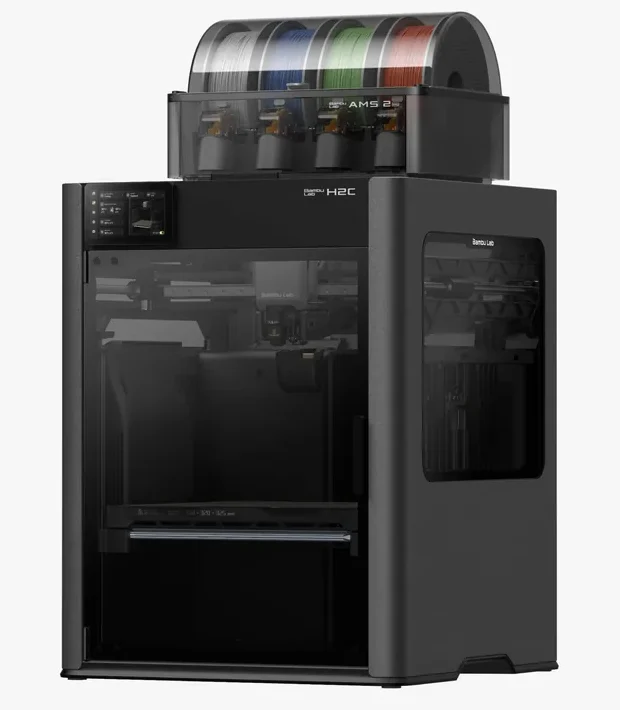
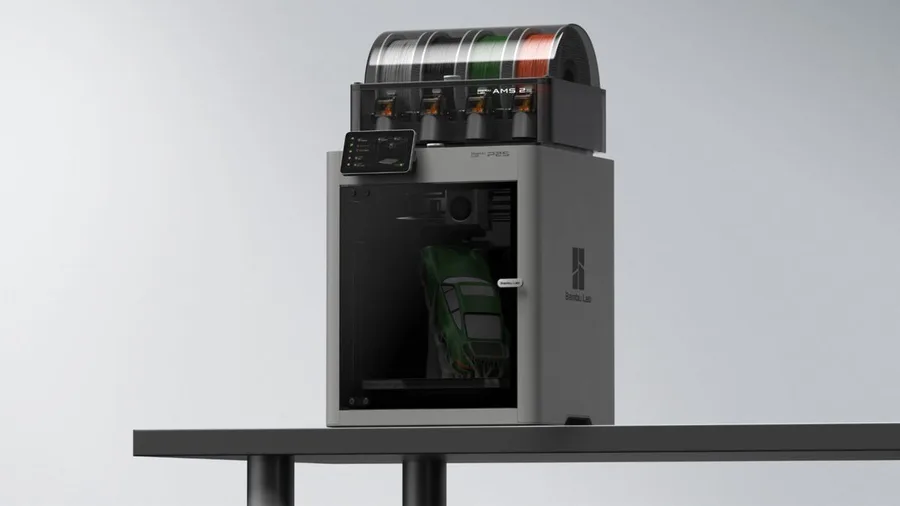
Pick the H2C if you print in several materials or colors often and want to cut purge waste: an advertised 330 × 320 × 320 mm volume, dual Vortek nozzles, a chamber heated to 65°C, and a top speed advertised at 1000 mm/s per Bambu Lab. Pick the P2S for a far lighter, more compact machine (14.9 kg versus 32.5 kg), with a 1920 × 1080 camera, AMS 2 Pro compatibility, and a broad official material list without managing two nozzles.
Documentary comparison of manufacturer specifications. Not personally tested.
Choose the Bambu Lab H2C if…
- A far larger advertised volume (330 × 320 × 320 mm) than the P2S, with dual Vortek nozzles for working several materials on one part.
- A top speed advertised at 1000 mm/s versus 600 mm/s for the P2S, with the same maximum acceleration per both sheets.
- A chamber actively heated up to 65°C and a nozzle up to 350°C, for technical filaments like PA6-GF or PC FR per Bambu Lab.
- The Vortek system is built to cut purge between colors or materials, compared with a single-nozzle machine like the P2S.
Choose the Bambu Lab P2S if…
- A much lighter, more compact machine (14.9 kg and 392 × 406 × 478 mm) than the H2C (32.5 kg and 492 × 514 × 626 mm), easier to set up.
- AMS 2 Pro compatibility with a drying function, without a Vortek nozzle changer to manage day to day.
- An already broad official material list (PLA through PC, including ASA and TPU) with a single nozzle to maintain per Bambu Lab.
Specifications side by side
| Specification | Bambu Lab H2C | Bambu Lab P2S |
|---|---|---|
| Technology | Filament (FDM) | Filament (FDM) |
| Build volume | 330 × 320 × 320 mm (13 × 12.6 × 12.6 in) | 256 × 256 × 256 mm (10.1 × 10.1 × 10.1 in) |
| Printer dimensions | 492 × 514 × 626 mm (19.4 × 20.2 × 24.6 in) | 392 × 406 × 478 mm (15.4 × 16 × 18.8 in) |
| Weight | 32.5 kg (71.7 lb) | 14.9 kg (32.8 lb) |
| Enclosure | Enclosed, active heating up to 65 °C (149 °F) | Enclosed |
| Claimed top speed | 1,000 mm/s | 600 mm/s |
| Claimed acceleration | 20,000 mm/s² | 20,000 mm/s² |
| Max nozzle temperature | 350 °C (662 °F) | 300 °C (572 °F) |
| Max bed temperature | 120 °C (248 °F) | 110 °C (230 °F) |
| Nozzles | 2 (multi-nozzle) | — |
| Multicolor | Vortek system: up to six colors plus a seventh nozzle for support or an extra color, per Bambu Lab; check which AMS units and spools the bundle includes. | AMS 2 Pro compatible; check the Combo contents. |
| Materials | Common and engineering filaments per Bambu Lab profiles (manufacturer examples: PA6-GF, PC FR, TPU for AMS); nozzle up to 350 °C. | PLA, PETG, ABS, ASA, TPU, PET, PA, PC, PVA and composites (PLA-CF, PETG-CF, ABS-GF, ASA-CF, PA6-CF, PPA-CF, PET-CF…) per Bambu Lab's spec sheet; check the right profile and nozzle for each material. |
| Screen | 5-inch touchscreen | 5-inch touchscreen |
| Built-in camera | Yes | Yes |
| Connectivity | Wi-Fi, USB | Wi-Fi, USB |
| Listed features | Filament runout sensor, filament cutter, built-in air filtration | Filament runout sensor, filament cutter, built-in air filtration |
— : not listed by the manufacturer on the pages we reviewed.
Build volume and footprint
The H2C advertises a 330 × 320 × 320 mm nominal volume with both Vortek nozzles per Bambu Lab, well above the P2S's 256 × 256 × 256 mm. The exact figure depends on the mode: the H2C sheet lists 325 × 320 × 320 mm with the left nozzle alone, 305 × 320 × 325 mm with the right nozzle alone, and 300 × 320 × 320 mm when both nozzles work the same part.
The gap widens further on footprint and weight: 492 × 514 × 626 mm and 32.5 kg for the H2C, versus 392 × 406 × 478 mm and 14.9 kg for the P2S per both Bambu Lab sheets. The H2C weighs more than double and needs a sturdy stand and dedicated space, while the P2S stays easy to move between rooms.
Speed and motion
Bambu Lab advertises a top speed of 1000 mm/s for the H2C versus 600 mm/s for the P2S, with the same maximum acceleration of 20,000 mm/s² on both machines. That figure stays a manufacturer ceiling: actual print time depends mostly on the slicer profile, part geometry, and material used.
The clearest mechanical difference is nozzle count: a single nozzle on the P2S, advertised as quick-swap, versus two nozzles with a Vortek changer on the H2C, which induction-heats the selected nozzle in about eight seconds according to the manufacturer.
Materials, temperatures and enclosure
The H2C runs hotter across the board: a nozzle up to 350°C, a bed up to 120°C, and a chamber actively heated up to 65°C per Bambu Lab, with manufacturer examples like PA6-GF, PC FR, or TPU for AMS. The P2S stays at 300°C at the nozzle and 110°C at the bed, with no active chamber heating documented on its sheet, same as the P1S.
That temperature gap opens the door to more demanding filaments on the H2C, but the P2S already covers a wide range per its spec sheet: PLA, PETG, ABS, ASA, TPU, PET, PA, PC, PVA, and several composites. The choice mostly comes down to the specific material you're targeting and its profile, not just the advertised ceiling.
Multicolor
The H2C's Vortek system swaps nozzles instead of purging a single one at every color change: Bambu Lab claims up to seven materials per print with reduced purge, illustrating the gain on its own models (532 g of purge on the H2C versus 3,032 g on the H2D for a multicolor figure). These are manufacturer examples, not our measurements; the real gap depends on how many color changes your file needs.
The P2S relies on AMS 2 Pro, compatible in a Combo version depending on the listing, with a drying function documented by Bambu Lab for moisture-sensitive filaments. Both systems add external units to feed colors: the multicolor buying guide covers what each one genuinely changes before you choose.
Everyday features
Both machines share a 5-inch touchscreen, a filament sensor, a built-in filament cutter, and air filtration per their respective sheets: H12 HEPA plus activated carbon for the H2C, activated carbon for the P2S. Connectivity matches too, Wi-Fi and USB, with no Ethernet on either.
On the camera side, the P2S advertises 1920 × 1080 at 30 frames per second for error detection; the H2C also has a built-in camera, whose resolution we have not recorded. Before deciding, compare the H2C's full spec sheet against the P1S, closer to the P2S in size, if the H2C's footprint looks oversized for your use; the startup budget tool helps price out the full gap between the two setups.
Sources
- Bambu Lab — fiche technique H2C (bambulab.com)
- Bambu Lab — fiche technique P2S (bambulab.com)
- How we compare printers
Published 2026-09-28, updated 2026-09-28.