
Head-to-head comparison
Bambu Lab H2C vs H2D: Vortek or dual nozzle for multicolor?
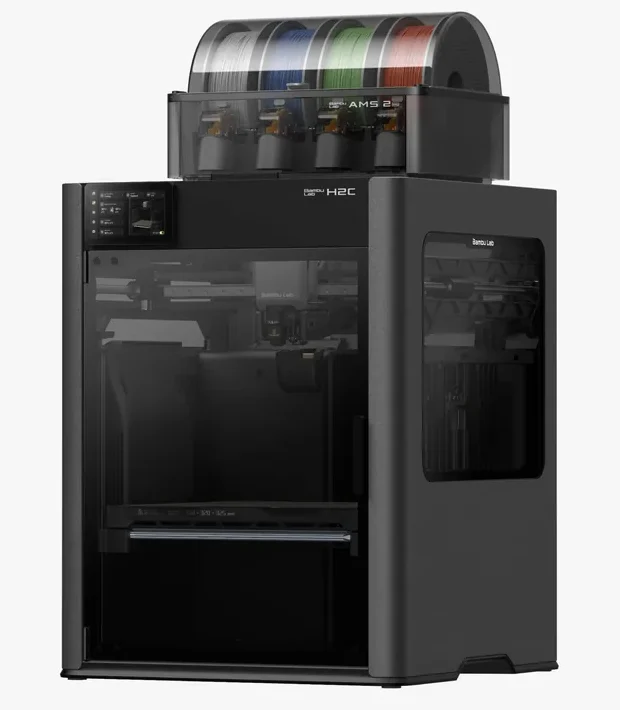
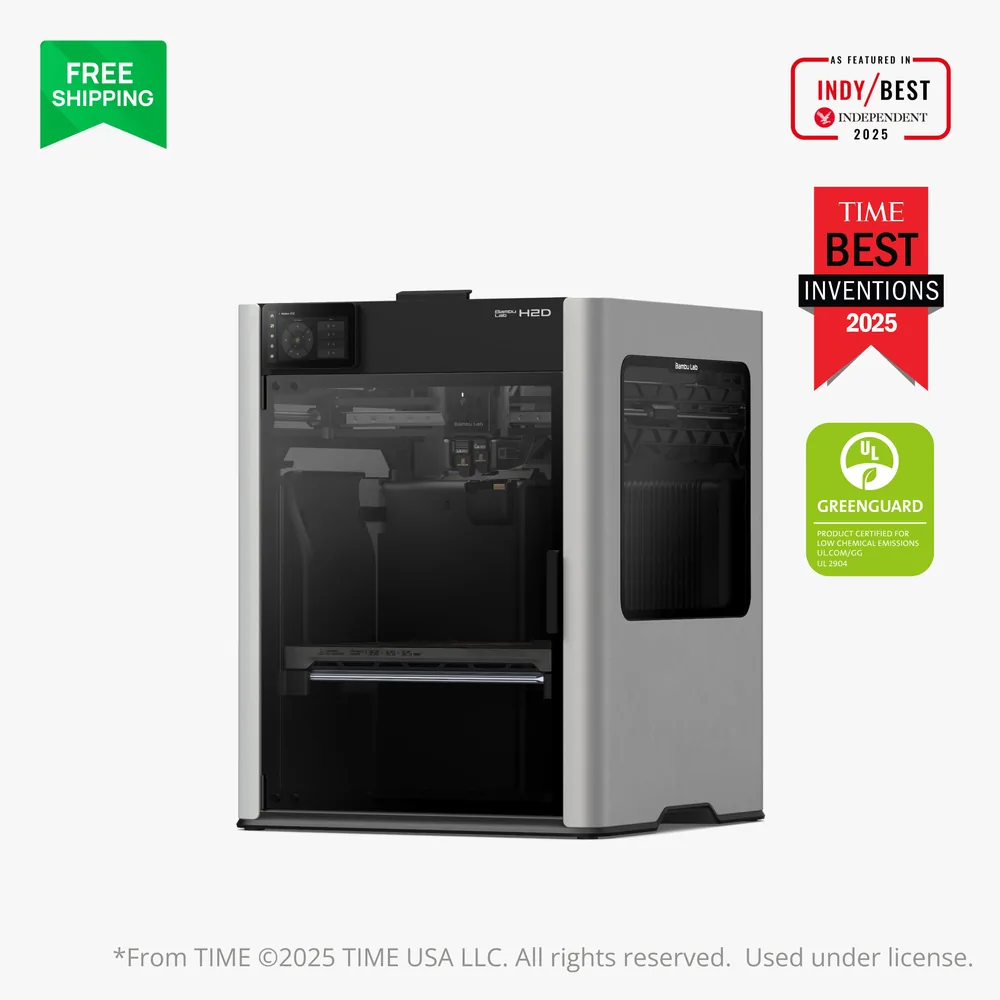
The short answer
Pick the H2C if you often print several colors or materials on the same part: its Vortek system picks up the next hotend, induction-heated in about eight seconds, and Bambu Lab advertises up to seven materials per print with far less purge than an H2D. Pick the H2D for a simpler two-fixed-nozzle mechanism, 1.5 kg lighter, with hardened nozzles for composites and an optional laser module the H2C sheet doesn't document.
Documentary comparison of manufacturer specifications. Not personally tested.
Choose the Bambu Lab H2C if…
- Vortek system: induction hotend swap in about eight seconds per Bambu Lab, to cut purge between colors.
- Up to seven materials or colors advertised per print, versus two fixed nozzles on the H2D.
- Manufacturer example: 532g of purge on a multicolor figure versus 3,032g advertised on the H2D for the same file.
- The same 350°C nozzle, the same 120°C bed, and the same chamber heated to 65°C as the H2D.
Choose the Bambu Lab H2D if…
- Two fixed nozzles, a simpler mechanism than a hotend changer, at a lower advertised weight: 31 kg versus 32.5 kg.
- Hardened nozzles for carbon- or glass-fiber composites, explicitly documented on its sheet.
- An optional laser or cutting module, 10W or 40W, not mentioned on the H2C sheet.
- AMS 2 Pro advertised up to 16 colors on top of the two nozzles.
Specifications side by side
| Specification | Bambu Lab H2C | Bambu Lab H2D |
|---|---|---|
| Technology | Filament (FDM) | Filament (FDM) |
| Build volume | 330 × 320 × 320 mm (13 × 12.6 × 12.6 in) | 350 × 320 × 320 mm (13.8 × 12.6 × 12.6 in) |
| Printer dimensions | 492 × 514 × 626 mm (19.4 × 20.2 × 24.6 in) | 492 × 514 × 626 mm (19.4 × 20.2 × 24.6 in) |
| Weight | 32.5 kg (71.7 lb) | 31 kg (68.3 lb) |
| Enclosure | Enclosed, active heating up to 65 °C (149 °F) | Enclosed, active heating up to 65 °C (149 °F) |
| Claimed top speed | 1,000 mm/s | 1,000 mm/s |
| Claimed acceleration | 20,000 mm/s² | 20,000 mm/s² |
| Max nozzle temperature | 350 °C (662 °F) | 350 °C (662 °F) |
| Max bed temperature | 120 °C (248 °F) | 120 °C (248 °F) |
| Nozzles | 2 (multi-nozzle) | 2 (multi-nozzle) |
| Multicolor | Vortek system: up to six colors plus a seventh nozzle for support or an extra color, per Bambu Lab; check which AMS units and spools the bundle includes. | Compatible with the AMS 2 Pro for multicolor printing, sold separately or bundled in a Combo. |
| Materials | Common and engineering filaments per Bambu Lab profiles (manufacturer examples: PA6-GF, PC FR, TPU for AMS); nozzle up to 350 °C. | PLA, PETG, ABS, ASA, TPU, PC, and PA per Bambu Lab, hardened nozzles for CF/GF composites, chamber actively heated to 65°C. |
| Screen | 5-inch touchscreen | 5-inch touchscreen |
| Built-in camera | Yes | Yes |
| Connectivity | Wi-Fi, USB | Wi-Fi, USB |
| Listed features | Filament runout sensor, filament cutter, built-in air filtration | Filament runout sensor, filament cutter, built-in air filtration |
— : not listed by the manufacturer on the pages we reviewed.
Build volume and footprint
Both machines share the same advertised footprint, 492 × 514 × 626 mm, with the H2C the heavier of the two at 32.5 kg versus 31 kg for the H2D. Build volumes stay close without being identical across configurations.
Per Bambu Lab, the H2C advertises 325 × 320 × 320 mm with its left nozzle, 305 × 320 × 325 mm with the right one, and 300 × 320 × 320 mm when both nozzles work on the same part. The H2D advertises 325 × 320 × 325 mm with a single nozzle active and up to 350 × 320 × 320 mm in width with both: slightly more raw volume available than the H2C in dual-nozzle mode.
Speed and motion: Vortek versus dual nozzle
The H2D prints with two fixed nozzles mounted on the same carriage: each can hold a different material or color, with no mechanical change mid-print beyond selecting the active nozzle. The H2C works differently: its Vortek system physically swaps the nozzle in use, induction-heated in about eight seconds per Bambu Lab, to fetch the next color or material.
Both machines advertise the same top speed, 1000 mm/s, with the same acceleration. The gap isn't in raw print speed, then, but in time lost at each color or material change, which favors the Vortek mechanism according to the manufacturer.
Materials, temperatures and enclosure
Both machines share a nozzle advertised up to 350°C, a 120°C bed, and a chamber actively heated to 65°C with HEPA and activated-carbon filtration. That temperature combination is identical on both sheets, the highest in the Bambu Lab catalog alongside the H2S.
The H2D explicitly lists PLA, PETG, ABS, ASA, TPU, PC, and PA, with hardened nozzles for fiber-filled composites. The H2C sheet speaks more broadly of common and engineering filaments, with manufacturer examples like PA6-GF or PC FR: a different presentation, for a comparable technical ambition.
Multicolor and purge
This is the core difference between the two machines. The H2D combines two materials or colors directly through its two nozzles, and reaches up to 16 advertised colors once an AMS 2 Pro is added. The H2C targets advanced multicolor directly: up to seven materials per print per Bambu Lab, fed by AMS units like the rest of the lineup.
Bambu Lab illustrates the gap on its own models with a multicolor dinosaur figure: 532g of advertised purge on the H2C versus 3,032g on the H2D for the same file. These are manufacturer examples, not independent measurements; the real gap depends on how many color changes your own file needs.
Everyday features
Both sheets document a 5-inch touchscreen, a camera, Wi-Fi and USB connectivity (no Ethernet on either), a filament sensor, and a filament cutter. The optional laser module is documented only on the H2D sheet.
The number of Vortek hotends supplied with the H2C and the AMS units in each bundle vary by listing: compare the full spec sheets of the H2C and the H2D, and plan a sturdy stand for these heavy, bulky machines.
Sources
- Bambu Lab — fiche technique H2C (bambulab.com)
- Bambu Lab — fiche technique H2D (bambulab.com)
- How we compare printers
Published 2026-09-28, updated 2026-09-28.