
Head-to-head comparison
Bambu Lab H2D vs H2D Pro: is the Pro version worth it?
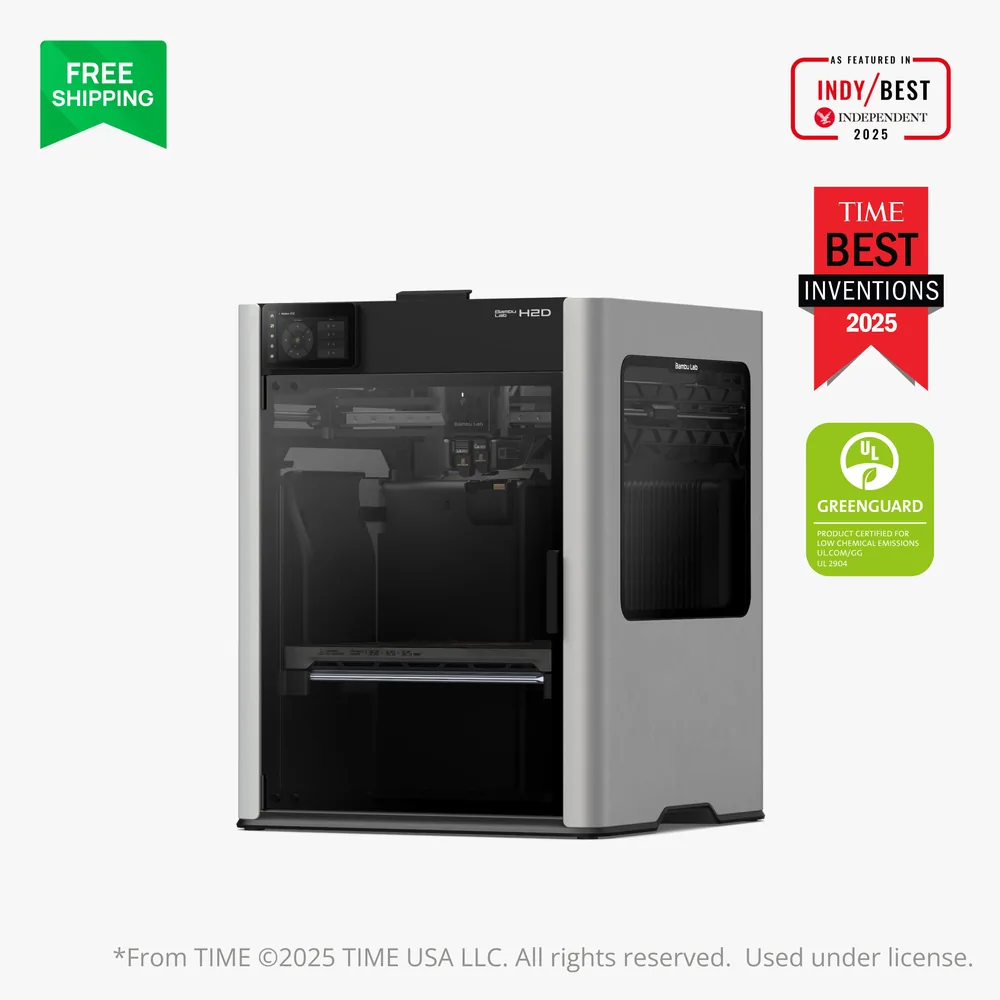
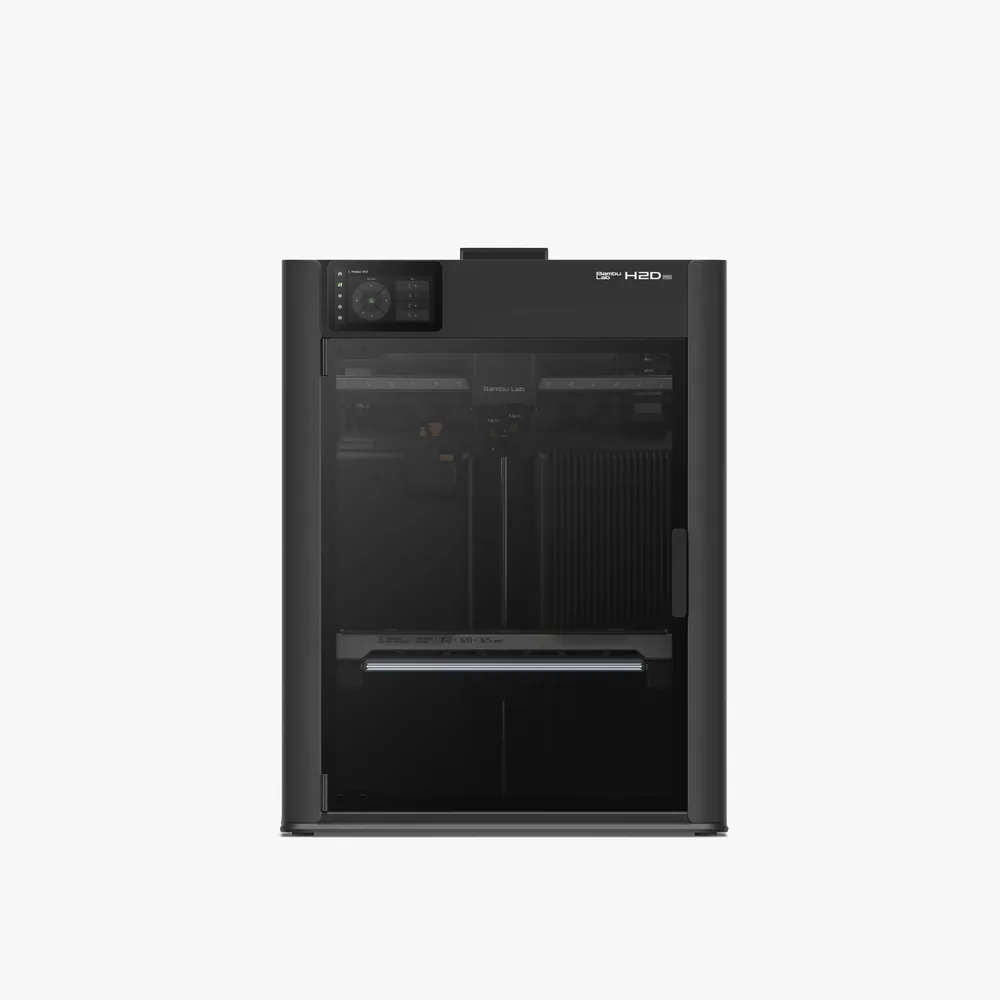
The short answer
The H2D and H2D Pro share the same build volume, the same two nozzles, and the same chamber heated to 65°C: the difference isn't in printing itself. Pick the H2D Pro if you need an Ethernet port, enterprise Wi-Fi with a physical kill switch, a tungsten carbide nozzle more durable on abrasive filaments, or a motion accuracy advertised at 50 µm. For personal use without those needs, the standard H2D covers the same build sizes.
Documentary comparison of manufacturer specifications. Not personally tested.
Choose the Bambu Lab H2D if…
- The same build volume, the same two nozzles, and the same 65°C heated chamber as the Pro, without paying for business-oriented features.
- A hardened-steel nozzle, enough for the non-abrasive materials already listed: PLA, PETG, ABS, ASA, TPU, PC, PA.
- Standard Wi-Fi and USB, enough for a single machine on a home network.
Choose the Bambu Lab H2D Pro if…
- An Ethernet port and WPA2-Enterprise Wi-Fi with a physical kill switch, built for a managed network.
- A tungsten carbide nozzle: HRA 90 hardness versus 74 for hardened steel, advertised life about 50% longer with fiber-filled filaments.
- An optical encoder measuring movement at 5 µm, presented by Bambu Lab as the basis for 50 µm motion accuracy.
- 32GB of internal storage, plus Bambu Lab support for integrating several machines as a fleet.
Specifications side by side
| Specification | Bambu Lab H2D | Bambu Lab H2D Pro |
|---|---|---|
| Technology | Filament (FDM) | Filament (FDM) |
| Build volume | 350 × 320 × 320 mm (13.8 × 12.6 × 12.6 in) | 350 × 320 × 320 mm (13.8 × 12.6 × 12.6 in) |
| Printer dimensions | 492 × 514 × 626 mm (19.4 × 20.2 × 24.6 in) | 492 × 514 × 626 mm (19.4 × 20.2 × 24.6 in) |
| Weight | 31 kg (68.3 lb) | 31 kg (68.3 lb) |
| Enclosure | Enclosed, active heating up to 65 °C (149 °F) | Enclosed, active heating up to 65 °C (149 °F) |
| Claimed top speed | 1,000 mm/s | 1,000 mm/s |
| Claimed acceleration | 20,000 mm/s² | 20,000 mm/s² |
| Max nozzle temperature | 350 °C (662 °F) | 350 °C (662 °F) |
| Max bed temperature | 120 °C (248 °F) | 120 °C (248 °F) |
| Nozzles | 2 (multi-nozzle) | 2 (multi-nozzle) |
| Multicolor | Compatible with the AMS 2 Pro for multicolor printing, sold separately or bundled in a Combo. | Two nozzles and AMS compatibility for multicolor and multi-material prints; check how many AMS units the listing includes. |
| Materials | PLA, PETG, ABS, ASA, TPU, PC, and PA per Bambu Lab, hardened nozzles for CF/GF composites, chamber actively heated to 65°C. | Engineering and fiber-filled filaments per Bambu Lab profiles; nozzle up to 350 °C and a chamber heated up to 65 °C. |
| Screen | 5-inch touchscreen | 5-inch touchscreen |
| Built-in camera | Yes | Yes |
| Connectivity | Wi-Fi, USB | Wi-Fi, Ethernet, USB |
| Listed features | Filament runout sensor, filament cutter, built-in air filtration | Filament runout sensor, filament cutter, built-in air filtration |
— : not listed by the manufacturer on the pages we reviewed.
Build volume and footprint
On this front, the two machines are identical: an advertised volume of 350 × 320 × 320 mm with both nozzles, 325 × 320 × 325 mm with one, in a 492 × 514 × 626 mm footprint at 31 kg per Bambu Lab. The choice between them never comes down to the size of the parts you can print.
That complete parity on build volume lets the comparison focus on what the Pro version adds rather than on size gaps, unlike other pairings in the H2 lineup.
Materials, temperatures and nozzle
Both machines share a nozzle advertised up to 350°C, a 120°C bed, and a chamber actively heated to 65°C, with the same list of technical materials per Bambu Lab's profiles. The difference is the nozzle itself: hardened steel on the standard H2D, tungsten carbide on the Pro.
Bambu Lab advertises HRA 90 hardness for the carbide nozzle versus 74 for hardened steel, with about 50% longer life on carbon- or glass-fiber filaments, which are particularly abrasive on a standard nozzle.
Networking and claimed accuracy
The H2D Pro adds an Ethernet port, WPA2-Enterprise Wi-Fi authentication (EAP-PEAP, EAP-TLS, EAP-TTLS), and physical switches to cut Wi-Fi, plus 32GB of internal storage, none of which the H2D sheet details. These additions mainly target integration into a managed business network.
The Pro also carries an optical encoder plate measuring movement at 5 µm, which Bambu Lab presents as the basis for 50 µm motion accuracy. These are manufacturer-advertised specifications, not measurements performed by our team.
Everyday features and who each one is for
Both sheets document a 5-inch touchscreen, a camera, a filament sensor and cutter, and air filtration. The optional laser module, 10W or 40W, is documented on the standard H2D sheet; the H2D Pro sheet doesn't mention it.
Bambu Lab positions the H2D Pro for workshops and businesses, pointing buyers toward resellers and a sales contact rather than a standard online checkout. Check the warranty and support offered before choosing it over the standard H2D for personal use.
Sources
- Bambu Lab — fiche technique H2D (bambulab.com)
- Bambu Lab — fiche technique H2D Pro (bambulab.com)
- How we compare printers
Published 2026-09-28, updated 2026-09-28.