
Head-to-head comparison
Bambu Lab H2S vs H2D: one nozzle or two for large parts?
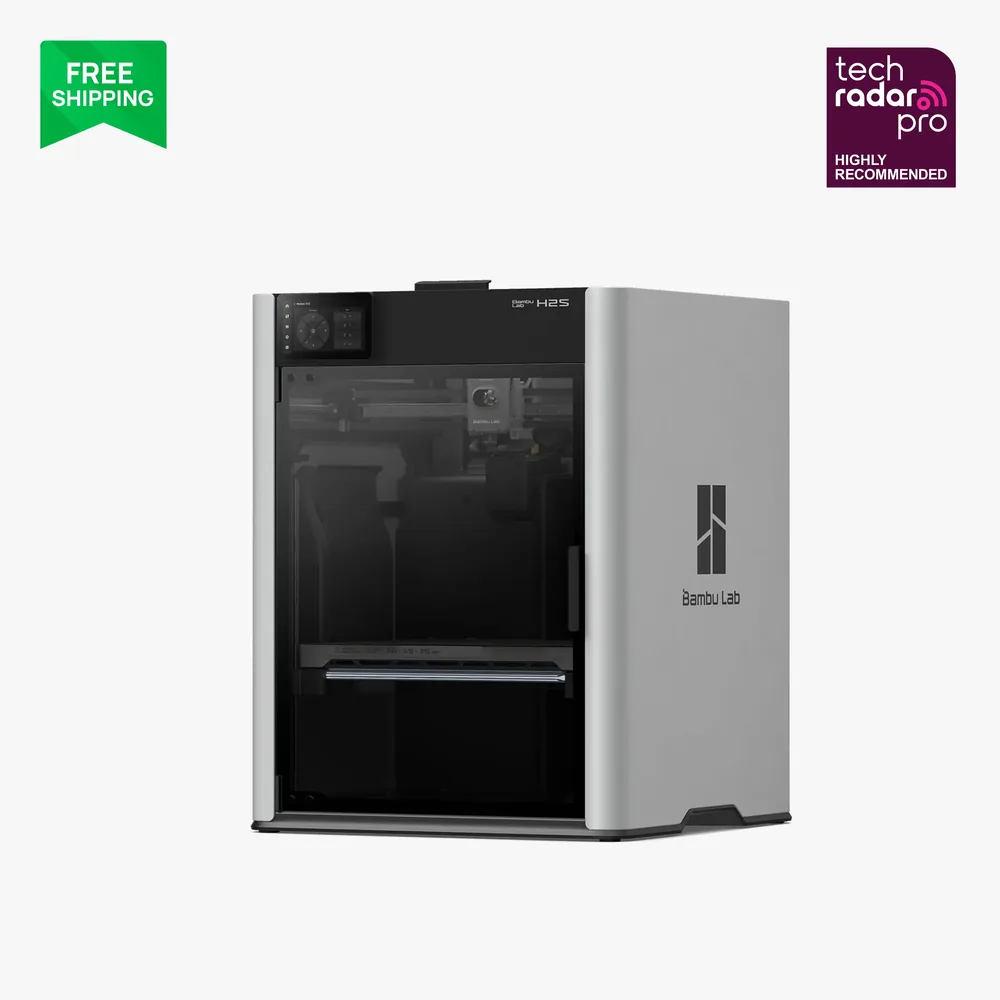
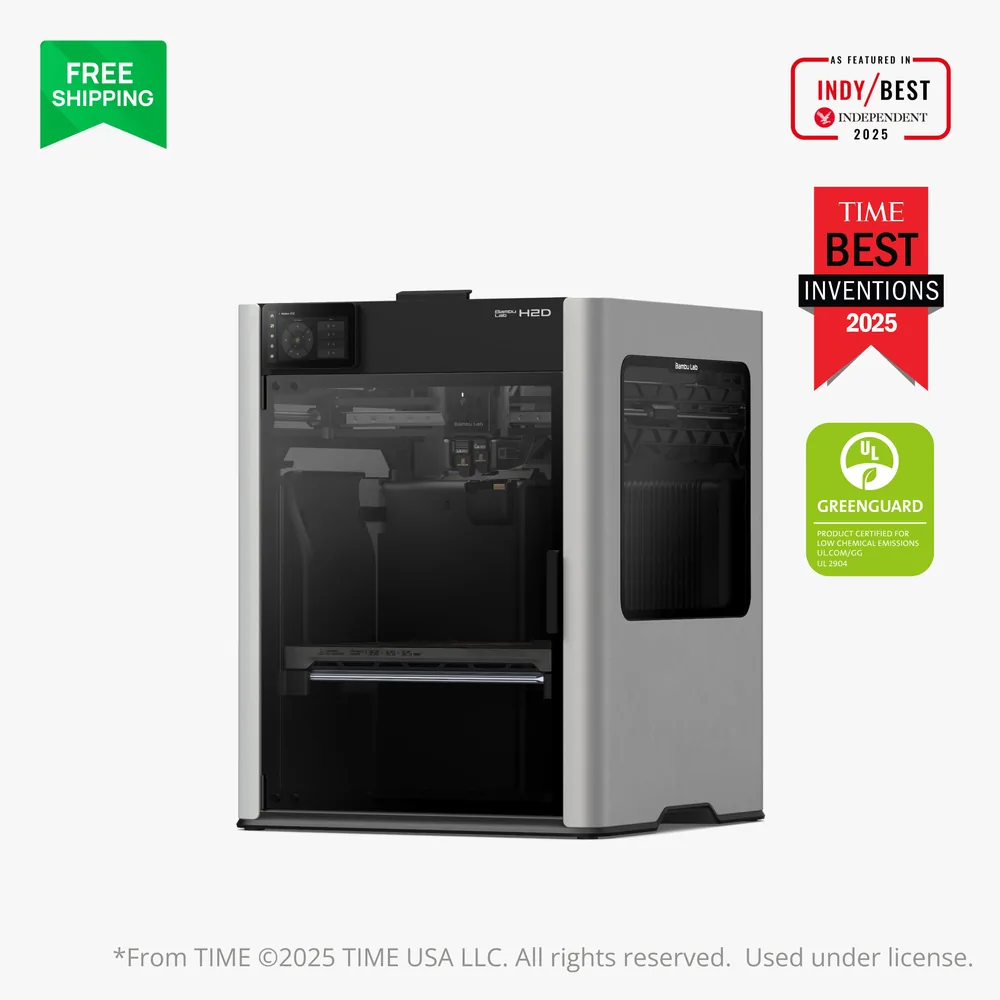
The short answer
Pick the H2S for the largest single-nozzle build volume Bambu Lab advertises, 340 × 320 × 340 mm, in a simpler mechanism to maintain. Pick the H2D if you want to combine two materials or colors without an AMS, use hardened nozzles for CF/GF composites, or add an optional laser module: build volume then drops to 350 × 320 × 320 mm with both nozzles.
Documentary comparison of manufacturer specifications. Not personally tested.
Choose the Bambu Lab H2S if…
- The largest single-nozzle build volume in Bambu Lab's catalog per the manufacturer, 340 × 320 × 340 mm.
- A single-nozzle mechanism, simpler to calibrate and maintain than a dual-nozzle system.
- A slightly lower advertised weight, 30 kg versus 31 kg for the H2D.
- PC explicitly listed among compatible materials, alongside PLA, PETG, ABS, ASA, and PA.
Choose the Bambu Lab H2D if…
- A second nozzle to combine two materials or colors on one part without an AMS.
- Hardened nozzles for carbon- or glass-fiber composites, not listed on the H2S sheet.
- TPU explicitly compatible on top of the materials shared with the H2S.
- An optional laser or cutting module (10W or 40W), absent from the H2S sheet.
Specifications side by side
| Specification | Bambu Lab H2S | Bambu Lab H2D |
|---|---|---|
| Technology | Filament (FDM) | Filament (FDM) |
| Build volume | 340 × 320 × 340 mm (13.4 × 12.6 × 13.4 in) | 350 × 320 × 320 mm (13.8 × 12.6 × 12.6 in) |
| Printer dimensions | 492 × 514 × 626 mm (19.4 × 20.2 × 24.6 in) | 492 × 514 × 626 mm (19.4 × 20.2 × 24.6 in) |
| Weight | 30 kg (66.1 lb) | 31 kg (68.3 lb) |
| Enclosure | Enclosed, active heating up to 65 °C (149 °F) | Enclosed, active heating up to 65 °C (149 °F) |
| Claimed top speed | 1,000 mm/s | 1,000 mm/s |
| Claimed acceleration | 20,000 mm/s² | 20,000 mm/s² |
| Max nozzle temperature | 350 °C (662 °F) | 350 °C (662 °F) |
| Max bed temperature | 120 °C (248 °F) | 120 °C (248 °F) |
| Multicolor | Compatible with the AMS 2 Pro for multicolor printing, sold separately or bundled in a Combo. | Compatible with the AMS 2 Pro for multicolor printing, sold separately or bundled in a Combo. |
| Materials | PLA, PETG, ABS, ASA, PC, and PA per Bambu Lab, with a hotend up to 350°C and a chamber actively heated to 65°C. | PLA, PETG, ABS, ASA, TPU, PC, and PA per Bambu Lab, hardened nozzles for CF/GF composites, chamber actively heated to 65°C. |
| Screen | 5-inch touchscreen | 5-inch touchscreen |
| Built-in camera | Yes | Yes |
| Connectivity | Wi-Fi, USB | Wi-Fi, USB |
| Listed features | Filament runout sensor, filament cutter, built-in air filtration | Filament runout sensor, filament cutter, built-in air filtration |
| Nozzles | — | 2 (multi-nozzle) |
— : not listed by the manufacturer on the pages we reviewed.
Build volume and footprint
Both machines share the same advertised footprint, 492 × 514 × 626 mm, at a similar weight: 30 kg for the H2S versus 31 kg for the H2D. The real difference sits in usable build volume, not floor space.
Bambu Lab presents the H2S as the largest in its lineup in single-nozzle mode, at 340 × 320 × 340 mm. The H2D drops to 325 × 320 × 325 mm with one nozzle active, and grows to 350 × 320 × 320 mm in width when both nozzles work together on the same part: wider, but shorter than the H2S.
Speed and motion
Bambu Lab advertises the same 1000 mm/s top speed and the same maximum acceleration on both machines, so advertised speed doesn't separate this pair. The mechanical difference comes down to nozzle count: one on the H2S, two on the H2D.
That second nozzle changes the printing logic: it lets you switch material or color without purging a single nozzle each time, unlike a single-nozzle machine that has to flush the previous material before loading a new one.
Materials, temperatures and enclosure
Both machines share a nozzle advertised up to 350°C, a 120°C bed, and a chamber actively heated to 65°C per Bambu Lab, the most capable combination in the catalog alongside the H2C. PLA, PETG, ABS, ASA, and PA appear on both sheets, and the H2S explicitly adds PC to its list.
The H2D goes further on technical materials: Bambu Lab adds TPU and hardened nozzles for carbon- or glass-fiber composites, two points the H2S sheet doesn't mention.
Multicolor and options
On the H2S, any multicolor printing runs through an AMS 2 Pro sold separately or in a Combo bundle: the base machine prints one material or color at a time. The H2D can already combine two materials or colors with its two nozzles, and reaches up to 16 advertised colors once an AMS 2 Pro is added.
The H2D also offers an optional laser or cutting module, 10W or 40W depending on the bundle, a possibility the H2S sheet doesn't document. On both machines, these accessories remain separate add-ons to the base printer.
Everyday features
Both sheets document a 5-inch touchscreen, a camera, Wi-Fi and USB connectivity, a filament sensor and cutter, and air filtration: on this front, the H2S and H2D are identical. Each machine's base bundle includes the printer, a textured PEI plate, a spool holder, an accessory box, and a safety key, with no AMS or laser.
Before buying, compare the full spec sheets of the H2S and the H2D, along with the exact bundle a retailer lists, rather than relying on the product photo alone.
Sources
- Bambu Lab — fiche technique H2S (bambulab.com)
- Bambu Lab — fiche technique H2D (bambulab.com)
- How we compare printers
Published 2026-09-28, updated 2026-09-28.