
Head-to-head comparison
Bambu Lab P2S vs H2S: compact format or large volume?
The short answer
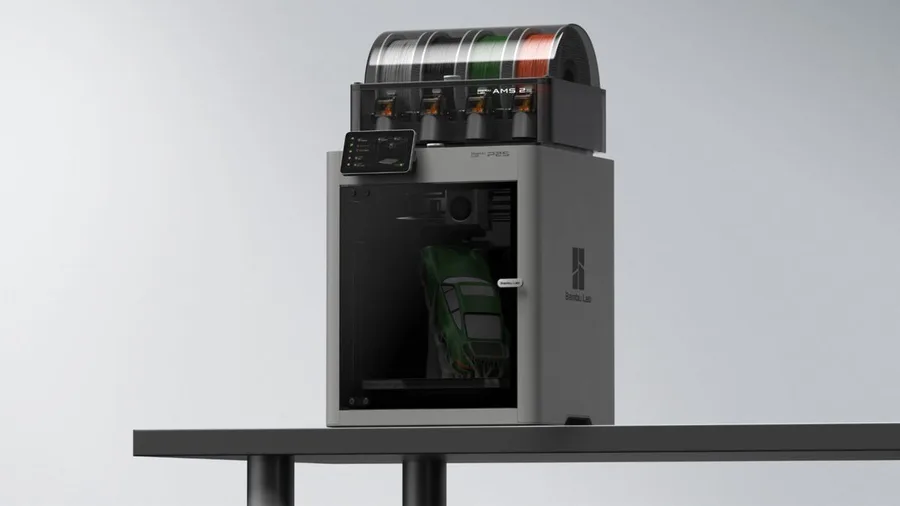
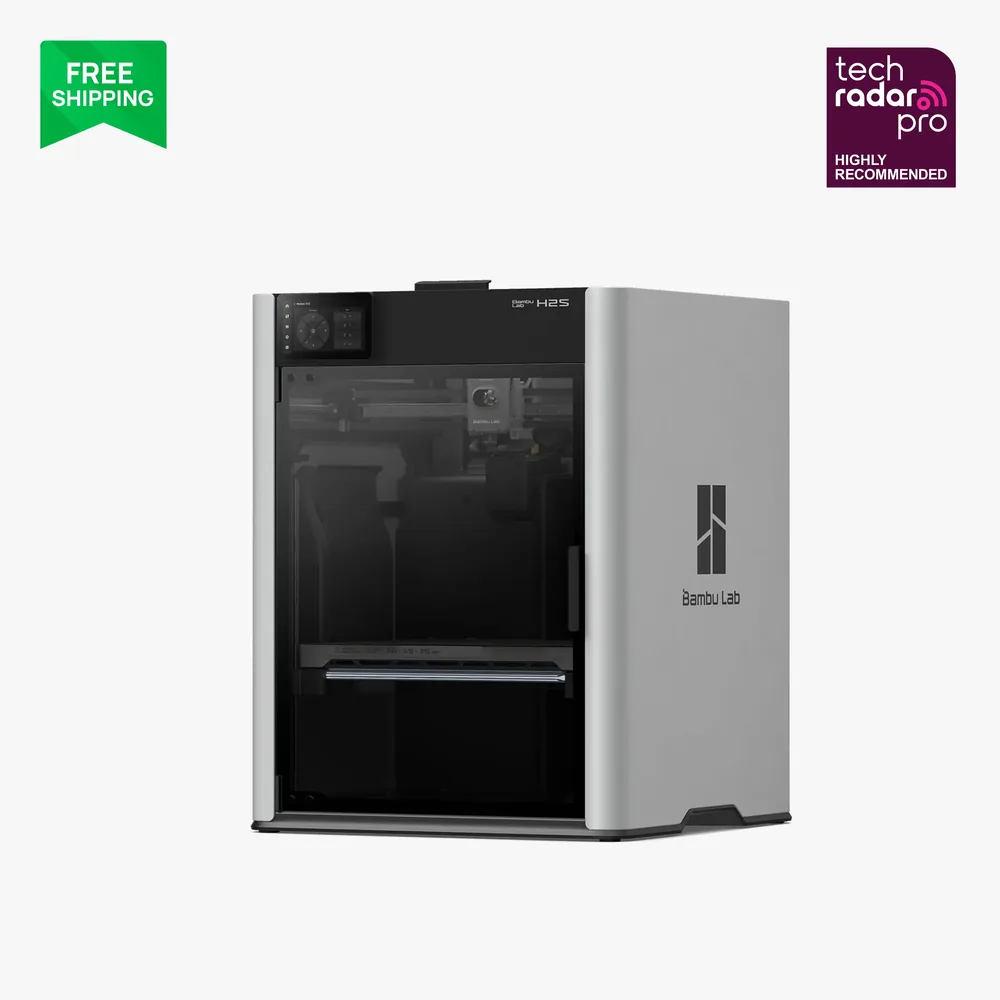
Pick the P2S for a compact enclosed printer, 392 × 406 × 478 mm at 14.9 kg, if a 256 mm cube covers your projects. Pick the H2S if you're after large single-piece parts: 340 × 320 × 340 mm advertised, a chamber actively heated to 65°C, and materials like PC or PA explicitly listed, in a machine twice as heavy.
Documentary comparison of manufacturer specifications. Not personally tested.
Choose the Bambu Lab P2S if…
- A much smaller footprint, 392 × 406 × 478 mm versus 492 × 514 × 626 mm for the H2S.
- An advertised weight nearly half that of the H2S, 14.9 kg versus 30 kg.
- The same AMS 2 Pro compatibility as the H2S, for the same multicolor ecosystem on a more compact base.
Choose the Bambu Lab H2S if…
- The largest single-nozzle build volume in Bambu Lab's catalog per the manufacturer, 340 × 320 × 340 mm versus a 256 mm cube for the P2S.
- A nozzle advertised up to 350°C and a 120°C bed, versus 300°C and 110°C on the P2S.
- A chamber actively heated to 65°C, documented, where the P2S sheet doesn't specify a controlled chamber temperature.
- PC and PA explicitly listed as compatible, a level of detail the P2S sheet doesn't provide on its materials.
Specifications side by side
| Specification | Bambu Lab P2S | Bambu Lab H2S |
|---|---|---|
| Technology | Filament (FDM) | Filament (FDM) |
| Build volume | 256 × 256 × 256 mm (10.1 × 10.1 × 10.1 in) | 340 × 320 × 340 mm (13.4 × 12.6 × 13.4 in) |
| Printer dimensions | 392 × 406 × 478 mm (15.4 × 16 × 18.8 in) | 492 × 514 × 626 mm (19.4 × 20.2 × 24.6 in) |
| Weight | 14.9 kg (32.8 lb) | 30 kg (66.1 lb) |
| Enclosure | Enclosed | Enclosed, active heating up to 65 °C (149 °F) |
| Claimed top speed | 600 mm/s | 1,000 mm/s |
| Claimed acceleration | 20,000 mm/s² | 20,000 mm/s² |
| Max nozzle temperature | 300 °C (572 °F) | 350 °C (662 °F) |
| Max bed temperature | 110 °C (230 °F) | 120 °C (248 °F) |
| Multicolor | AMS 2 Pro compatible; check the Combo contents. | Compatible with the AMS 2 Pro for multicolor printing, sold separately or bundled in a Combo. |
| Materials | PLA, PETG, ABS, ASA, TPU, PET, PA, PC, PVA and composites (PLA-CF, PETG-CF, ABS-GF, ASA-CF, PA6-CF, PPA-CF, PET-CF…) per Bambu Lab's spec sheet; check the right profile and nozzle for each material. | PLA, PETG, ABS, ASA, PC, and PA per Bambu Lab, with a hotend up to 350°C and a chamber actively heated to 65°C. |
| Screen | 5-inch touchscreen | 5-inch touchscreen |
| Built-in camera | Yes | Yes |
| Connectivity | Wi-Fi, USB | Wi-Fi, USB |
| Listed features | Filament runout sensor, filament cutter, built-in air filtration | Filament runout sensor, filament cutter, built-in air filtration |
— : not listed by the manufacturer on the pages we reviewed.
Build volume and footprint
Both machines are enclosed, but not at the same scale. The P2S advertises a 256 × 256 × 256 mm volume in a 392 × 406 × 478 mm footprint, while the H2S climbs to 340 × 320 × 340 mm in a 492 × 514 × 626 mm footprint per Bambu Lab.
Weight follows the same pattern: 14.9 kg for the P2S versus 30 kg for the H2S, nearly double. That gap directly affects your choice of stand or location, with the H2S needing a noticeably sturdier base.
Speed and motion
Bambu Lab advertises a top speed of 600 mm/s for the P2S versus 1000 mm/s for the H2S, with the same maximum acceleration on both machines. Both stay single-nozzle, without the mechanical complexity of a dual-nozzle or hotend-changer system.
The P2S adds a nozzle advertised as quick-swap, a point the H2S sheet doesn't detail in the same terms. For most parts, advertised speed matters less than the build volume gap between these two machines.
Materials, temperatures and enclosure
The H2S advertises a nozzle up to 350°C, a 120°C bed, and a chamber actively heated to 65°C: Bambu Lab explicitly lists PLA, PETG, ABS, ASA, PC, and PA as compatible. The P2S shares a 300°C nozzle and a 110°C bed, with no actively controlled chamber temperature documented on its sheet.
On materials, the P2S sheet stays cautious and points to profiles specific to this machine rather than guaranteeing broad compatibility. For technical parts in PC or PA, the H2S remains the clearer documented argument.
Multicolor and everyday features
On both machines, advanced multicolor printing runs through an AMS 2 Pro sold separately or in a Combo bundle: neither the P2S nor the H2S includes it in the base configuration. Both sheets also document a 5-inch touchscreen, a camera, Wi-Fi and USB connectivity, a filament sensor, and a filament cutter.
The H2S adds air filtration advertised by the manufacturer, absent from the P2S sheet. Before buying, compare the full spec sheets of the P2S and the H2S, along with the exact bundle a retailer lists.
Sources
- Bambu Lab — fiche technique P2S (bambulab.com)
- Bambu Lab — fiche technique H2S (bambulab.com)
- How we compare printers
Published 2026-09-28, updated 2026-09-28.