
Head-to-head comparison
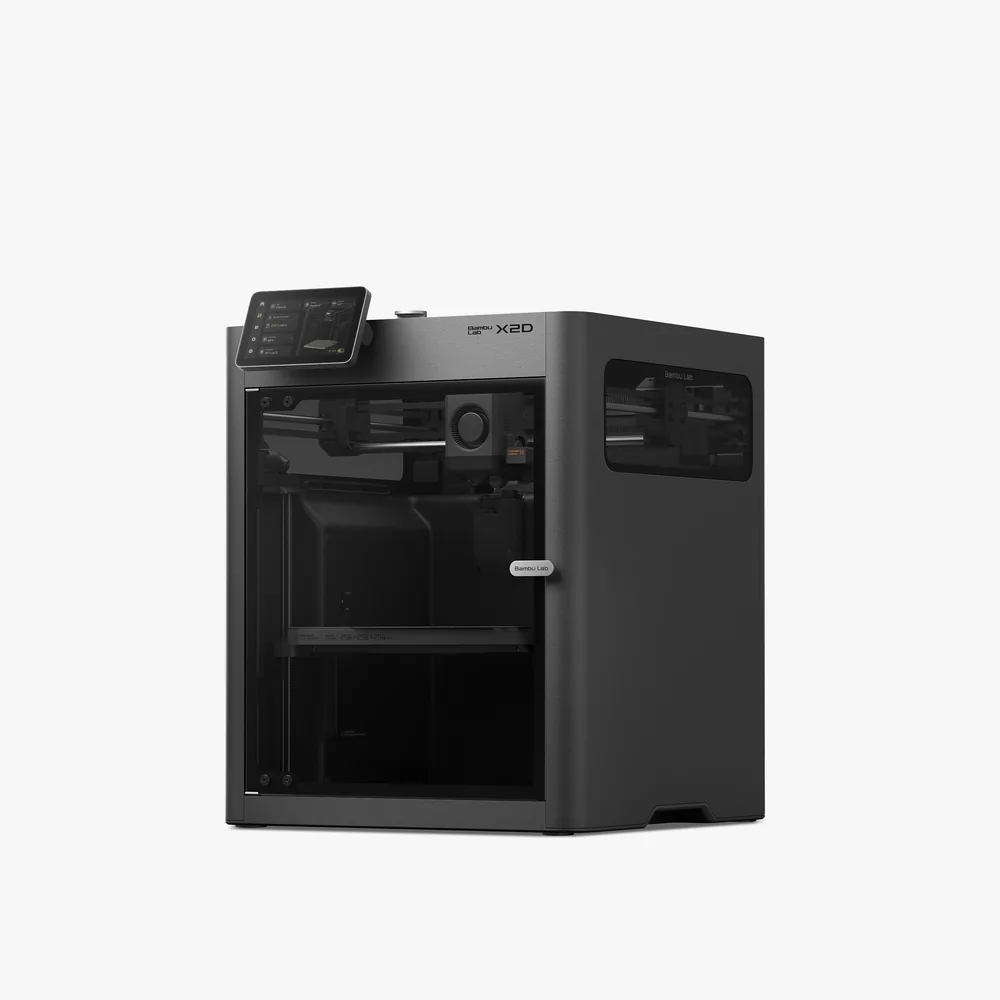
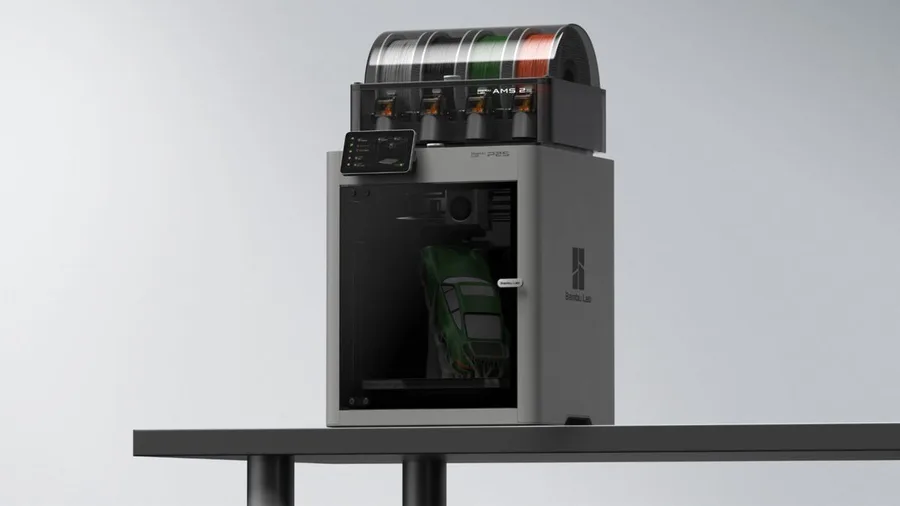
Bambu Lab X2D vs P2S: same footprint, different machines
The short answer
The X2D and P2S share the exact same footprint advertised by Bambu Lab, 392 × 406 × 478 mm, so floor space isn't the deciding factor. Pick the X2D for a 120°C bed, a chamber actively heated to 65°C, a speed advertised at 1000 mm/s, and a second nozzle that Bambu Lab mainly promotes for support material. Pick the P2S for a simpler single-nozzle mechanism, enough for standard PLA and PETG work.
Documentary comparison of manufacturer specifications. Not personally tested.
Choose the Bambu Lab X2D if…
- The same footprint as the P2S, but a bed advertised at 120°C and a chamber actively heated to 65°C.
- A second nozzle that Bambu Lab mainly promotes for easy-to-remove supports, and whose spec sheet also lists PLA, PETG, ABS, ASA, and TPU.
- A top speed advertised at 1000 mm/s versus 600 mm/s for the P2S per Bambu Lab.
- PLA, PETG, ABS, ASA, and PA explicitly listed as compatible by Bambu Lab thanks to the heated chamber.
Choose the Bambu Lab P2S if…
- The same footprint as the X2D, at a lighter advertised weight: 14.9 kg versus 16.25 kg.
- A simpler single-nozzle mechanism, with no second nozzle to tune in the slicer.
- A 110°C bed, enough for PLA and PETG, with AMS 2 Pro available in a Combo.
Specifications side by side
| Specification | Bambu Lab X2D | Bambu Lab P2S |
|---|---|---|
| Technology | Filament (FDM) | Filament (FDM) |
| Build volume | 256 × 256 × 260 mm (10.1 × 10.1 × 10.2 in) | 256 × 256 × 256 mm (10.1 × 10.1 × 10.1 in) |
| Printer dimensions | 392 × 406 × 478 mm (15.4 × 16 × 18.8 in) | 392 × 406 × 478 mm (15.4 × 16 × 18.8 in) |
| Weight | 16.3 kg (35.8 lb) | 14.9 kg (32.8 lb) |
| Enclosure | Enclosed, active heating up to 65 °C (149 °F) | Enclosed |
| Claimed top speed | 1,000 mm/s | 600 mm/s |
| Claimed acceleration | 20,000 mm/s² | 20,000 mm/s² |
| Max nozzle temperature | 300 °C (572 °F) | 300 °C (572 °F) |
| Max bed temperature | 120 °C (248 °F) | 110 °C (230 °F) |
| Nozzles | 2 (multi-nozzle) | — |
| Multicolor | An auxiliary nozzle that Bambu Lab mainly promotes for support, alongside the main nozzle; an AMS 2 Pro or HT AMS is a separate accessory for full multicolor, up to 25 colors per Bambu Lab. | AMS 2 Pro compatible; check the Combo contents. |
| Materials | PLA, PETG, ABS, ASA, PA, and engineering filaments thanks to a 300°C nozzle and a 65°C actively heated chamber per Bambu Lab. | PLA, PETG, ABS, ASA, TPU, PET, PA, PC, PVA and composites (PLA-CF, PETG-CF, ABS-GF, ASA-CF, PA6-CF, PPA-CF, PET-CF…) per Bambu Lab's spec sheet; check the right profile and nozzle for each material. |
| Screen | 5-inch touchscreen | 5-inch touchscreen |
| Built-in camera | Yes | Yes |
| Connectivity | Wi-Fi, USB | Wi-Fi, USB |
| Listed features | Filament runout sensor, filament cutter, built-in air filtration | Filament runout sensor, filament cutter, built-in air filtration |
— : not listed by the manufacturer on the pages we reviewed.
Build volume and footprint
The X2D and P2S share the exact same footprint advertised by Bambu Lab, 392 × 406 × 478 mm, a rare match in a lineup where every machine usually takes up a different amount of space. Nominal build volume barely differs: 256 × 256 × 260 mm for the X2D with its main nozzle versus 256 × 256 × 256 mm for the P2S, a negligible gap for most parts.
The X2D is heavier, 16.25 kg versus 14.9 kg for the P2S, worth factoring in for a cart or shelf. Its usable volume drops to 235.5 × 256 × 256 mm when both nozzles work together on the same part, a nuance the P2S sheet doesn't have since it only carries one nozzle.
Speed and motion
Bambu Lab advertises a top speed of 1000 mm/s for the X2D versus 600 mm/s for the P2S, with the same maximum acceleration on both machines. That speed gap comes with a more structural mechanical difference: the X2D carries an independent second nozzle, while the P2S stays single-nozzle.
Bambu Lab presents that auxiliary nozzle first as the support nozzle: the main nozzle prints the part, the auxiliary one prints the support, which peels away more cleanly. Its spec sheet still lists PLA, PETG, ABS, ASA, and TPU for this nozzle, which allows a second material or color on the same part, with the build volume reduced to 235.5 × 256 × 256 mm. The P2S counters with a nozzle advertised as quick-swap, useful for maintenance rather than dual material.
Materials, temperatures and enclosure
The X2D advertises a nozzle up to 300°C, a 120°C bed, and a chamber actively heated to 65°C: Bambu Lab explicitly lists PLA, PETG, ABS, ASA, and PA as compatible thanks to that combination. The P2S shares the same 300°C nozzle but a bed capped at 110°C, with no actively controlled chamber temperature documented on its sheet.
On materials, the P2S sheet stays cautious: Bambu Lab recommends checking profiles specific to this machine rather than assuming the same compatibility as another printer in the lineup. For technical parts in PA or thick ABS, the X2D's heated chamber remains the clearer documented argument.
Multicolor
On both machines, full multicolor printing runs through a separate accessory: an AMS 2 Pro or HT AMS for the X2D, with up to 25 colors advertised, or an AMS 2 Pro for the P2S, also available in a Combo version. Without an AMS, the X2D's auxiliary nozzle adds at most a second material or color, and Bambu Lab mainly promotes it for support.
The multicolor buying guide helps decide between a second nozzle and a full AMS system depending on whether your parts lean mechanical or decorative.
Everyday features
Both spec sheets document a 5-inch touchscreen, a camera, Wi-Fi and USB connectivity, a filament sensor, and a filament cutter: on this front, the X2D and P2S are equivalent. The X2D adds air filtration advertised by the manufacturer, absent from the P2S sheet.
Before deciding, compare the full spec sheets of the X2D and the P2S, along with the exact bundle a retailer lists, especially whether an AMS is included.
Sources
- Bambu Lab — fiche technique X2D (bambulab.com)
- Bambu Lab — fiche technique P2S (bambulab.com)
- How we compare printers
Published 2026-09-28, updated 2026-09-28.