
Head-to-head comparison
Flashforge AD5X vs Bambu Lab A1: built-in multicolor or more volume?
The short answer
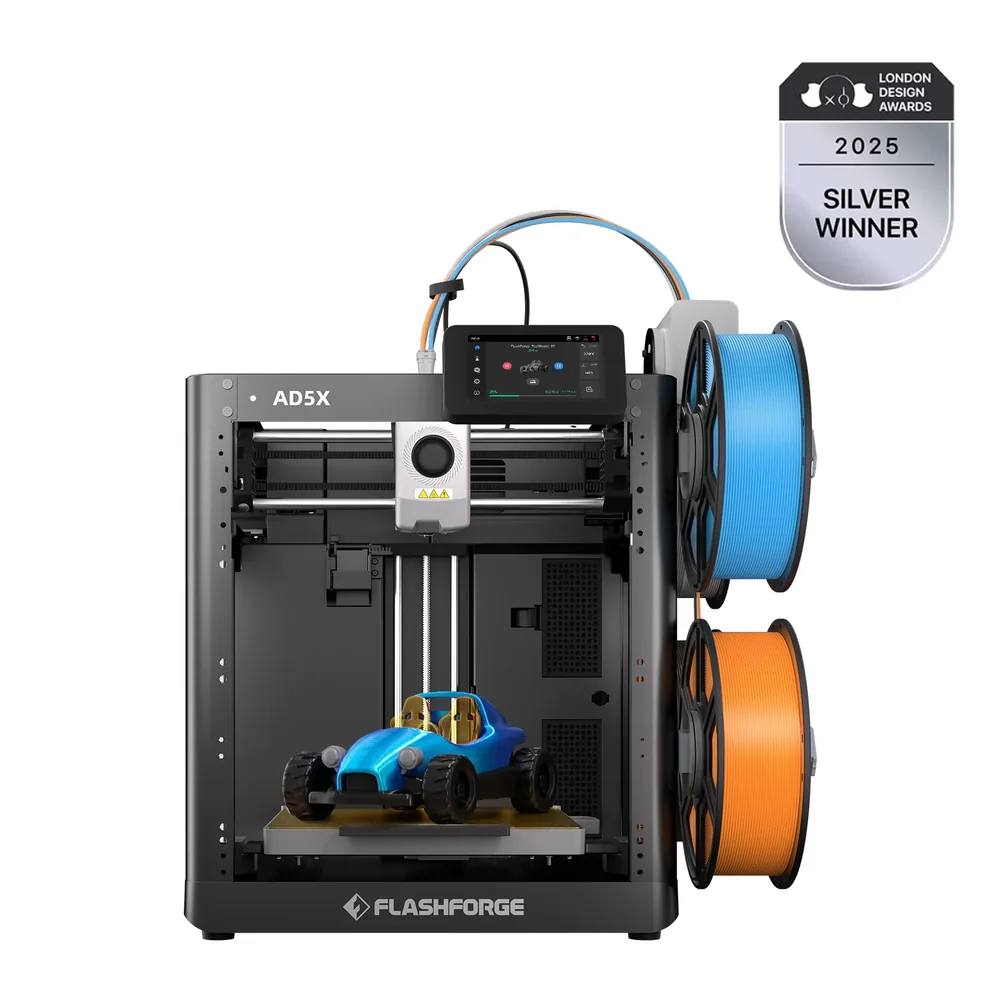
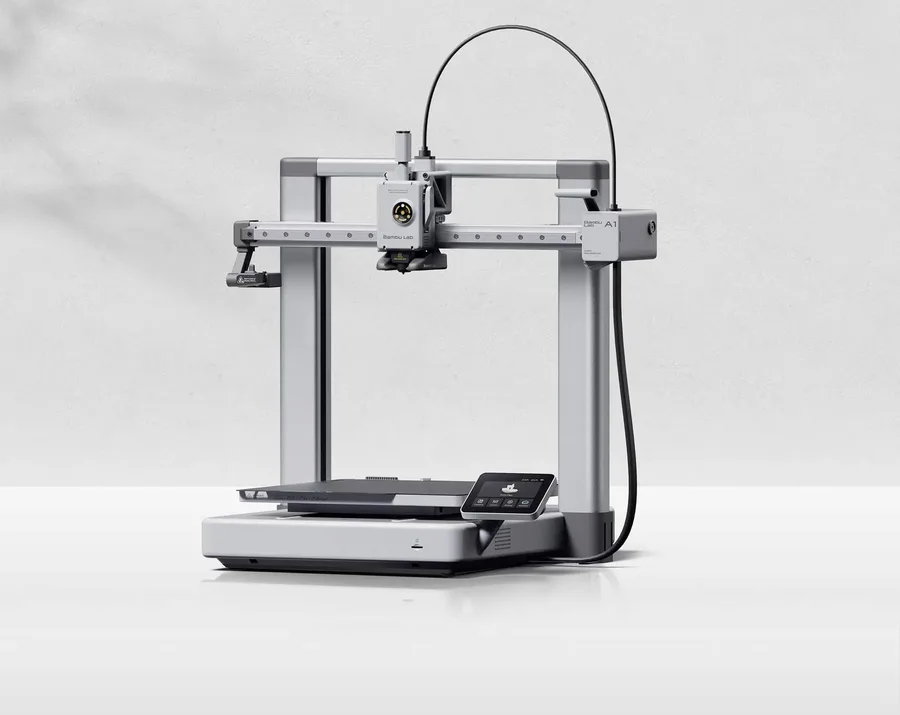
Pick the AD5X for multicolor built in out of the box, up to 4 colors or materials per Flashforge, with no separate accessory to buy, plus TPU and fiber-filled filaments explicitly listed. Pick the A1 for a larger nominal volume, 256 × 256 × 256 mm versus 220 × 220 × 220 mm, and a camera documented on its sheet, at the cost of adding an optional AMS lite for multicolor.
Documentary comparison of manufacturer specifications. Not personally tested.
Choose the Flashforge AD5X if…
- A built-in IFS multicolor system, up to 4 colors or materials, with no external box to add unlike the A1.
- TPU95A, TPU64D-75D, PLA-CF, and PETG-CF explicitly listed compatible, beyond the PLA and PETG documented for the A1.
- A bed heated up to 110°C versus 100°C for the A1, and an Ethernet port for a stable wired connection.
Choose the Bambu Lab A1 if…
- A larger nominal volume, 256 × 256 × 256 mm versus 220 × 220 × 220 mm for the AD5X.
- A camera documented on its sheet for print monitoring, a point the AD5X's official pages don't confirm.
- Precisely documented footprint and weight, 465 × 410 × 430 mm at 8.3 kg, where the AD5X sheet doesn't specify either.
Specifications side by side
| Specification | Flashforge AD5X | Bambu Lab A1 |
|---|---|---|
| Technology | Filament (FDM) | Filament (FDM) |
| Build volume | 220 × 220 × 220 mm (8.7 × 8.7 × 8.7 in) | 256 × 256 × 256 mm (10.1 × 10.1 × 10.1 in) |
| Enclosure | Open frame | Open frame |
| Claimed top speed | 600 mm/s | 500 mm/s |
| Claimed acceleration | 20,000 mm/s² | 10,000 mm/s² |
| Max nozzle temperature | 300 °C (572 °F) | 300 °C (572 °F) |
| Max bed temperature | 110 °C (230 °F) | 100 °C (212 °F) |
| Multicolor | Built-in IFS (Intelligent Filament System), no external box, for up to 4 colors or materials per Flashforge. | AMS lite; check the exact bundle. |
| Materials | PLA, PETG, TPU95A, TPU64D-75D, PLA-CF, and PETG-CF per Flashforge. | PLA and PETG with manufacturer profiles. |
| Screen | 4.3-inch touchscreen | 3.5-inch touchscreen |
| Connectivity | Wi-Fi, Ethernet, USB | Wi-Fi, microSD card |
| Listed features | Auto bed leveling, filament runout sensor, filament cutter | Filament runout sensor, filament cutter |
| Printer dimensions | — | 465 × 410 × 430 mm (18.3 × 16.1 × 16.9 in) |
| Weight | — | 8.3 kg (18.3 lb) |
| Built-in camera | — | Yes |
— : not listed by the manufacturer on the pages we reviewed.
Build volume and footprint
The A1 advertises a 256 × 256 × 256 mm nominal volume versus 220 × 220 × 220 mm for the AD5X, a real gap for parts that push against the plate's limits. Bambu Lab precisely documents the A1's footprint, 465 × 410 × 430 mm, and its weight, 8.3 kg.
The official Flashforge pages consulted for the AD5X don't specify the machine's footprint or net weight: worth checking directly on a retailer's listing before buying, rather than assuming from the build volume alone.
Speed and materials
Flashforge distinguishes the AD5X's travel speed, advertised up to 600 mm/s, from its maximum print speed, advertised separately at 300 mm/s. The A1 sheet gives a single figure, 500 mm/s, without that same travel-versus-print distinction.
On materials, the AD5X documents PLA, PETG, TPU95A, TPU64D-75D, PLA-CF, and PETG-CF. The A1 stays on PLA and PETG per its sheet, with no TPU or fiber-filled composite documented.
Multicolor
This is the most concrete difference between the two machines. The AD5X builds the IFS system directly into its chassis, with no external box to set up alongside it, driving up to 4 simultaneous colors or materials per Flashforge. The A1 stays single-material out of the box: multicolor runs through an optional AMS lite, a separate accessory to add and connect.
The multicolor buying guide covers the differences between a built-in system like the IFS and an external box like the AMS lite before you choose.
Everyday features
The AD5X offers a 4.3-inch touchscreen, Wi-Fi, Ethernet, and USB connectivity, a filament sensor and cutter, and auto bed leveling. A camera isn't documented on the official pages consulted for this model.
The A1 offers a 3.5-inch screen, a camera, and Wi-Fi and microSD connectivity, with the same filament sensor and cutter as the AD5X. Compare the full spec sheets of both machines before buying, especially if the camera or the Ethernet port matter to your choice.
Sources
- Flashforge — fiche technique AD5X (flashforge.com)
- Bambu Lab — fiche technique A1 (bambulab.com)
- How we compare printers
Published 2026-09-28, updated 2026-09-28.