
Head-to-head comparison
Flashforge AD5X vs Adventurer 5M Pro: Multicolor or Enclosed?
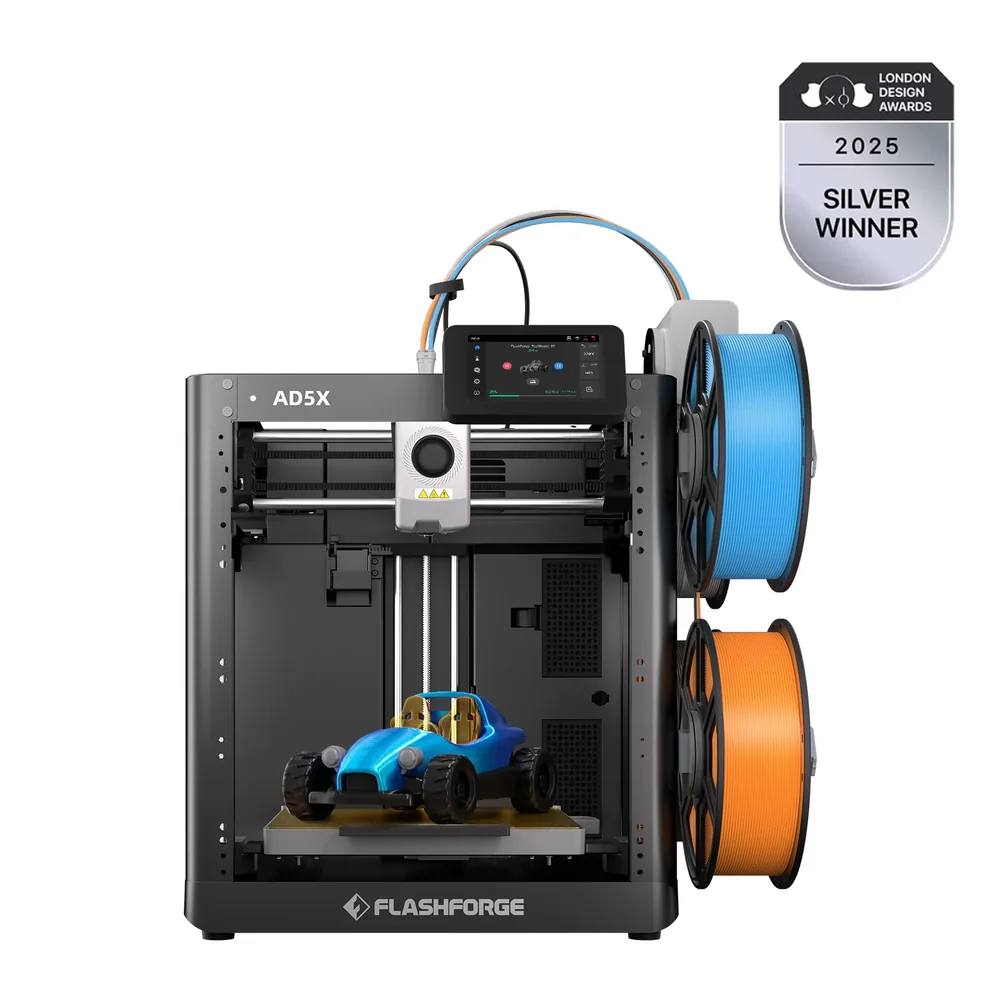
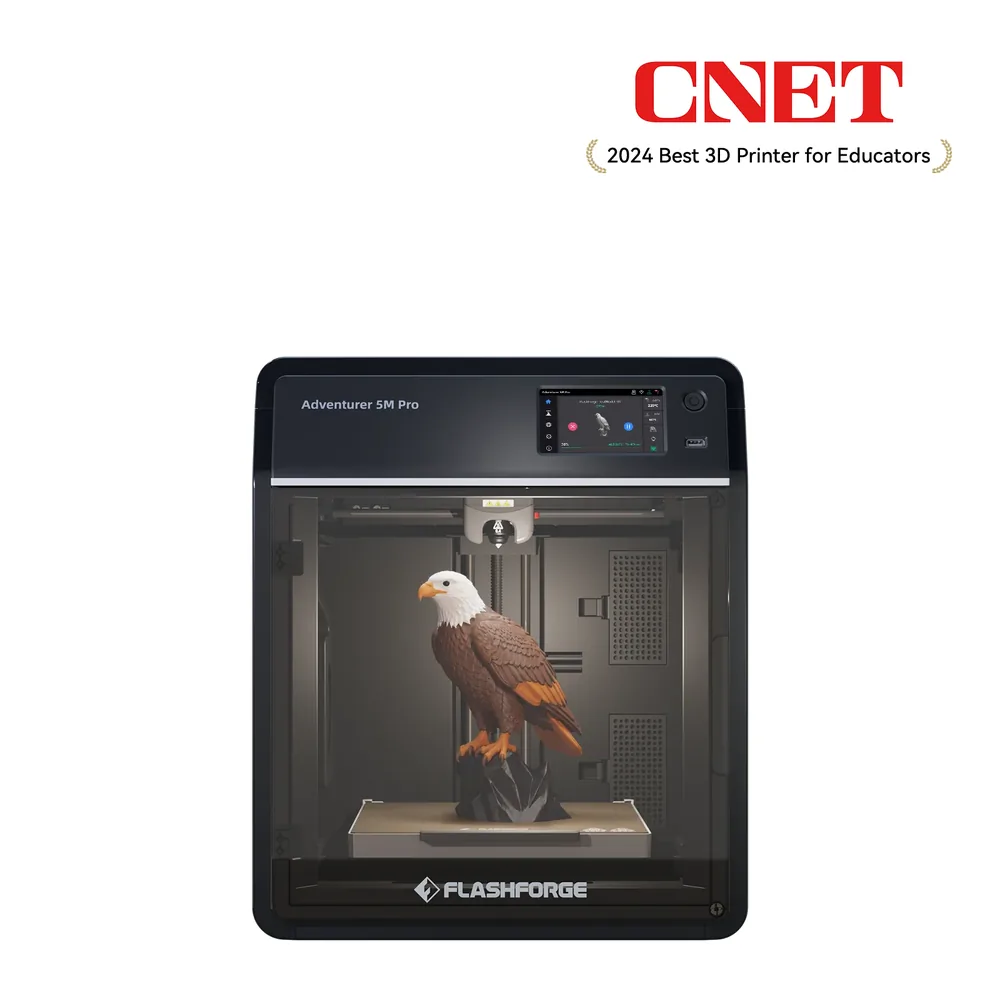
The short answer
Pick the AD5X if multicolor printing matters from day one, with the built-in IFS system for 4 colors and a hotend advertised up to 300°C, accepting an open frame. Pick the Adventurer 5M Pro if an enclosed chassis with dual HEPA and activated-carbon filtration, a built-in camera, and documented ABS/ASA compatibility matter more than multicolor.
Documentary comparison of manufacturer specifications. Not personally tested.
Choose the Flashforge AD5X if…
- A built-in IFS multicolor system, no external box to add, for up to 4 colors or materials per Flashforge.
- A hotend advertised up to 300°C, above the Adventurer 5M Pro's 280°C.
- Documented TPU95A and TPU64D-75D compatibility, alongside PLA, PETG, PLA-CF, and PETG-CF.
- A built-in filament cutter and WiFi, Ethernet, and USB connectivity per Flashforge.
Choose the Flashforge Adventurer 5M Pro if…
- An enclosed chassis with dual HEPA and activated-carbon filtration, built for ABS and ASA indoors.
- A monitoring camera built into the base machine, a feature absent from the AD5X's listing.
- A quick-detach nozzle system (0.25/0.4/0.6/0.8mm), with ABS, ASA, TPU, PLA-CF, and PETG-CF documented depending on the nozzle used.
- The same volume and CoreXY chassis as the AD5X and Adventurer 5M, for a shared baseline to compare.
Specifications side by side
| Specification | Flashforge AD5X | Flashforge Adventurer 5M Pro |
|---|---|---|
| Technology | Filament (FDM) | Filament (FDM) |
| Build volume | 220 × 220 × 220 mm (8.7 × 8.7 × 8.7 in) | 220 × 220 × 220 mm (8.7 × 8.7 × 8.7 in) |
| Enclosure | Open frame | Enclosed |
| Claimed top speed | 600 mm/s | 600 mm/s |
| Claimed acceleration | 20,000 mm/s² | 20,000 mm/s² |
| Max nozzle temperature | 300 °C (572 °F) | 280 °C (536 °F) |
| Max bed temperature | 110 °C (230 °F) | 100 °C (212 °F) |
| Multicolor | Built-in IFS (Intelligent Filament System), no external box, for up to 4 colors or materials per Flashforge. | Single extruder; no stock multicolor system per Flashforge. |
| Materials | PLA, PETG, TPU95A, TPU64D-75D, PLA-CF, and PETG-CF per Flashforge. | PLA, PETG, ABS, and ASA with the 0.4mm nozzle; TPU, PLA-CF, and PETG-CF with the 0.6 or 0.8mm nozzle per Flashforge. |
| Screen | 4.3-inch touchscreen | 4.3-inch touchscreen |
| Connectivity | Wi-Fi, Ethernet, USB | Wi-Fi, Ethernet, USB |
| Listed features | Auto bed leveling, filament runout sensor, filament cutter | Auto bed leveling, filament runout sensor, built-in air filtration |
| Printer dimensions | — | 380 × 400 × 453 mm (15 × 15.7 × 17.8 in) |
| Built-in camera | — | Yes |
— : not listed by the manufacturer on the pages we reviewed.
Multicolor and enclosure
The AD5X adds the IFS (Intelligent Filament System) directly into the Adventurer 5M's chassis, with no external box to set up alongside it per Flashforge, at the same 220 × 220 × 220 mm nominal build volume. Each color transition consumes and purges some filament, worth factoring in for highly detailed parts.
The Adventurer 5M Pro does the opposite: it keeps a single extruder with no stock multicolor system per Flashforge, but encloses the same CoreXY chassis in a sealed shell with dual HEPA and activated-carbon filtration, built to block a large share of particulates and volatile compounds.
Materials, temperatures and enclosure
The AD5X's nozzle heats up to 300°C per Flashforge, up from the Adventurer 5M Pro's 280°C, and its bed reaches 110°C versus 100°C. The listing advertises compatibility with PLA, PETG, TPU95A, TPU64D-75D, PLA-CF, and PETG-CF.
The Adventurer 5M Pro compensates with its enclosed chassis: PLA and PETG run with the 0.4mm nozzle, and ABS, ASA, TPU, PLA-CF, and PETG-CF are added with the 0.6 or 0.8mm nozzle per Flashforge. Without an enclosure, ABS and ASA aren't among those listed for the AD5X.
Everyday features
The Adventurer 5M Pro ships with a built-in monitoring camera per Flashforge, a feature the AD5X's listing doesn't mention. Both share a 4.3-inch touchscreen, power-loss recovery, and auto bed leveling.
On connectivity, both machines advertise WiFi, Ethernet, and USB. The AD5X adds a built-in filament cutter to its listing, useful for the frequent changes tied to the IFS multicolor system.
What to check before buying
The number of spools included with the AD5X and the exact box contents aren't specified on the manufacturer's listing: check the retailer's page, along with replacement filters and nozzles for the Adventurer 5M Pro.
To choose between the two, the multicolor buying guide covers what a built-in system like the IFS adds, and the enclosed 3D printer guide explains the value of a filtered enclosure for ABS and ASA.
Sources
- Flashforge — AD5X tech specs (flashforge.com)
- Flashforge — Adventurer 5M Pro tech specs (flashforge.com)
- How we compare printers
Published 2026-09-28, updated 2026-09-28.