
PETG vs ABS: Which One for Heat, Impacts, and Your Enclosure
PETG and ABS both answer needs that go "beyond PLA," but for different reasons. One is easy to print and shrugs off moisture, the other handles heat better but demands an enclosure and stronger ventilation.
Find My 3D Printer editorial team·Published September 16, 2026·Manufacturer documentation, no hands-on tests claimed

The short answer
PETG prints easily, needs no enclosure, and resists moisture well, but it softens above roughly 80 degrees C per Prusa. ABS handles heat and mechanical stress better, but needs a warm, enclosed environment to avoid warping, plus a ventilated room because of fumes. The choice mostly comes down to the service temperature a part needs to survive and whether your printer has an enclosure.
PETG and ABS solve different problems
PLA covers most decorative prints and quick prototypes, but it softens quickly under heat and does not hold up well to repeated impacts. PETG and ABS exist to go beyond those limits, each with its own logic.
PETG leans on simplicity: it prints almost as easily as PLA, with no enclosure required, while gaining impact and moisture resistance. ABS leans on heat tolerance and mechanical toughness, at the cost of a more demanding print.
A few real scenarios help decide: a garage storage bin left outside through summer, a fan mount near a heat source, or a case meant to survive repeated drops each point toward a different priority, whether that is ease of printing, heat, or impact resistance.
Mechanical strength and outdoor use
PETG tolerates moisture and occasional bad weather well, making it a reasonable pick for a part left outside part of the year, as long as temperatures stay moderate. Its relative flexibility also lets it absorb an impact rather than snapping outright, unlike a stiffer material.
ABS, stiffer and stronger in tension per Prusa, suits mechanical parts under continuous stress better, such as a housing exposed to vibration. Left outdoors long-term, it yellows and grows more brittle over time, which often pushes makers toward ASA, described as a more UV-resistant successor.
Comparing heat tolerance
According to Prusa's Knowledge Base, PETG holds up well to temperature up to roughly 80 degrees C, which is fine for everyday indoor use but gets marginal for a part left in a hot car in summer or placed near a heat source.
ABS, by contrast, is described by Prusa as a technical material suited to mechanically stressed parts thanks to its better high-temperature resistance. For a part that must stay rigid above 80 degrees C, ABS or ASA remain the better-documented choices.
Enclosure, warping, and ventilation
PETG has the advantage of not needing an enclosure: Prusa notes it does not shrink or warp significantly thanks to its low thermal expansion, which makes it suitable for open-frame printers as well as enclosed ones.
ABS, documented by Prusa as prone to significant warping, needs a printer inside an enclosure with a higher ambient temperature to keep that defect in check. It also releases fumes that call for a well-ventilated room, though without a direct draft on the part itself, unlike PETG, which does not carry this same constraint per the same documentation.
Stringing, odor, and ease of printing
PETG's main printing flaw is stringing: Prusa recommends fixing it with higher retraction and a lower nozzle temperature. That is a simple fix compared with the trade-offs often needed to tame ABS.
ABS releases fumes during printing and therefore needs a ventilated room; PETG carries no such fume-related ventilation requirement. For a printer set up in a shared apartment or a living space, this often weighs as much as the mechanical question in the final choice.
Post-processing: acetone vapor smoothing
ABS can be smoothed with acetone vapor for a glossy finish, or sanded dry and then wet, which is why it remains popular for parts where final appearance matters as much as function. PETG does not smooth this way: its surface stays as printed, aside from ordinary sanding.
Acetone vapor treatment should stay an occasional, well-ventilated task, never a casual one: the fumes are flammable and irritating, which is why this work belongs outdoors or under a fume hood rather than in a closed room. Gloves and eye protection are worth the extra minute regardless of how small the part is.
Recommended temperatures and build surface
The two materials are not set up the same way. For PETG, Prusa recommends a nozzle at 230 degrees C (446 degrees F) for the first layer and 240 degrees C (464 degrees F) afterward, with a bed at 85 then 90 degrees C (185 then 194 degrees F), and strongly advises a textured or satin sheet: on smooth PEI, PETG grips so hard it can damage the surface. For ABS, the same documentation lists a nozzle at 255 degrees C (491 degrees F) and a bed at 100 degrees C (212 degrees F), adjustable between 80 and 110 degrees C depending on the object's size, on a smooth or textured PEI sheet with glue stick.
Those figures come from Prusa's own profiles and are a starting point, not a universal truth: every filament maker publishes its own ranges, and a temperature tower remains the most reliable way to fine-tune. The choice of PEI build plate matters too, since a smooth sheet damaged by PETG is one of the most common beginner mishaps.
Shrinkage, bridges, supports: what each one prints poorly
ABS shrinks slightly as it cools: Prusa puts that shrinkage factor at roughly 1 to 2 percent and recommends printing a test object to compare against the source model before committing to a precision-fit part. PETG, by contrast, has very little thermal expansion and therefore suits large single-piece models better, as well as watertight parts thanks to its excellent layer adhesion.
PETG has its own weaknesses documented by Prusa: poor bridging and overhangs, supports that are hard to remove, and a weaker showing on highly detailed parts. ABS, on the other hand, sands and glues easily but yellows and turns brittle outdoors. Without an enclosure, Prusa suggests a simple workaround for ABS: turning on the draft shield in the slicer, which keeps the model slightly warmer and mitigates warping, though it does not replace a real enclosure for a wide part.
So, PETG or ABS for your part?
For an everyday part exposed to moisture, without extreme heat requirements, PETG remains the simpler choice: it prints on most machines, including open-frame setups such as some configurations of the Bambu Lab P1S or the Creality K1C.
For a mechanical part exposed to heat, or one that must take repeated impacts in a warm environment, ABS remains the better-documented option, provided you have an enclosure and a ventilated room. When in doubt, comparing the material guides first and checking whether the target printer's spec sheet lists an enclosure avoids a disappointing purchase.
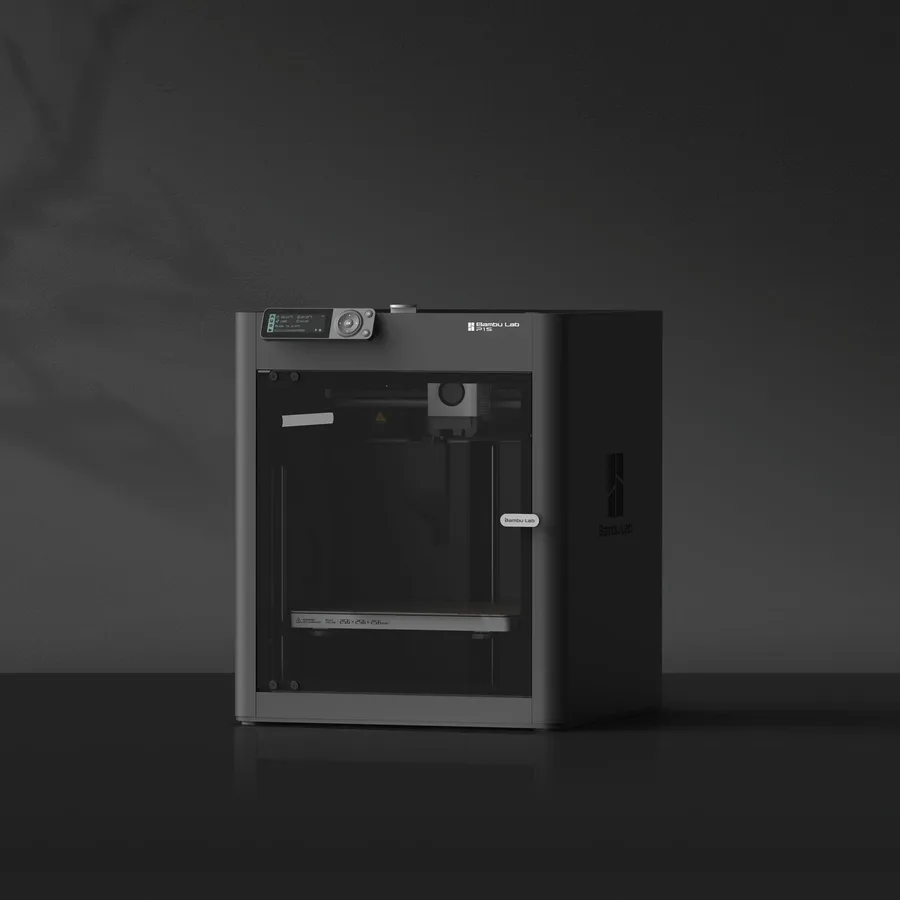
Bambu Lab P1S
256 × 256 × 256 mm
The same nominal volume as the A1, with an enclosure and a different motion system.
Check the precise AMS version, adapters and accessories included. Enclosure alone does not establish material suitability.
Specifications and sellerCreality K1C 2025
220 × 220 × 250 mm
An enclosed format with different dimensions from 256 mm printers; manufacturer-specified hotend up to 300°C.
Distinguish the original K1C from K1C 2025. Check accessories and regional delivery before ordering; check the exact bundle in the manufacturer’s US listing.
Specifications and sellerSources and limits
- Prusa Knowledge Base — PETG
- Prusa Knowledge Base — ABS
We organize manufacturer and community documentation; we have not measured these products ourselves. The manual for your exact model takes precedence over general guidance.
A clearer shortlist starts with your projects.
Use the free buying checklist and budget worksheet before comparing offers.