
Head-to-head comparison
Bambu Lab X2D vs H2D: which dual-nozzle printer to pick?
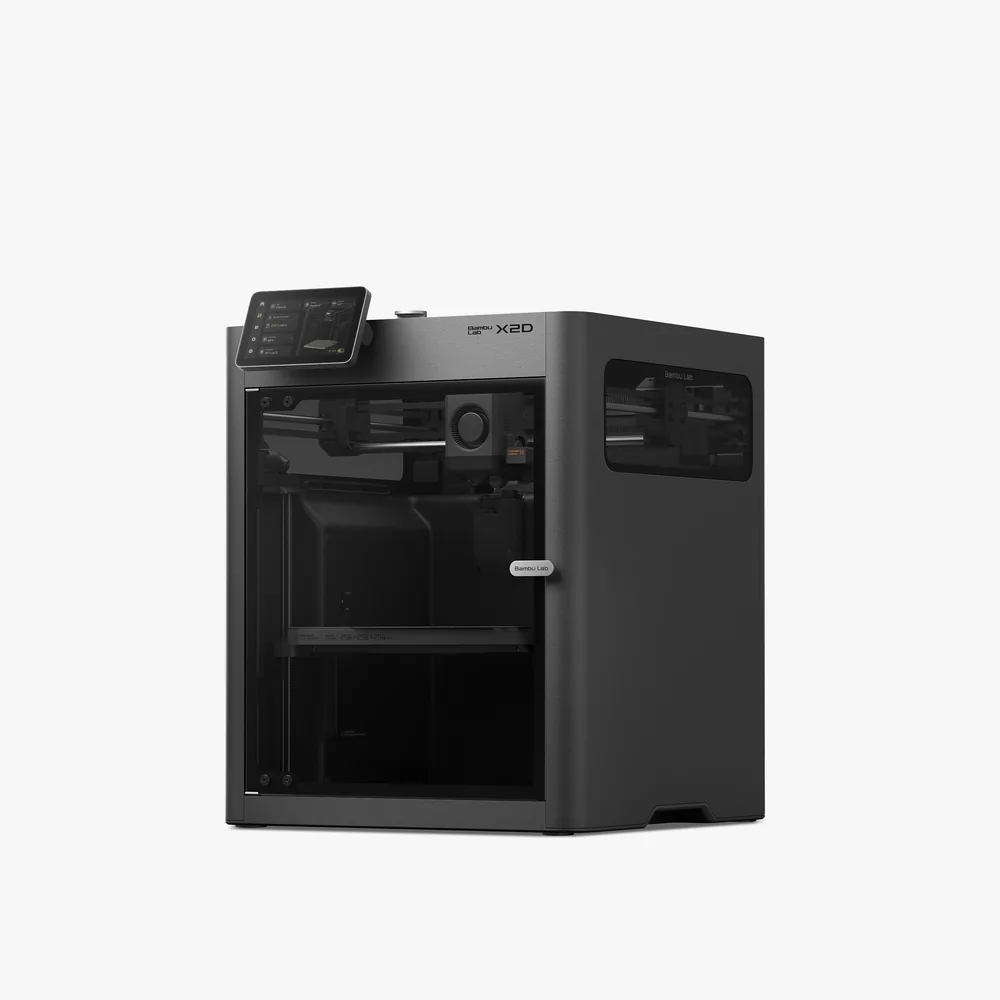
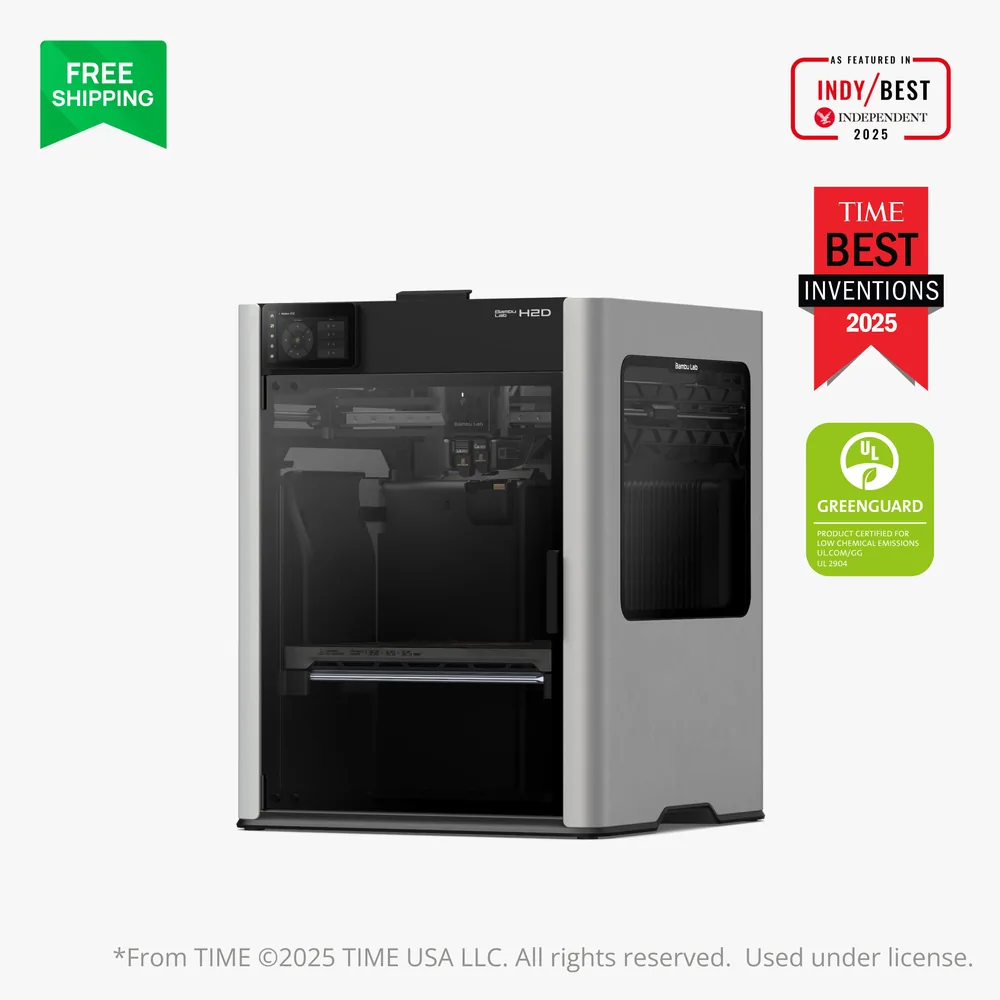
The short answer
Pick the X2D for a compact printer, 392 × 406 × 478 mm at 16.25 kg, whose second nozzle Bambu Lab mainly promotes for support, while full multicolor runs through an AMS advertising up to 25 colors. Pick the H2D for two nozzles designed to combine materials or colors, a 350°C nozzle compatible with TPU and composites, and an optional laser, in a much larger machine.
Documentary comparison of manufacturer specifications. Not personally tested.
Choose the Bambu Lab X2D if…
- A much smaller footprint and weight: 392 × 406 × 478 mm and 16.25 kg versus 492 × 514 × 626 mm and 31 kg for the H2D.
- Up to 25 colors advertised via AMS 2 Pro or HT AMS, versus 16 colors advertised on the H2D.
- PLA, PETG, ABS, ASA, and PA explicitly listed compatible with a 300°C nozzle and a 65°C chamber.
Choose the Bambu Lab H2D if…
- Two nozzles designed to combine two materials or two colors on the same part, in a much larger build volume.
- A nozzle advertised up to 350°C versus 300°C on the X2D, plus hardened nozzles for CF/GF composites and TPU on top.
- An optional laser or cutting module, 10W or 40W, not documented on the X2D sheet.
- A notably larger nominal volume, up to 350 × 320 × 320 mm versus 256 × 256 × 260 mm for the X2D.
Specifications side by side
| Specification | Bambu Lab X2D | Bambu Lab H2D |
|---|---|---|
| Technology | Filament (FDM) | Filament (FDM) |
| Build volume | 256 × 256 × 260 mm (10.1 × 10.1 × 10.2 in) | 350 × 320 × 320 mm (13.8 × 12.6 × 12.6 in) |
| Printer dimensions | 392 × 406 × 478 mm (15.4 × 16 × 18.8 in) | 492 × 514 × 626 mm (19.4 × 20.2 × 24.6 in) |
| Weight | 16.3 kg (35.8 lb) | 31 kg (68.3 lb) |
| Enclosure | Enclosed, active heating up to 65 °C (149 °F) | Enclosed, active heating up to 65 °C (149 °F) |
| Claimed top speed | 1,000 mm/s | 1,000 mm/s |
| Claimed acceleration | 20,000 mm/s² | 20,000 mm/s² |
| Max nozzle temperature | 300 °C (572 °F) | 350 °C (662 °F) |
| Max bed temperature | 120 °C (248 °F) | 120 °C (248 °F) |
| Nozzles | 2 (multi-nozzle) | 2 (multi-nozzle) |
| Multicolor | An auxiliary nozzle that Bambu Lab mainly promotes for support, alongside the main nozzle; an AMS 2 Pro or HT AMS is a separate accessory for full multicolor, up to 25 colors per Bambu Lab. | Compatible with the AMS 2 Pro for multicolor printing, sold separately or bundled in a Combo. |
| Materials | PLA, PETG, ABS, ASA, PA, and engineering filaments thanks to a 300°C nozzle and a 65°C actively heated chamber per Bambu Lab. | PLA, PETG, ABS, ASA, TPU, PC, and PA per Bambu Lab, hardened nozzles for CF/GF composites, chamber actively heated to 65°C. |
| Screen | 5-inch touchscreen | 5-inch touchscreen |
| Built-in camera | Yes | Yes |
| Connectivity | Wi-Fi, USB | Wi-Fi, USB |
| Listed features | Filament runout sensor, filament cutter, built-in air filtration | Filament runout sensor, filament cutter, built-in air filtration |
— : not listed by the manufacturer on the pages we reviewed.
Build volume and footprint
The X2D stays a compact machine: 392 × 406 × 478 mm at 16.25 kg, with a nominal volume of 256 × 256 × 260 mm on its main nozzle. The H2D takes up notably more space, 492 × 514 × 626 mm at 31 kg, nearly double the X2D's weight.
The H2D's volume climbs to 350 × 320 × 320 mm when both nozzles work together on the same part, versus 235.5 × 256 × 256 mm for the X2D in dual-nozzle mode. The size gap between the two machines is real, not just a matter of nozzle count.
Two nozzles, two headline roles
Both spec sheets list two nozzles. On the X2D, Bambu Lab promotes the auxiliary nozzle for support: the main nozzle prints the part, the auxiliary one prints the support, which comes off more easily. Its sheet also lists PLA, PETG, ABS, ASA, and TPU for that nozzle, but the build volume drops to 235.5 × 256 × 256 mm in dual-nozzle mode. On the H2D, both nozzles are presented as full print nozzles, meant to combine two materials or two colors on the same part.
That distinction matters before comparing the sheets side by side: a buyer after dual-material printing and a large build volume should look at the H2D, while the X2D mainly targets easier support removal in a compact printer.
Materials, temperatures and enclosure
Both machines share a 120°C bed and a chamber actively heated to 65°C, but not the same nozzle: 300°C advertised for the X2D versus 350°C for the H2D. Bambu Lab lists PLA, PETG, ABS, ASA, and PA for the X2D.
The H2D goes further with TPU and PC on top, plus hardened nozzles for carbon- or glass-fiber composites: a hotter nozzle opens the door to more technical materials.
Multicolor
On the X2D, full multicolor printing runs through a separate AMS 2 Pro or HT AMS, with up to 25 colors advertised by Bambu Lab. On the H2D, the two nozzles can already combine two materials or colors without an AMS, and the machine reaches up to 16 advertised colors once an AMS 2 Pro is added.
The multicolor buying guide helps decide between an AMS-based system and a dual nozzle depending on how many colors you need and your budget for accessories.
Everyday features
Both sheets document a 5-inch touchscreen, a camera, Wi-Fi and USB connectivity, a filament sensor and cutter, and air filtration. The optional laser module is documented only on the H2D sheet.
Before buying, compare the full spec sheets of the X2D and the H2D, especially the bundle contents (AMS, high-temperature nozzles, laser) a retailer lists.
Sources
- Bambu Lab — fiche technique X2D (bambulab.com)
- Bambu Lab — fiche technique H2D (bambulab.com)
- How we compare printers
Published 2026-09-28, updated 2026-09-28.