
For large-format Klipper with Wi-Fi
Elegoo Neptune 4 Plus
An open-frame FDM printer with a 320 × 320 × 385 mm nominal build volume, Klipper firmware pre-installed, and Wi-Fi connectivity per Elegoo.
In short The Elegoo Neptune 4 Plus is an open-frame filament (FDM) 3D printer with a 320 × 320 × 385 mm (12.6 × 12.6 × 15.2 in) build volume. Elegoo claims a 500 mm/s top speed, a 300 °C (572 °F) nozzle and a 100 °C (212 °F) bed; the printer measures 578 × 533 × 640 mm (22.8 × 21 × 25.2 in) and weighs 14.4 kg (31.7 lb).
Documentary analysis · Not personally tested
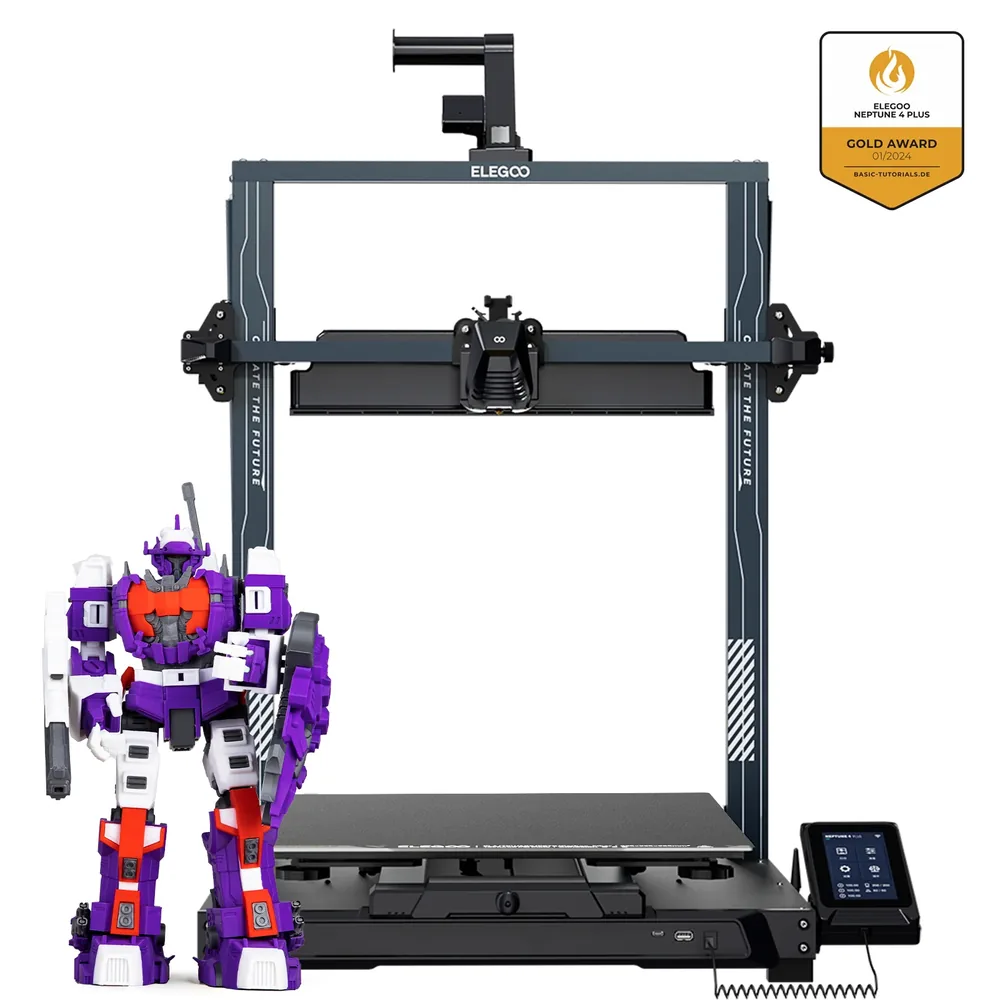 FDM · Open frame
Why consider it?
A 320 × 320 × 385 mm volume, X/Y acceleration sensors for automatic resonance calibration, 121-point leveling, and Wi-Fi, USB, and LAN connectivity per Elegoo.
What to verify
A bed this size heats up more slowly than a 225 mm footprint; the chassis stays open, so ABS and ASA need a separate enclosure.
Elegoo Neptune 4 Plus specifications
- Technology
- Filament (FDM)
- Build volume
- 320 × 320 × 385 mm (12.6 × 12.6 × 15.2 in)
- Printer dimensions
- 578 × 533 × 640 mm (22.8 × 21 × 25.2 in)
- Weight
- 14.4 kg (31.7 lb)
- Enclosure
- Open frame
- Claimed top speed
- 500 mm/s
- Claimed acceleration
- 12,000 mm/s²
- Max nozzle temperature
- 300 °C (572 °F)
- Max bed temperature
- 100 °C (212 °F)
- Multicolor
- No multicolor system; this model stays monochrome like the rest of the Neptune 4 lineup.
- Materials
- PLA, TPU, PETG, ABS, ASA, and nylon with a nozzle advertised up to 300°C; ABS and ASA are recommended with an enclosure sold as an accessory.
- Connectivity
- Wi-Fi, USB
- Listed features
- Auto bed leveling, filament runout sensor
How much space does it need?
The Elegoo Neptune 4 Plus measures 578 × 533 × 640 mm (22.8 × 21 × 25.2 in) for a 320 × 320 × 385 mm (12.6 × 12.6 × 15.2 in) build volume: the dashed box is the printer, the solid cube the nominal build volume, about 20% of the machine’s volume. Add room for the spool or multicolor unit, cables and ventilation.
Source: official Elegoo pages (fr.elegoo.com), checked September 28, 2026. Manufacturer claims, not our measurements. Build volume is nominal: orientation, supports and reserved zones can reduce the usable space.
Which projects is it for?
The Neptune 4 Plus carries over the Neptune 4's Klipper architecture with a 320 × 320 × 385 mm nominal build volume per Elegoo, versus 225 × 225 × 265 mm on the standard model. It suits larger parts, multiple batches on one plate, and projects that need extra room without jumping to an industrial format.
The advertised speed reaches 500 mm/s with acceleration up to 12,000 mm/s², a notch below the base Neptune 4 on that specific spec, which tracks with a larger bed having more mass to move.
Materials and setup
Like the rest of the lineup, this machine advertises a nozzle heating up to 300°C, compatible with PLA, TPU, PETG, ABS, ASA, and nylon per Elegoo. The titanium-alloy throat and dual-gear direct extruder aim for consistent extrusion despite the speed.
Acceleration sensors on the X and Y axes enable automatic resonance calibration, a feature missing on the standard Neptune 4, useful on a larger chassis where vibrations are more noticeable.
What the bundle includes or not
The box includes the base unit, gantry, spool holder arm, touch screen, and spiral cable per Elegoo's "What's In Box" list, with further items not detailed, 11 and up in total. The exact contents should be checked on the retailer's listing before buying.
Unlike the base Neptune 4, this version adds Wi-Fi alongside USB and LAN, with remote web control per Elegoo; there is still no built-in camera, however.
Alternatives to compare
For an even larger footprint, the Neptune 4 Max pushes the volume to 420 × 420 × 480 mm on the same architecture. For a tighter budget on a smaller bed, the Neptune 4 or Neptune 4 Pro remain the direct comparisons.
The functional parts guide and the beginner's buying guide help judge whether this volume is actually needed for your projects.
Similar printers to compare
Sources and limits
- Source: official Elegoo pages (fr.elegoo.com), checked September 28, 2026. Manufacturer claims, not our measurements.
- How we assess specifications
We have not measured noise, real printing speed, accuracy or reliability, so none of these is rated here.