
For a large volume with a tool changer
Prusa Research XL+
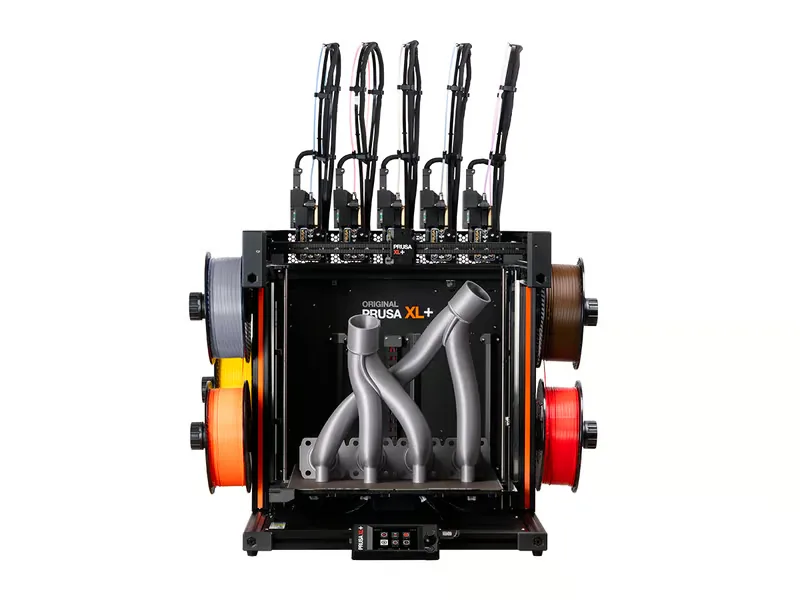
An open-frame FDM printer with up to 5 interchangeable toolheads and a 360 × 360 × 360 mm build volume: the current XL+ from Prusa Research, shown here in single-tool configuration.
In short The Prusa XL+ is an open-frame filament (FDM) 3D printer with a 360 × 360 × 360 mm (14.2 × 14.2 × 14.2 in) build volume. Prusa Research claims a 290 °C (554 °F) nozzle and a 120 °C (248 °F) bed; the printer measures 700 × 720 × 900 mm (27.6 × 28.3 × 35.4 in) and weighs 27.9 kg (61.5 lb).
Documentary analysis · Not personally tested
 FDM · Open frame
Why consider it?
A tool changer that scales from 1 to 5 toolheads, a 16-zone segmented heatbed to limit warping, and the + revision brings faster calibration and 10-15% faster printing per Prusa Research.
What to verify
Open frame by default with no active chamber heating; the optional enclosure is needed to stabilize temperature for technical materials, and Prusa Research doesn't publish a maximum speed or acceleration figure.
Prusa XL+ specifications
- Technology
- Filament (FDM)
- Build volume
- 360 × 360 × 360 mm (14.2 × 14.2 × 14.2 in)
- Printer dimensions
- 700 × 720 × 900 mm (27.6 × 28.3 × 35.4 in)
- Weight
- 27.9 kg (61.5 lb)
- Enclosure
- Open frame
- Max nozzle temperature
- 290 °C (554 °F)
- Max bed temperature
- 120 °C (248 °F)
- Multicolor
- Up to 5 automatic toolheads (tool changer) on multi-tool versions; this listing covers the single-tool, one-head version.
- Materials
- PLA, PETG, ASA, ABS, PC, PA, TPU/Flex, and composite materials per Prusa Research, with soluble supports possible by dedicating a toolhead.
- Screen
- 3.5-inch screen
- Connectivity
- Wi-Fi, USB
- Listed features
- Auto bed leveling, filament runout sensor
How much space does it need?
The Prusa XL+ measures 700 × 720 × 900 mm (27.6 × 28.3 × 35.4 in) for a 360 × 360 × 360 mm (14.2 × 14.2 × 14.2 in) build volume: the dashed box is the printer, the solid cube the nominal build volume, about 10% of the machine’s volume. Add room for the spool or multicolor unit, cables and ventilation.
Source: official Prusa Research pages (prusa3d.com), checked September 28, 2026. Manufacturer claims, not our measurements. Build volume is nominal: orientation, supports and reserved zones can reduce the usable space.
Which projects is it for?
The XL+ is the current version of the Prusa XL: the product page that used to list the XL now shows this model, with an open frame and a 360 × 360 × 360 mm build volume per Prusa Research. This listing covers the single-tool (one-head) configuration; the machine also ships with 2 to 5 automatically interchangeable toolheads depending on what you buy.
The tool changer targets large single-piece parts and, on multi-head versions, multi-material prints without manual filament swaps. Prusa Research lists faster calibration and 10-15% faster printing than the previous XL generation.
Materials and setup
Prusa Research lists a Nextruder hotend up to 290°C and a heatbed segmented into 16 independent zones reaching up to 120°C, designed to cut warping on large surfaces. Listed materials are PLA, PETG, ASA, ABS, PC, PA, TPU/Flex, and composites, with soluble supports possible by dedicating a toolhead.
Bed leveling is automatic (Mesh Bed Leveling over the print area). Prusa Research doesn't publish a top print speed or acceleration figure for this machine, unlike the CORE One+.
What the bundle includes or not
Per Prusa Research, box contents depend on the configuration chosen (toolhead count, kit or semi-assembled version); the handbook, online manual access, and power cable are listed in every case. The official printer dimensions, 700 × 900 × 720 mm at 27.9 kg for the single-tool version, include the side spool holders and the separate top enclosure cover.
The enclosure that stabilizes temperature up to 50°C (60°C with an external heater module) is sold separately, as is a Wi-Fi module that Prusa Research lets you remove on request.
Alternatives to compare
For a natively enclosed chamber at a more modest volume, the CORE One+ is the comparison at Prusa Research, along with the CORE One L+ for a middle ground with a 60°C heated chamber.
The multicolor buying guide helps compare a tool changer like the XL+'s against a spool-based AMS or MMU system.
Similar printers to compare
Sources and limits
- Source: official Prusa Research pages (prusa3d.com), checked September 28, 2026. Manufacturer claims, not our measurements.
- How we assess specifications
We have not measured noise, real printing speed, accuracy or reliability, so none of these is rated here.