
For workshops and businesses
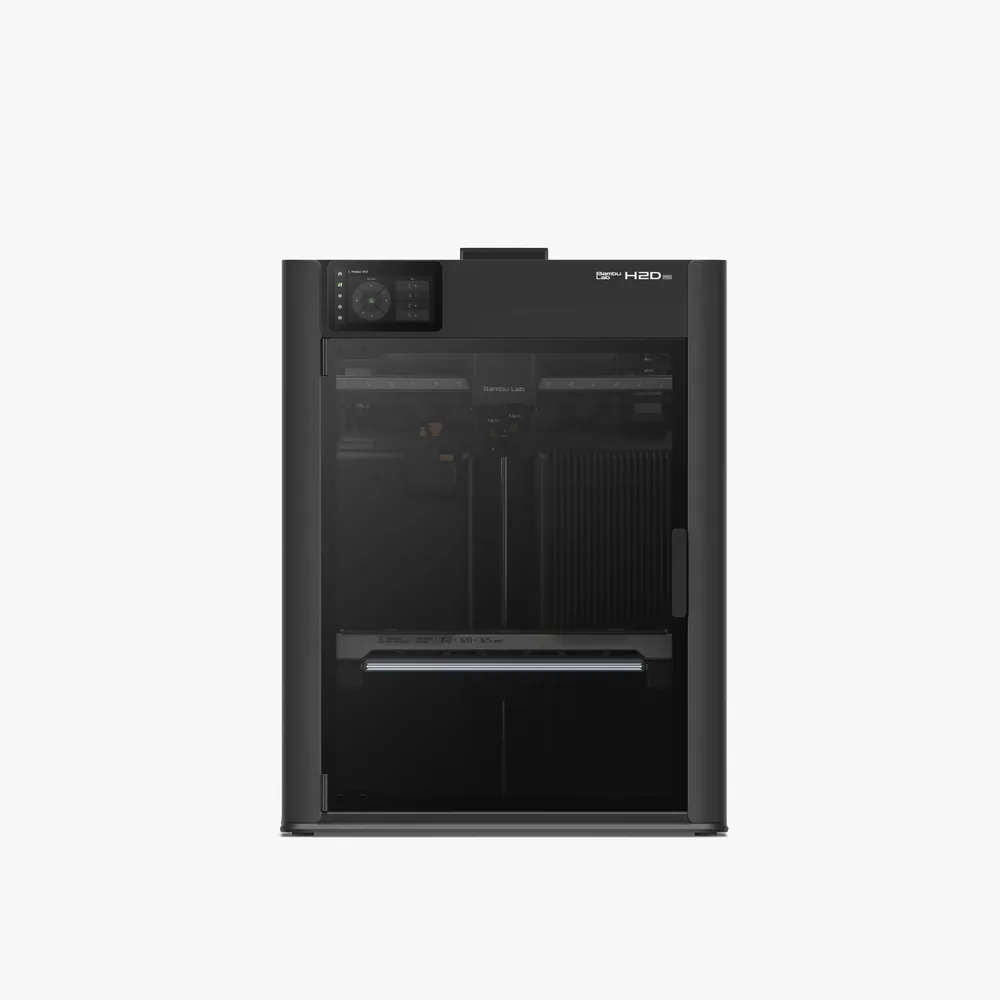
Bambu Lab H2D Pro
An enclosed dual-nozzle FDM printer (350 × 320 × 320 mm total) derived from the H2D for professional use: Ethernet, enterprise Wi-Fi and a tungsten carbide nozzle.
In short The Bambu Lab H2D Pro is an enclosed filament (FDM) 3D printer with a 350 × 320 × 320 mm (13.8 × 12.6 × 12.6 in) build volume. Bambu Lab claims a 1,000 mm/s top speed, a 350 °C (662 °F) nozzle and active chamber heating to 65 °C (149 °F); the printer measures 492 × 514 × 626 mm (19.4 × 20.2 × 24.6 in) and weighs 31 kg (68.3 lb).
Documentary analysis · Not personally tested
 FDM · Enclosed
Why consider it?
It builds on the H2D and adds what businesses ask for: an Ethernet port, WPA2-Enterprise Wi-Fi, a physical Wi-Fi kill switch, a tungsten carbide nozzle and an optical encoder rated for 50 µm motion accuracy.
What to verify
Positioned for professionals: Bambu Lab points buyers to resellers and a sales contact. Check price, warranty and support before choosing it over a standard H2D.
Bambu Lab H2D Pro specifications
- Technology
- Filament (FDM)
- Build volume
- 350 × 320 × 320 mm (13.8 × 12.6 × 12.6 in)
- Printer dimensions
- 492 × 514 × 626 mm (19.4 × 20.2 × 24.6 in)
- Weight
- 31 kg (68.3 lb)
- Enclosure
- Enclosed, active heating up to 65 °C (149 °F)
- Claimed top speed
- 1,000 mm/s
- Claimed acceleration
- 20,000 mm/s²
- Max nozzle temperature
- 350 °C (662 °F)
- Max bed temperature
- 120 °C (248 °F)
- Nozzles
- 2 (multi-nozzle)
- Multicolor
- Two nozzles and AMS compatibility for multicolor and multi-material prints; check how many AMS units the listing includes.
- Materials
- Engineering and fiber-filled filaments per Bambu Lab profiles; nozzle up to 350 °C and a chamber heated up to 65 °C.
- Screen
- 5-inch touchscreen
- Built-in camera
- Yes
- Connectivity
- Wi-Fi, Ethernet, USB
- Listed features
- Filament runout sensor, filament cutter, built-in air filtration
How much space does it need?
The Bambu Lab H2D Pro measures 492 × 514 × 626 mm (19.4 × 20.2 × 24.6 in) for a 350 × 320 × 320 mm (13.8 × 12.6 × 12.6 in) build volume: the dashed box is the printer, the solid cube the nominal build volume, about 23% of the machine’s volume. Add room for the spool or multicolor unit, cables and ventilation.
Source: official Bambu Lab pages (bambulab.com), checked September 28, 2026. Manufacturer claims, not our measurements. Build volume is nominal: orientation, supports and reserved zones can reduce the usable space.
Compare the Bambu Lab H2D Pro
Which projects is it for?
The H2D Pro targets workshops, engineering teams, schools and businesses that print technical parts in volume and need the printer on a managed network. It keeps the H2D base: two nozzles, 325 × 320 × 325 mm with one nozzle and 350 × 320 × 320 mm total with both.
For a home user the case is weaker: the additions are mostly about connectivity, nozzle durability and claimed motion accuracy. If those do not matter to you, the standard H2D or the H2S cover the same build sizes.
Materials and setup
The nozzle is tungsten carbide: Bambu Lab claims HRA 90 hardness versus 74 for hardened steel, and about 50% longer life with abrasive fiber-filled filaments. The nozzle reaches 350 °C, the bed 120 °C and the chamber is actively heated up to 65 °C, with H12 HEPA and activated carbon filtration.
Another addition is an optical encoder plate that measures movement at 5 µm, which the manufacturer presents as the basis for 50 µm motion accuracy. These are claimed specifications, not measurements by our team.
What the bundle includes or not
On the network side, the H2D Pro adds an Ethernet port, WPA2-Enterprise Wi-Fi authentication (EAP-PEAP, EAP-TLS, EAP-TTLS) and physical switches to cut Wi-Fi, plus 32 GB of internal storage. Bambu Lab also offers help integrating a printer fleet through its resellers.
The exact package (AMS units, laser module, service) varies: ask for a complete quote and compare it with an H2D equipped the same way. The printer weighs 31 kg and measures 492 × 514 × 626 mm, so plan a dedicated stand.
Alternatives to compare
The natural comparison is the H2D, which shares the build volume, both nozzles and the heated chamber. For multicolor printing with less purge, the H2C and its Vortek system are another route.
If space is tight, the X2D keeps two nozzles and a heated chamber in a 256 mm class footprint. Our professional 3D printer guide lists what to check for business use.
Similar printers to compare
Sources and limits
- Source: official Bambu Lab pages (bambulab.com), checked September 28, 2026. Manufacturer claims, not our measurements.
- How we assess specifications
We have not measured noise, real printing speed, accuracy or reliability, so none of these is rated here.