
Elegoo vs Bambu Lab: Centauri Carbon 2 or P2S for CoreXY Speed and Multicolor
Elegoo or Bambu Lab is the question most buyers hit when they want a fast CoreXY printer that can also handle multicolor without a premium budget. This guide compares the Centauri Carbon 2 and the P2S using official product pages, and separates what the makers state from what you still need to check before you buy.
Find My 3D Printer editorial team·Published October 3, 2026·Manufacturer documentation, no hands-on tests claimed

The short answer
Elegoo and Bambu Lab each offer a CoreXY printer aimed at accessible multicolor printing: the Centauri Carbon 2 and the P2S. According to Elegoo's official US store, the Centauri Carbon 2 is a CoreXY multi-material printer sold either alone, with the CANVAS multicolor module as a separate purchase, or as a Combo, for which Elegoo advertises a 350 °C nozzle and an enclosed chamber. Both printers share the same motion system, so real print time depends mostly on hotend flow, cooling, slicer profiles and the number of color changes. The decision comes down to software ecosystem, how you want to buy into multicolor and which materials you plan to print, more than any headline top speed.
What the official pages actually let you compare
Elegoo and Bambu Lab are chasing the same buyer: someone who wants a fast CoreXY machine that prints out of the box, with multicolor on the roadmap. For Bambu Lab, the printer in question is the P2S. For Elegoo, it is the Centauri Carbon 2, which the brand's US store titles a "CoreXY Multi-Material 3D Printer."
This guide draws on Elegoo's official product pages for the Centauri Carbon 2 and its Combo version. They state three things clearly: a CoreXY motion system, a nozzle rated at 350 °C, and an enclosed chamber with what Elegoo calls a Smart Grille. For the P2S, the detailed specs live on the Bambu Lab P2S catalog page. That is why this comparison stays qualitative on the Bambu side instead of quoting numbers nobody has verified.
Keep one limit in mind. Product pages describe what a manufacturer promises, not how a printer behaves after months on your desk. Treat every claim below as the maker's statement, and check the Elegoo Centauri Carbon 2 page for the full spec list before you order.
CoreXY speed: what the design changes and what it does not promise
On a CoreXY printer, the toolhead moves in X and Y using two stationary motors and a crossed belt path. The bed only travels up and down. That keeps the fast-moving mass low compared with a bed slinger, where the whole plate and the part shuttle back and forth. Lower moving mass allows harder acceleration without shaking a tall print loose. The CoreXY vs bed slinger explainer covers the mechanics.
Both printers in this matchup use that layout, so neither starts with a design handicap. The Elegoo page excerpts used here give no usable speed or acceleration figure, and this guide does not repeat one for the P2S either. A top-speed duel would not tell you much anyway.
What you feel day to day is total print time. That depends on how much plastic the hotend can melt, how well the part cooling keeps up, how the slicer profiles are tuned and, in multicolor jobs, how many filament swaps the model needs. A headline speed says nothing about any of that. A better check is to slice the same file with each maker's stock profile and compare the estimated times.
Entry-level multicolor: Elegoo CANVAS versus the Bambu Lab ecosystem
Elegoo's multicolor hardware is a module called CANVAS. The standalone Centauri Carbon 2 listing is blunt about it: the printer is "Multicolor Upgrade Ready" and CANVAS is sold separately. The Combo listing is pitched as a multicolor printer from day one, and the US store also offers it with a 4 kg PLA Basic bundle on a refillable spool. So you can start in single color and add the module later, or buy the full kit up front.
Elegoo's warranty table hints at what is inside the module: a feeder motor, a five-way module, a gearbox or cutter assembly, a wiper unit and PTFE tubes. That reads like a motorized feeder that cuts filament and cleans the nozzle between colors. The excerpts used here do not state how many spools it handles.
On the Bambu Lab side, check the P2S page to see which multicolor unit is compatible and whether it is part of the bundle you are looking at. Either way, the same rule applies to any system that swaps filament mid-print: every color change costs time and purge material. A model with many colors per layer burns more filament and more hours than a single-color part of the same size.
350 °C nozzle and enclosed chamber: materials beyond PLA
For the Centauri Carbon 2 Combo, Elegoo leads with a 350 °C nozzle and an enclosed chamber with a Smart Grille, under the tagline "Redefined Material Versatility." That nozzle temperature is far above what PLA and PETG need and points at engineering filaments. The enclosure shields the part from drafts, which are a common trigger for warping on ABS and ASA.
The excerpts used here do not explain how the grille works. Confirm its exact role in Elegoo's documentation before you treat it as a deciding factor.
For the P2S, compare the same items on its catalog page: maximum nozzle temperature, whether the chamber is enclosed, and the officially supported materials. A hot nozzle alone is not enough. Fiber-filled filaments wear brass nozzles quickly, and nylon needs to be dried properly before it prints well. Also remember that no spec sheet is a commitment about how strong a printed part will be. For anything load-bearing or critical, a hobby print is not a substitute for a certified component.
Software, warranty and shipping: the brand-level differences
Brand choice goes beyond the printer. Bambu Lab builds its own slicer, Bambu Studio, and leans on a tightly integrated mix of software, printer and multicolor unit. That is comfortable if you are happy to stay inside that system. With Elegoo, check which slicer the brand recommends for the Centauri series and whether your usual filament profiles already exist there.
Elegoo's US store spells out its warranty part by part. The PEI plate, nozzle, PTFE tube, heater, thermistor and hot end sit in the consumables group. The extruder and printhead kit carry a limited warranty. CANVAS parts are listed separately, including the feeder module motherboard, feeder motor, five-way module, cutter assembly, fan and housing, with a note that damage caused by human error is not covered.
Shipping matters too. Elegoo's US store delivers to the 48 contiguous states and Washington, D.C., ships printers to Hawaii, and does not deliver to P.O. boxes or APO/FPO addresses. Read the exact warranty periods on the seller's page, then run the same line-by-line check with Bambu Lab before you decide.
Which printer fits which buyer
The Centauri Carbon 2 has one simple argument: you can grow into it. Buy the printer alone, learn in single color, then add CANVAS once you know you need it. The Combo skips that step if multicolor is the goal from the first print. The 350 °C nozzle and enclosed chamber Elegoo advertises also leave room to move toward more demanding materials later.
The P2S makes more sense if you want to stay in the Bambu Lab ecosystem or already own another printer from the brand. The habits you build in Bambu Studio carry over from one machine to the next, which saves real time when you run more than one printer.
Then there is budget. Both machines compete for the accessible multicolor buyer, but the real total depends on the bundle, the multicolor unit, the spools and the accessories. Price the whole setup with the startup budget tool instead of comparing two stickers. Then write down your materials, how many colors a typical part needs and how much desk space you have. Those three answers separate these printers better than a spec sheet does.
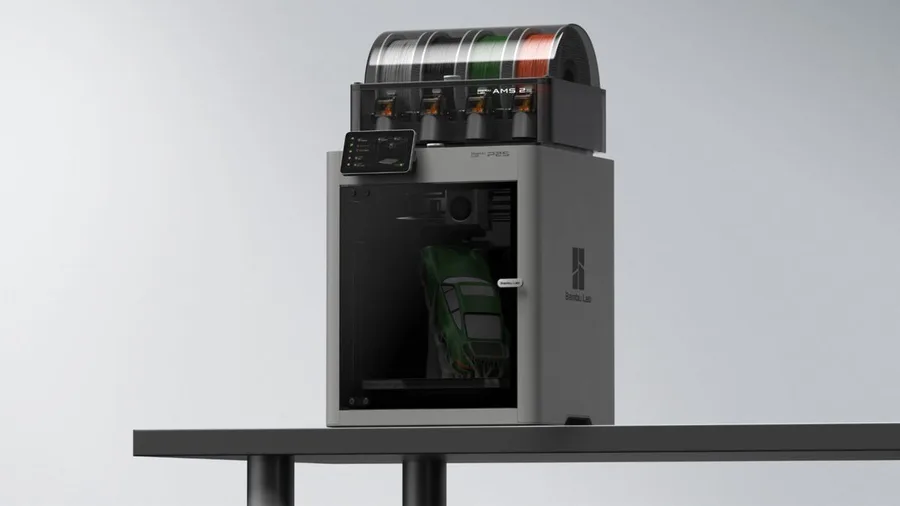
Bambu Lab P2S
256 × 256 × 256 mm
The enclosed frame, hotend up to 300°C and bed up to 110°C support a broader material discussion than an open-frame machine.
AMS 2 Pro and drying capabilities depend on the package selected. Advertised automation is not a measured reliability score.
Specifications and seller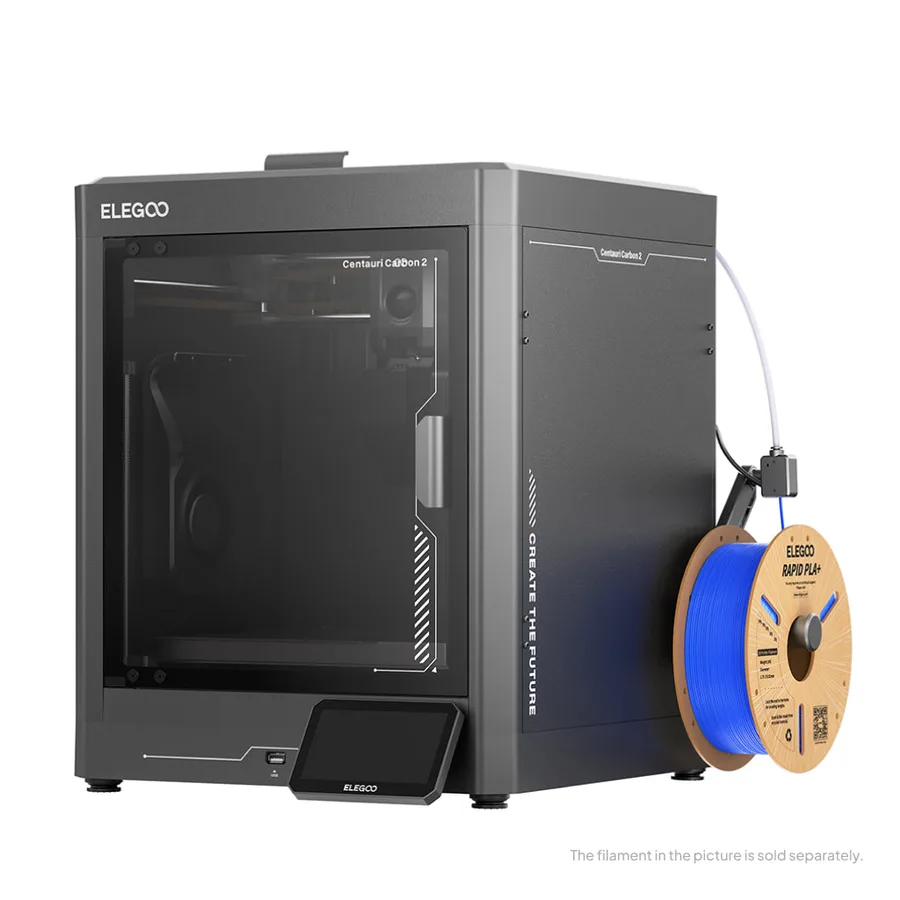
Elegoo Centauri Carbon 2
256 × 256 × 256 mm
Another manufacturer to compare when you need an enclosed machine in the 256 mm build-volume class.
Carbon, Carbon 2 and Carbon 2 Combo are different listings. Confirm the complete package before comparing prices.
Specifications and sellerSources and limits
- Elegoo — Centauri Carbon 2
- Elegoo — Centauri Carbon 2 Combo
We organize manufacturer and community documentation; we have not measured these products ourselves. The manual for your exact model takes precedence over general guidance.
A clearer shortlist starts with your projects.
Use the free buying checklist and budget worksheet before comparing offers.