
Elegoo 3D Printer: Understanding the Lineup and the Brand
Elegoo built its early reputation on affordable resin printers, but the brand's FDM lineup has grown just as wide. This page breaks down both product families, the software that ships with them, and the post-processing gear, so you know where each model actually fits before comparing.
Find My 3D Printer editorial team·Published September 10, 2026·Manufacturer documentation, no hands-on tests claimed

The short answer
Elegoo is a Chinese 3D printer manufacturer that built its name on MSLA resin printers, from the Mars 5 Ultra through the Saturn 4 Ultra 16K and the Jupiter line, before expanding into FDM with the Neptune 4 series, the enclosed Centauri Carbon printers, and the large-format OrangeStorm Giga, per elegoo.com. The brand rounds out its ecosystem with Mercury wash-and-cure stations, its own resins, and several slicing tools. Choosing between resin and FDM, and then between Elegoo's own models, mostly comes down to the job at hand and how much post-processing you're willing to do, not a universal ranking.
Who is Elegoo, and why is the brand tied to resin printing?
Elegoo is a Chinese manufacturer of 3D printers and consumer electronics that has been active in the resin printing space for years before building out its own FDM lineup. Per the "About" page on elegoo.com, the company built its early reputation on accessible MSLA resin printers that helped bring the technology to hobbyists and miniature painters.
That resin-first history is why the brand still gets associated with the process first, even though its FDM catalog has grown considerably with the Neptune and Centauri Carbon series. Elegoo also sells its own resins, Mercury wash-and-cure stations, and several in-house software tools, which makes for a fairly complete ecosystem if you stay within its range.
The Elegoo resin lineup: Mars 5 Ultra, Saturn 4 Ultra 16K, and Jupiter
The Mars 5 Ultra and the Saturn 4 Ultra 16K are two MSLA resin printers with monochrome LCD screens in the current lineup, with a listed build volume of 153.36 x 77.76 x 165 mm for the former and 211.68 x 118.37 x 220 mm for the latter, per the elegoo.com product pages. The Saturn 4 Ultra 16K adds a finer screen resolution, resin-vat heating listed at 30°C, and automatic leveling, features aimed at fine-detail work.
Above those two models, the Jupiter line targets a considerably larger resin build volume, with an automated resin-feeding and heating system per elegoo.com, aimed at bigger parts than the Mars or Saturn are built for. That step up naturally means a heavier investment in resin and post-processing equipment to plan for ahead of time.
Both machines run compatible 405 nm UV resins, with exposure settings tied to each manufacturer profile; getting good detail depends on more than raw build volume, since screen type and backlighting both shape the result for a given profile.
The Elegoo FDM lineup: Neptune 4, Centauri Carbon, and OrangeStorm Giga
On the FDM side, the Neptune series remains the brand's entry point, with open-frame machines sold at several tiers, including the Neptune 4 Pro, which per elegoo.com lists a print speed up to 500 mm/s, a nozzle rated to 300°C, and a Klipper-based control board. Those numbers put it closer to fast FDM printers than to a typical budget machine.
The Centauri Carbon and Centauri Carbon 2 make up the brand's enclosed CoreXY FDM lineup, with a nominal 256 x 256 x 256 mm build volume per our Centauri Carbon and Centauri Carbon 2 catalog pages. Beyond those two, the OrangeStorm Giga is Elegoo's large-format FDM printer, built for parts well beyond what a standard 256 mm CoreXY machine can handle.
The Centauri Carbon is rated for PLA, PETG, and carbon-fiber-reinforced filaments thanks to a hardened-steel nozzle rated up to 320°C per our catalog page, a wider material range than the standard Neptune 4 targets. That material range matters as much as build volume when picking a model within the FDM lineup.
Mercury stations and house resins: post-processing at Elegoo
Elegoo rounds out its resin lineup with the Mercury series of wash-and-cure stations, which combine isopropyl alcohol washing and UV curing in one unit per the elegoo.com product pages. Several versions exist with different capacities and washing modes, worth checking carefully for your exact printer before buying.
The brand also sells its own 405 nm UV resins with dedicated profiles for its printers, without locking you out of compatible third-party resins using the same standard. Our resin post-processing guide covers the washing and curing method and the safety precautions to follow regardless of printer or resin brand.
Elegoo software: Elegoo Slicer, Elegoo Cura, and OrcaSlicer compatibility
On the resin side, Elegoo offers its own slicer alongside documented compatibility with third-party tools like Chitubox and Voxeldance, per Elegoo's software documentation. On the FDM side, the brand ships a dedicated version of Elegoo Cura with printer profiles, plus announced OrcaSlicer compatibility for newer models, worth confirming profile by profile depending on the machine's version.
That two-track approach, an in-house tool alongside a widely used open-source slicer, leaves the choice between a simplified setup and the finer control OrcaSlicer offers. Either way, the shipped profiles are a starting point to fine-tune for the filament or resin you actually use.
Which Elegoo printer fits which job?
If you're after miniatures, figurines, or parts with very fine detail, resin remains the most documented process in Elegoo's lineup, with the Mars 5 Ultra for a compact footprint and the Saturn 4 Ultra 16K for a larger build volume. That choice means accepting routine washing and curing, plus careful handling of liquid resin, a time and equipment investment covered in our resin buying guide.
For functional parts, prototypes, or more general-purpose use, the Neptune or Centauri Carbon FDM lineups suit buyers who'd rather prioritize easy maintenance over extreme detail, choosing between the Neptune's open frame and the Centauri Carbon's enclosed chamber if you print draft-sensitive materials like ABS. Either way, the resin post-processing page and the comparison tool are useful for checking the machines actually covered in our catalog before deciding.
What to check before buying an Elegoo printer
The biggest source of confusion in Elegoo's lineup is telling versions of the same model apart: the European product page for the original Centauri Carbon, for instance, redirected to the Centauri Carbon 2 at the time this page was written, a sign that the lineup moves fast and that you should confirm the exact product on the official listing before buying. The same applies to Mercury stations and bundles like CANVAS, which are sold separately depending on the configuration.
The build volume-to-price ratio comes up often in user feedback on Elegoo products, along with documentation quality, generally described as solid but sometimes less detailed than more established FDM competitors. To compare an Elegoo printer against other brands on the site, check our Mars 5 Ultra, Saturn 4 Ultra 16K, Centauri Carbon, and Centauri Carbon 2 pages, plus the comparison tool and our pages on Prusa or Anycubic.
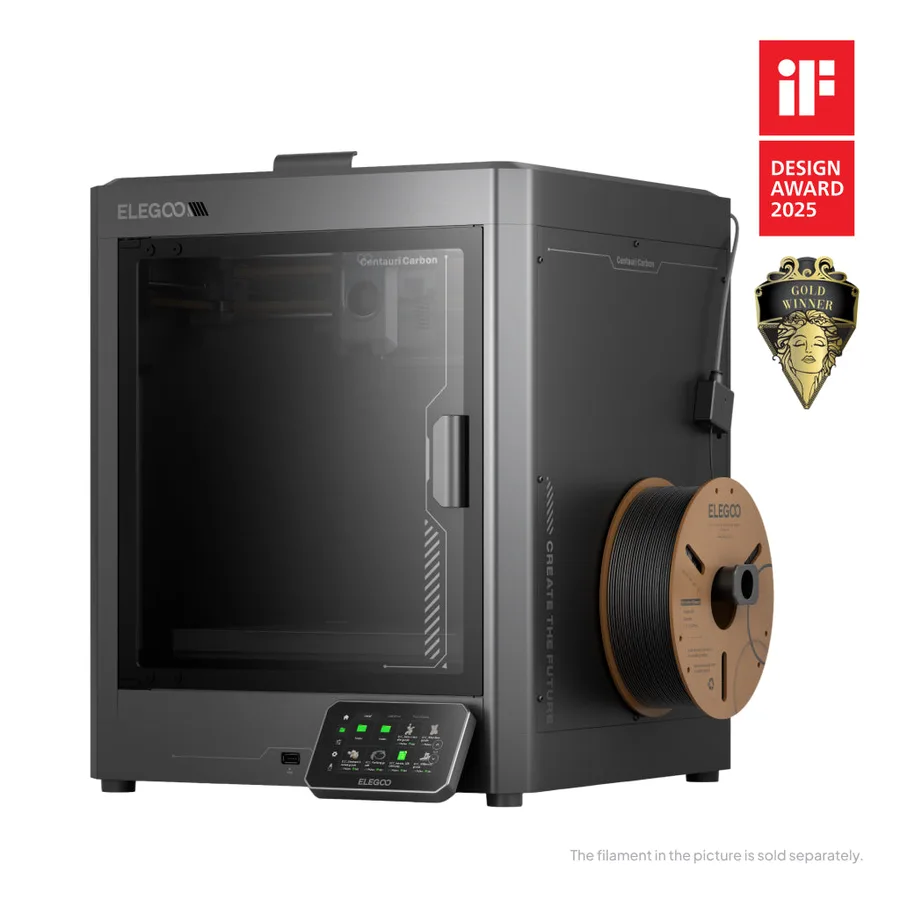
Elegoo Centauri Carbon
256 × 256 × 256 mm
Manufacturer specifications include a 320°C hotend, 110°C bed and automatic calibration.
Do not confuse the original Carbon with Carbon 2. Confirm the exact model and any CANVAS compatibility with the seller.
Specifications and seller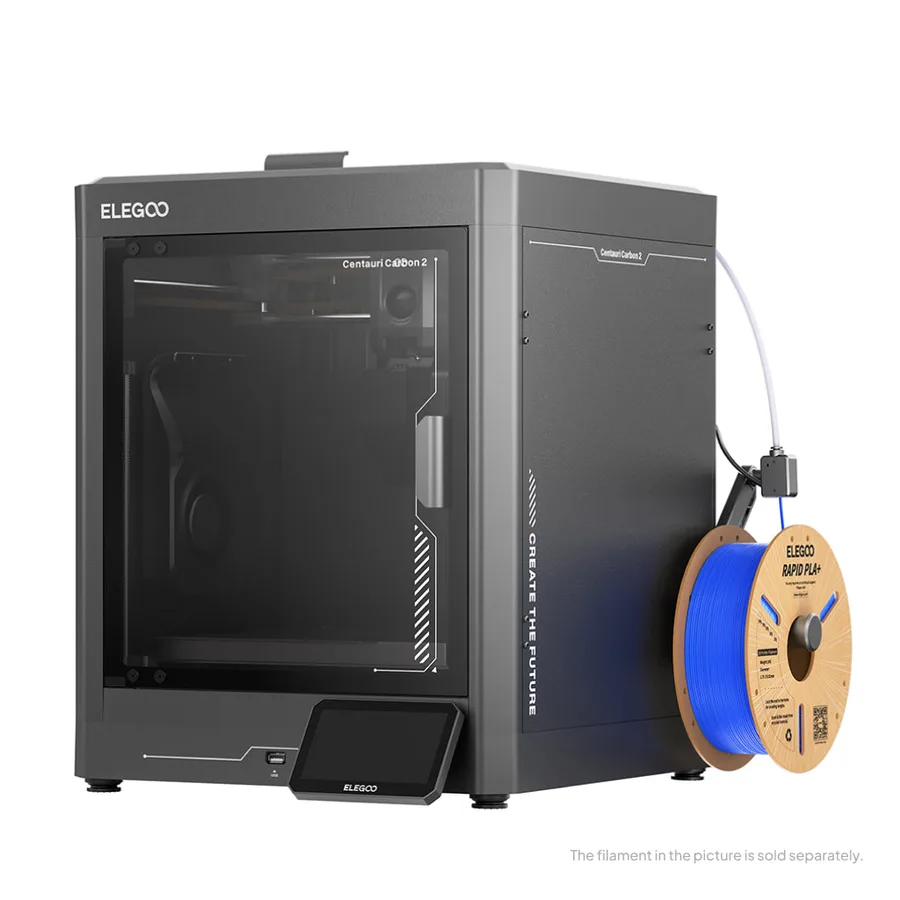
Elegoo Centauri Carbon 2
256 × 256 × 256 mm
Another manufacturer to compare when you need an enclosed machine in the 256 mm build-volume class.
Carbon, Carbon 2 and Carbon 2 Combo are different listings. Confirm the complete package before comparing prices.
Specifications and sellerElegoo Mars 5 Ultra
153.36 × 77.76 × 165 mm
A second documented resin format to compare with the larger Saturn 4 Ultra 16K.
The cover does not replace a suitable resin workspace. Plan washing, curing and consumables.
Specifications and seller
Elegoo Saturn 4 Ultra 16K
211.68 × 118.37 × 220 mm
Advertised 14 × 19 µm XY pixels and resin-vat heating to 30°C are relevant specifications for fine-detail workflows.
Pixel size is not measured finished-part accuracy. Budget for washing, curing, consumables and an appropriate workspace.
Specifications and sellerSources and limits
- Elegoo — About
- Elegoo — Mars 5 Ultra
- Elegoo — Centauri Carbon 2
- Elegoo — Neptune 4 Pro
- Elegoo US — Mercury wash & cure stations
- Elegoo — Saturn 4 Ultra 16K
We organize manufacturer and community documentation; we have not measured these products ourselves. The manual for your exact model takes precedence over general guidance.
A clearer shortlist starts with your projects.
Use the free buying checklist and budget worksheet before comparing offers.