
For a bigger CORE One
Prusa Research CORE One L+
An enclosed CoreXY FDM printer with active chamber heating up to 60°C and a 300 × 300 × 330 mm build volume per Prusa Research: the L+ version of the CORE One, in single-tool configuration.
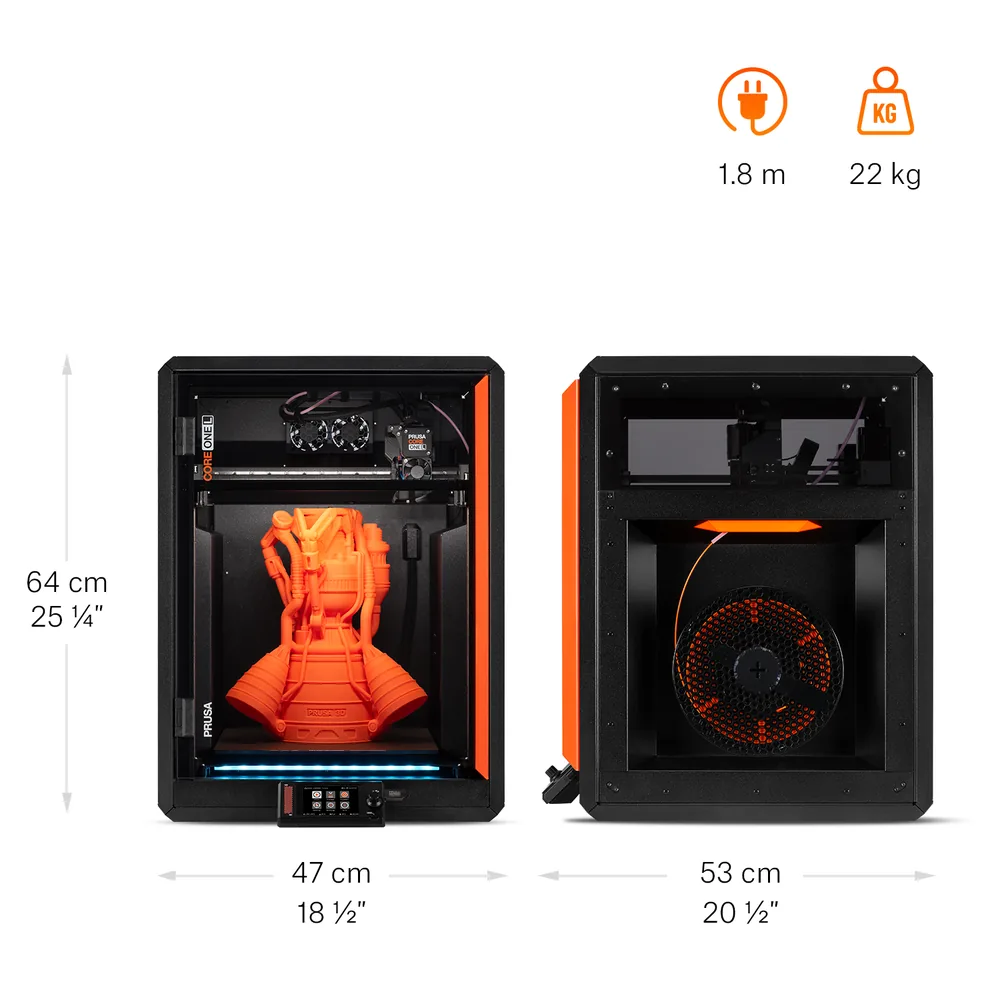
In short The Prusa CORE One L+ is an enclosed filament (FDM) 3D printer with a 300 × 300 × 330 mm (11.8 × 11.8 × 13 in) build volume. Prusa Research claims a 290 °C (554 °F) nozzle and active chamber heating to 60 °C (140 °F); the printer measures 469 × 521 × 635 mm (18.5 × 20.5 × 25 in) and weighs 21.9 kg (48.3 lb).
Documentary analysis · Not personally tested
 FDM · Enclosed
Why consider it?
Nearly double the standard CORE One+'s build volume, an actively convection-heated chamber up to 60°C, a 1080p night-vision camera included in the box, and fully automatic leveling via a load-cell sensor.
What to verify
Multicolor (MMU3, INDX) and the Advanced Filtration System remain separate add-ons; unlike the standard CORE One+, the manufacturer's spec sheet lists no Wi-Fi module for this machine, only Ethernet.
Prusa CORE One L+ specifications
- Technology
- Filament (FDM)
- Build volume
- 300 × 300 × 330 mm (11.8 × 11.8 × 13 in)
- Printer dimensions
- 469 × 521 × 635 mm (18.5 × 20.5 × 25 in)
- Weight
- 21.9 kg (48.3 lb)
- Enclosure
- Enclosed, active heating up to 60 °C (140 °F)
- Max nozzle temperature
- 290 °C (554 °F)
- Max bed temperature
- 120 °C (248 °F)
- Multicolor
- Optional MMU3 (5 materials) or INDX (up to 8 materials, Bondtech tool changer), both sold separately.
- Materials
- PLA, PETG, Flex, PVA, PC, PP, CPE, and PVB in standard configuration; ABS, ASA, HIPS, and PA with the optional Advanced Filtration System per Prusa Research.
- Screen
- 3.5-inch touchscreen
- Built-in camera
- Yes
- Connectivity
- Ethernet, USB
- Listed features
- Auto bed leveling, filament runout sensor
How much space does it need?
The Prusa CORE One L+ measures 469 × 521 × 635 mm (18.5 × 20.5 × 25 in) for a 300 × 300 × 330 mm (11.8 × 11.8 × 13 in) build volume: the dashed box is the printer, the solid cube the nominal build volume, about 19% of the machine’s volume. Add room for the spool or multicolor unit, cables and ventilation.
Source: official Prusa Research pages (prusa3d.com), checked September 28, 2026. Manufacturer claims, not our measurements. Build volume is nominal: orientation, supports and reserved zones can reduce the usable space.
Which projects is it for?
The CORE One L+ scales up the CORE One platform: Prusa Research lists a 300 × 300 × 330 mm build volume, nearly double the standard CORE One+'s 250 × 220 × 270 mm, inside an enclosed chamber with active convection heating up to 60°C versus 55°C on the standard model. It targets larger technical parts that benefit from a stable chamber temperature.
This listing covers the base single-tool version; a 4- or 8-tool INDX system is offered separately for multi-material work, alongside listings with advanced filtration or a critical-infrastructure-focused edition.
Materials and setup
Prusa Research lists a hotend up to 290°C (400°C with the optional HT hotend) and a heatbed up to 120°C. In standard configuration the printer runs PLA, PETG, Flex, PVA, PC, PP, CPE, and PVB; ABS, ASA, HIPS, and PA need the optional Advanced Filtration System per the manufacturer's listing.
First-layer leveling and calibration are fully automatic via a load-cell sensor. Multicolor isn't native: the MMU3 (5 materials) or the Bondtech INDX tool changer (up to 8 materials) are added separately.
What the bundle includes or not
Per Prusa Research, the assembled version includes the pre-built printer, the handbook, a 1kg Prusament PLA filament sample, a double-sided print sheet, two 0.4mm nozzles, a USB drive with sample models, and access to Prusa Academy. A 1080p night-vision camera ships in the box, though installing it stays optional.
The Advanced Filtration System and the INDX tool changer remain separate add-ons, each priced on its own: check precisely what a listing includes before buying.
Alternatives to compare
For a more compact footprint, the CORE One+ shares the same platform in a smaller chamber heated to 55°C. For an even larger volume with a tool changer scaling up to 5 heads, the XL+ remains the reference at Prusa Research.
The multicolor buying guide helps compare the MMU3 and INDX options before choosing.
Similar printers to compare
Sources and limits
- Source: official Prusa Research pages (prusa3d.com), checked September 28, 2026. Manufacturer claims, not our measurements.
- How we assess specifications
We have not measured noise, real printing speed, accuracy or reliability, so none of these is rated here.