
For large prints with A-series simplicity
Bambu Lab A2L
A large-format open-frame FDM printer (330 × 320 × 325 mm) that Bambu Lab positions as an affordable, beginner-friendly big-build machine.
In short The Bambu Lab A2L is an open-frame filament (FDM) 3D printer with a 330 × 320 × 325 mm (13 × 12.6 × 12.8 in) build volume. Bambu Lab claims a 500 mm/s top speed, a 300 °C (572 °F) nozzle and a 80 °C (176 °F) bed; the printer measures 544 × 529 × 505 mm (21.4 × 20.8 × 19.9 in) and weighs 12.8 kg (28.2 lb).
Documentary analysis · Not personally tested
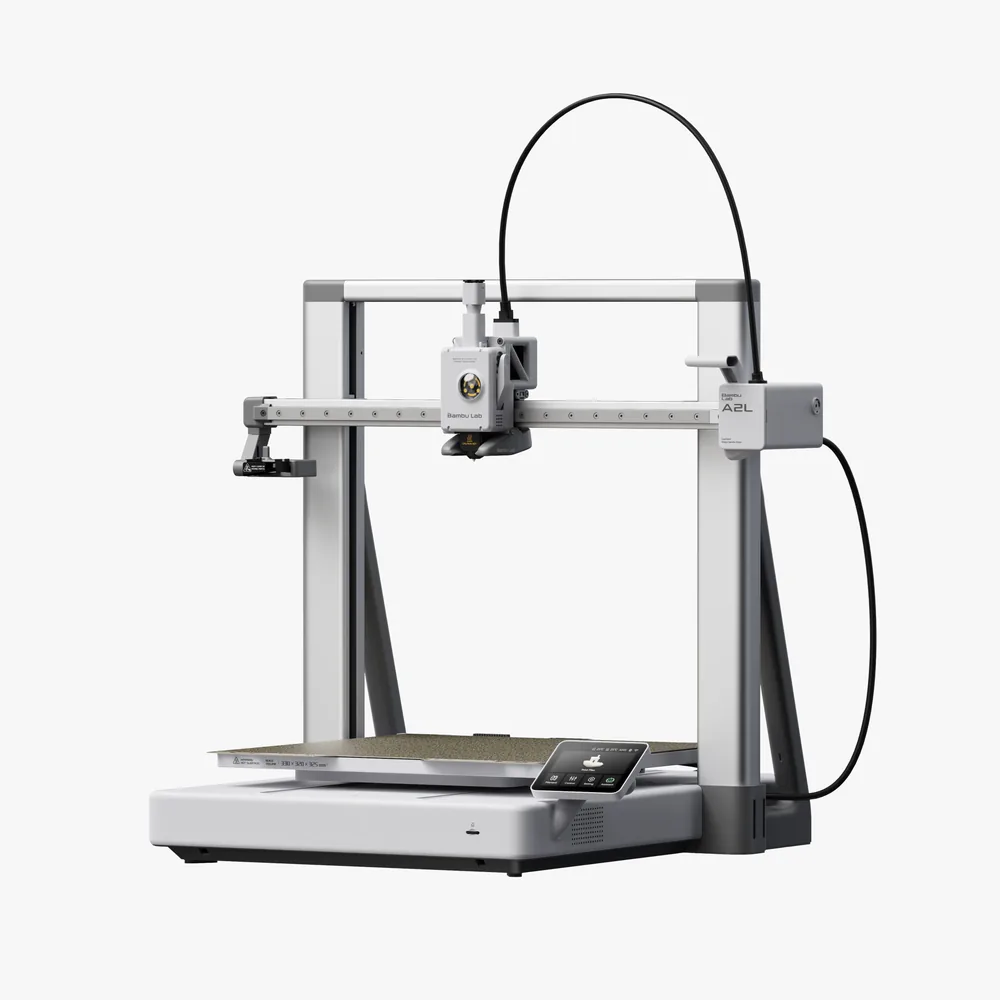 FDM · Open frame
Why consider it?
A large-format build volume (330 × 320 × 325 mm, about twice the space of the 256 mm class per Bambu Lab) on a simple open frame, with adaptive vibration compensation and optional cutting or drawing modules.
What to verify
Open frame and an 80 °C bed: not for regular ABS or ASA. A wide machine (544 × 529 × 505 mm): leave room for the moving bed.
Bambu Lab A2L specifications
- Technology
- Filament (FDM)
- Build volume
- 330 × 320 × 325 mm (13 × 12.6 × 12.8 in)
- Printer dimensions
- 544 × 529 × 505 mm (21.4 × 20.8 × 19.9 in)
- Weight
- 12.8 kg (28.2 lb)
- Enclosure
- Open frame
- Claimed top speed
- 500 mm/s
- Claimed acceleration
- 10,000 mm/s²
- Max nozzle temperature
- 300 °C (572 °F)
- Max bed temperature
- 80 °C (176 °F)
- Multicolor
- Works with AMS lite and the 2nd-gen AMS per Bambu Lab (4, 8 or 16 spools by combining units); check which unit the bundle includes.
- Materials
- Stainless steel nozzle up to 300 °C and a bed up to 80 °C: built first for PLA and other low-temperature materials.
- Screen
- 3.5-inch touchscreen
- Built-in camera
- Yes
- Connectivity
- Wi-Fi, microSD card
- Listed features
- Filament runout sensor, filament cutter
How much space does it need?
The Bambu Lab A2L measures 544 × 529 × 505 mm (21.4 × 20.8 × 19.9 in) for a 330 × 320 × 325 mm (13 × 12.6 × 12.8 in) build volume: the dashed box is the printer, the solid cube the nominal build volume, about 24% of the machine’s volume. Add room for the spool or multicolor unit, cables and ventilation.
Source: official Bambu Lab pages (bambulab.com), checked September 28, 2026. Manufacturer claims, not our measurements. Build volume is nominal: orientation, supports and reserved zones can reduce the usable space.
Which projects is it for?
The A2L is for makers who want big prints without moving to a more complex enclosed machine. Bambu Lab lists 330 × 320 × 325 mm, roughly twice the space of the 256 mm class A1: a full helmet in one piece, a whole batch of parts in one run, or a large prop without splitting the model.
The manufacturer pitches it as a beginner-friendly large-format printer. It keeps the A-series approach: automated calibration, a low-frame-rate camera for monitoring and timelapses, a filament cutter and a runout sensor.
Materials and setup
The stainless steel nozzle reaches 300 °C and the bed 80 °C. On an open frame, those numbers point to PLA, engineering PLAs and, with care, PETG; ABS and ASA are better handled by an enclosed printer such as the P2S.
Bambu Lab highlights adaptive vibration compensation: resonance calibration accounts for the toolhead position and the growing load on the bed, layer after layer, which matters on a bed-slinger. The claimed top speed is 500 mm/s with 10,000 mm/s² acceleration.
What the bundle includes or not
Multicolor runs through AMS lite or the 2nd-gen AMS, which Bambu Lab says can be combined up to sixteen spools. Depending on the listing, the printer ships alone or with a unit, so check the exact bundle before comparing prices.
The blade cutting module (stickers, leather, fabric, paper) and the pen drawing module are sold as options. Bambu Lab lists 544 × 529 × 505 mm and 12.8 kg: also leave clearance front and back for the moving bed. Plan the full cost with the startup budget tool.
Alternatives to compare
If desk space comes first, the A1 keeps the same philosophy in a 256 mm class frame. For large enclosed prints and engineering filaments, the H2S or the Creality K2 Plus go further, in a very different footprint.
Our large-format buying guide covers what to check before buying a printer this size, and the multicolor buying guide helps you choose between AMS lite and the 2nd-gen AMS.
Similar printers to compare
Sources and limits
- Source: official Bambu Lab pages (bambulab.com), checked September 28, 2026. Manufacturer claims, not our measurements.
- How we assess specifications
We have not measured noise, real printing speed, accuracy or reliability, so none of these is rated here.