
For an enclosed high-temp large format
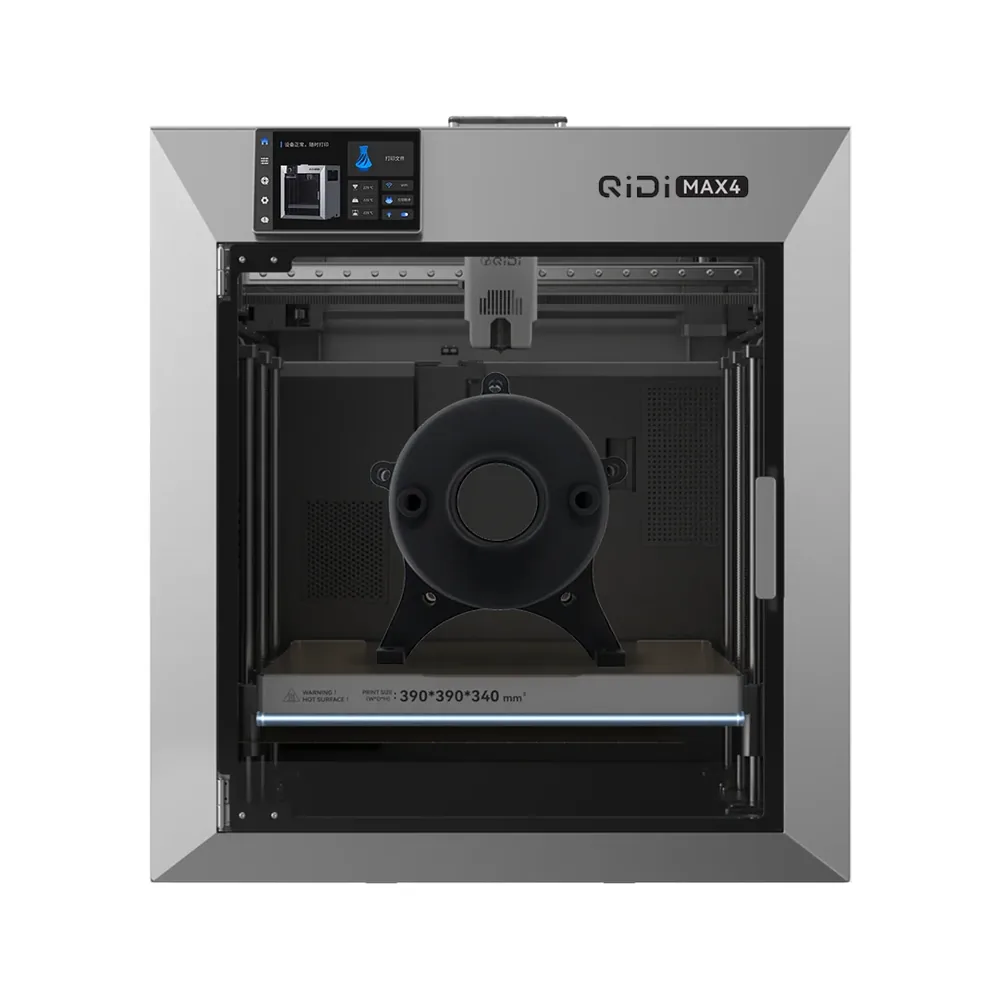
QIDI Tech Max4
An enclosed FDM printer with a 390 × 390 × 340 mm nominal build volume, a nozzle advertised up to 370°C, and a 65°C heated chamber per QIDI.
In short The Qidi Max4 is an enclosed filament (FDM) 3D printer with a 390 × 390 × 340 mm (15.4 × 15.4 × 13.4 in) build volume. QIDI Tech claims a 800 mm/s top speed, a 370 °C (698 °F) nozzle and active chamber heating to 65 °C (149 °F); the printer measures 558 × 578 × 612 mm (22 × 22.8 × 24.1 in) and weighs 40 kg (88.2 lb).
Documentary analysis · Not personally tested
 FDM · Enclosed
Why consider it?
A 390 × 390 × 340 mm volume in an enclosed chassis, an active 65°C heated chamber, a nozzle advertised up to 370°C, a speed advertised up to 800 mm/s, and an AI camera per QIDI.
What to verify
Multi-material or multicolor printing runs through the separately sold QIDI Box module. Some accessories like the Polar Cooler ship separately per QIDI; check the exact contents on the retailer's listing.
Qidi Max4 specifications
- Technology
- Filament (FDM)
- Build volume
- 390 × 390 × 340 mm (15.4 × 15.4 × 13.4 in)
- Printer dimensions
- 558 × 578 × 612 mm (22 × 22.8 × 24.1 in)
- Weight
- 40 kg (88.2 lb)
- Enclosure
- Enclosed, active heating up to 65 °C (149 °F)
- Claimed top speed
- 800 mm/s
- Claimed acceleration
- 30,000 mm/s²
- Max nozzle temperature
- 370 °C (698 °F)
- Max bed temperature
- 120 °C (248 °F)
- Multicolor
- No stock multicolor system; compatible with the separately sold QIDI Box module for multi-material printing.
- Materials
- PLA, PETG, ABS, ASA, TPU, PA, PC, PPS-CF, and other carbon-fiber composites per QIDI, thanks to a 370°C nozzle.
- Screen
- 5-inch touchscreen
- Built-in camera
- Yes
- Connectivity
- Wi-Fi, Ethernet, USB
- Listed features
- Auto bed leveling, filament runout sensor, built-in air filtration
How much space does it need?
The Qidi Max4 measures 558 × 578 × 612 mm (22 × 22.8 × 24.1 in) for a 390 × 390 × 340 mm (15.4 × 15.4 × 13.4 in) build volume: the dashed box is the printer, the solid cube the nominal build volume, about 26% of the machine’s volume. Add room for the spool or multicolor unit, cables and ventilation.
Source: official QIDI Tech pages (us.qidi3d.com), checked September 28, 2026. Manufacturer claims, not our measurements. Build volume is nominal: orientation, supports and reserved zones can reduce the usable space.
Which projects is it for?
The Max4 targets enclosed large-format printing with a nominal build volume of 390 × 390 × 340 mm per QIDI, presented by the manufacturer as a 55% step up from the Max3. It suits bulky parts, multiple batches, or projects that outgrow a standard desktop machine.
A speed advertised up to 800 mm/s with 30,000 mm/s² acceleration per QIDI keeps print time reasonable despite the large area to cover on each layer.
Materials and setup
A nozzle advertised up to 370°C and a chamber actively heated to 65°C per QIDI cover a wide range of engineering filaments: PLA, PETG, ABS, ASA, TPU, PA, PC, and PPS-CF, plus other carbon-fiber composites.
A closed-loop XY motor system with encoder feedback is advertised by QIDI to correct step loss, useful on a bed this size where deviations are more visible.
What the bundle includes or not
A real-time AI monitoring camera and three-stage filtration (HEPA and activated carbon) are advertised as built in by QIDI. The QIDI Box module for multicolor or multi-material printing remains a separate accessory, not included on the base machine.
QIDI notes that some accessories, like the Polar Cooler, may ship separately from the machine; the exact box contents should still be checked on the chosen retailer's listing.
Alternatives to compare
For a more compact enclosed format from the same brand, the Q1 Pro stays a more accessible base. For an already proven large format, the X-Max 3 covers a smaller volume in a similar lineup.
The startup budget tool helps weigh the cost of a machine this size against add-ons like the QIDI Box.
Similar printers to compare
Sources and limits
- Source: official QIDI Tech pages (us.qidi3d.com), checked September 28, 2026. Manufacturer claims, not our measurements.
- How we assess specifications
We have not measured noise, real printing speed, accuracy or reliability, so none of these is rated here.