
For a heated chamber, now discontinued
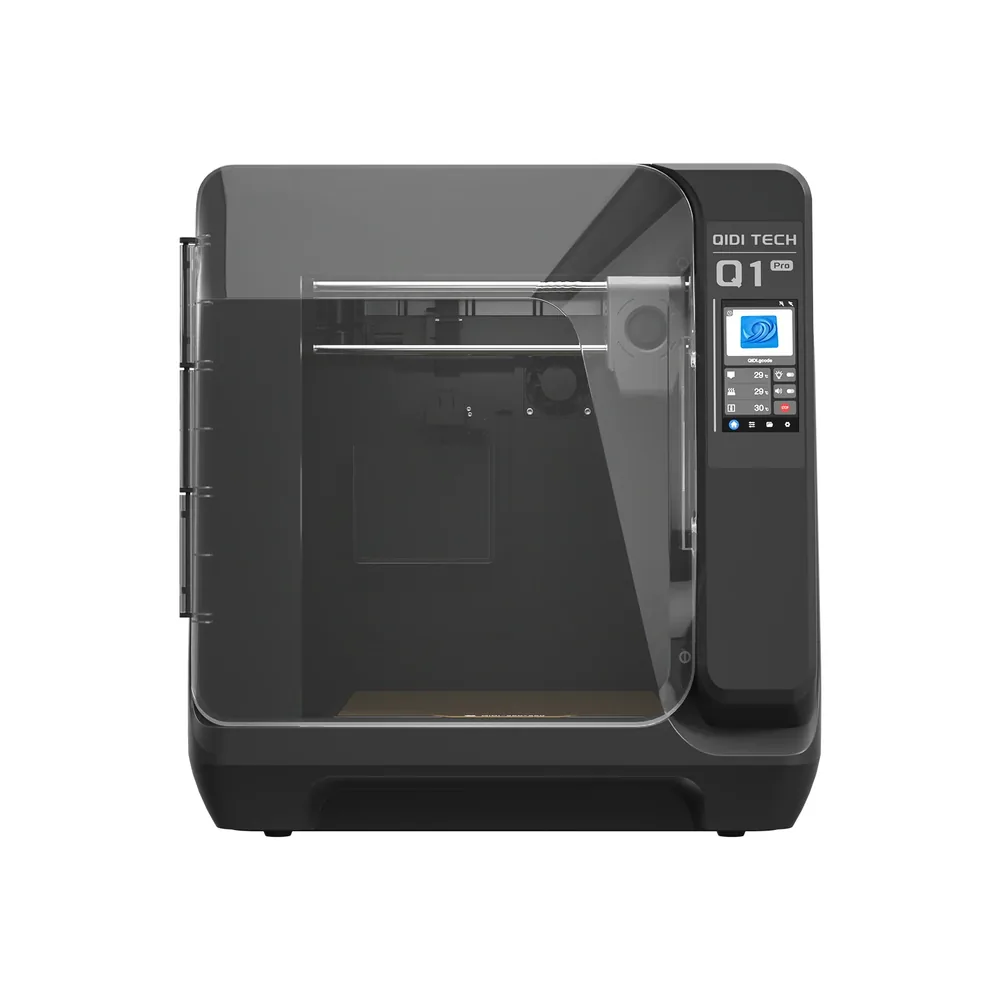
QIDI Tech Q1 Pro
A CoreXY FDM printer with an actively heated chamber up to 60°C, a 245 × 245 × 240 mm nominal build volume; discontinued by QIDI.
In short The Qidi Q1 Pro is an enclosed filament (FDM) 3D printer with a 245 × 245 × 240 mm (9.6 × 9.6 × 9.4 in) build volume. QIDI Tech claims a 600 mm/s top speed, a 350 °C (662 °F) nozzle and active chamber heating to 60 °C (140 °F); the printer measures 477 × 467 × 489 mm (18.8 × 18.4 × 19.3 in) and weighs 17 kg (37.5 lb).
Documentary analysis · Not personally tested
 FDM · Enclosed
Why consider it?
An actively heated chamber up to 60°C, a nozzle advertised up to 350°C, and a bed up to 120°C per QIDI, a rare combination at this compact size.
What to verify
QIDI lists this model as discontinued (its listing shows sold out) and points buyers to the QIDI Q2 as a successor; new-unit availability isn't guaranteed.
Qidi Q1 Pro specifications
- Technology
- Filament (FDM)
- Build volume
- 245 × 245 × 240 mm (9.6 × 9.6 × 9.4 in)
- Printer dimensions
- 477 × 467 × 489 mm (18.8 × 18.4 × 19.3 in)
- Weight
- 17 kg (37.5 lb)
- Enclosure
- Enclosed, active heating up to 60 °C (140 °F)
- Claimed top speed
- 600 mm/s
- Claimed acceleration
- 20,000 mm/s²
- Max nozzle temperature
- 350 °C (662 °F)
- Max bed temperature
- 120 °C (248 °F)
- Multicolor
- No stock multicolor system; compatible with the optional QIDI Box on later models in the lineup.
- Materials
- PLA, ABS, ASA, and PETG recommended; TPU, PA, PC, and glass/carbon-fiber reinforced composites also compatible per QIDI.
- Screen
- 4.3-inch touchscreen
- Built-in camera
- Yes
- Connectivity
- Wi-Fi, USB
- Listed features
- Auto bed leveling, filament runout sensor
How much space does it need?
The Qidi Q1 Pro measures 477 × 467 × 489 mm (18.8 × 18.4 × 19.3 in) for a 245 × 245 × 240 mm (9.6 × 9.6 × 9.4 in) build volume: the dashed box is the printer, the solid cube the nominal build volume, about 13% of the machine’s volume. Add room for the spool or multicolor unit, cables and ventilation.
Source: official QIDI Tech pages (qidi3d.com), checked September 28, 2026. Manufacturer claims, not our measurements. Build volume is nominal: orientation, supports and reserved zones can reduce the usable space.
Which projects is it for?
The Q1 Pro is a CoreXY FDM printer with an actively heated chamber up to 60°C, with a 245 × 245 × 240 mm nominal build volume per QIDI. It targeted makers who wanted to print technical materials (nylon, composites) without stepping up to a format as large as QIDI's X-Max 3.
QIDI now lists this model as discontinued on its official page, which nonetheless stays online with full specifications; it's no longer a standard new purchase, but a useful technical reference for comparing the lineup.
Materials and setup
The actively heated chamber up to 60°C, a nozzle advertised up to 350°C, and a bed up to 120°C let it print ABS, ASA, and PETG in good conditions per QIDI, on top of standard PLA.
QIDI also lists compatibility with TPU, PA, PC, and glass- or carbon-fiber reinforced composites, materials that benefit specifically from a stable chamber temperature to limit warping.
What the bundle includes or not
Per QIDI, full auto-calibration and dual-sensor leveling were part of the standard equipment, with a dual-motor Z-axis system for bed stability.
The exact box contents are no longer actively detailed since the listing is marked discontinued; if a unit is still found in stock, it's worth checking exactly what the offer includes (spare nozzles, documentation) before buying.
Alternatives to compare
QIDI directly points to the Q2 as its replacement, with a larger volume in a smaller footprint. For a substantially larger format with the same heated-chamber approach, the Plus 4 remains available from QIDI.
The beginner's buying guide helps weigh the value of an actively heated chamber before turning to a model that's still on sale.
Similar printers to compare
Sources and limits
- Source: official QIDI Tech pages (qidi3d.com), checked September 28, 2026. Manufacturer claims, not our measurements.
- How we assess specifications
We have not measured noise, real printing speed, accuracy or reliability, so none of these is rated here.