
For an enclosed CoreXY on a budget
Kingroon KLP1
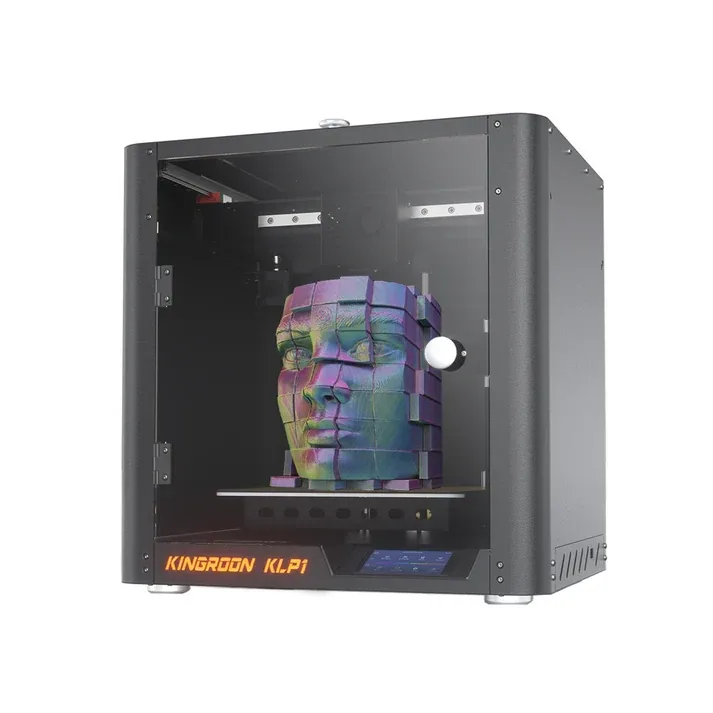
An enclosed CoreXY FDM printer running Klipper, with a 210 × 210 × 210 mm nominal build volume and a top speed advertised at 500 mm/s per Kingroon.
In short The Kingroon KLP1 is an enclosed filament (FDM) 3D printer with a 210 × 210 × 210 mm (8.3 × 8.3 × 8.3 in) build volume. Kingroon claims a 500 mm/s top speed.
Documentary analysis · Not personally tested
 FDM · Enclosed
Why consider it?
An enclosed chassis with an all-in-one Klipper mainboard (no Raspberry Pi needed), linear rails on the X and Y axes, an ADXL345 vibration-compensation module, and a top speed advertised at 500 mm/s per Kingroon.
What to verify
Kingroon doesn't state a maximum nozzle or bed temperature on the listing reviewed; availability varies by warehouse (marked sold out on some at the time of writing).
Kingroon KLP1 specifications
- Technology
- Filament (FDM)
- Build volume
- 210 × 210 × 210 mm (8.3 × 8.3 × 8.3 in)
- Enclosure
- Enclosed
- Claimed top speed
- 500 mm/s
- Claimed acceleration
- 10,000 mm/s²
- Multicolor
- No stock multicolor system; single extruder per Kingroon.
- Materials
- PLA, ABS, PETG, TPU, and wood with the standard nozzle; nylon and carbon fiber with the all-metal hotend per Kingroon.
- Listed features
- Auto bed leveling
Source: official Kingroon pages (kingroon.com), checked October 6, 2026. Manufacturer claims, not our measurements. Build volume is nominal: orientation, supports and reserved zones can reduce the usable space.
Which projects is it for?
The KLP1 is an enclosed CoreXY FDM printer, with a 210 × 210 × 210 mm nominal build volume per Kingroon. It targets beginners who want an enclosed machine on a tight budget, for printing PLA, ABS, or PETG without the drafts of an open frame.
Klipper firmware runs natively on an all-in-one mainboard, with no Raspberry Pi to add, simplifying initial setup compared with a typical Klipper install on a companion computer.
Materials and setup
Per Kingroon, the all-metal hotend handles conventional materials like PLA, ABS, PETG, TPU, and wood, as well as more technical materials like nylon and carbon fiber.
The listing reviewed doesn't state a numeric value for maximum nozzle or bed temperature: for the most demanding materials (nylon, composites), it's worth confirming these limits with the retailer before buying.
What the bundle includes or not
Kingroon advertises auto bed leveling out of the box, with a new bed structure, plus a top speed of 500 mm/s and 10,000 mm/s² acceleration driven by Klipper.
The exact box contents (spare nozzles, tools) aren't detailed on the manufacturer's listing; availability varies by warehouse, with some marked sold out at the time of writing, worth checking before ordering. Comparing exact warehouse stock before ordering is worth the extra minute, since a sold-out region can leave a checkout page live without actually shipping.
Alternatives to compare
For an open-frame, more compact format from the same brand, the KP3S Pro V2 is the closest alternative. For an enclosed chassis from another brand at this budget, the Elegoo Centauri Carbon is a useful comparison point.
The budget buying guide helps compare an entry-level enclosed printer like the KLP1 with a cheaper open-frame chassis that's more exposed to drafts.
Similar printers to compare
Sources and limits
- Source: official Kingroon pages (kingroon.com), checked October 6, 2026. Manufacturer claims, not our measurements.
- How we assess specifications
We have not measured noise, real printing speed, accuracy or reliability, so none of these is rated here.