
For an open-frame CoreXY on a budget
Flashforge Adventurer 5M
An open-frame CoreXY FDM printer with a 220 × 220 × 220 mm nominal build volume and a top speed advertised at 600 mm/s.
In short The Flashforge Adventurer 5M is an open-frame filament (FDM) 3D printer with a 220 × 220 × 220 mm (8.7 × 8.7 × 8.7 in) build volume. Flashforge claims a 600 mm/s top speed, a 280 °C (536 °F) nozzle and a 100 °C (212 °F) bed; the printer measures 363 × 402 × 448 mm (14.3 × 15.8 × 17.6 in).
Documentary analysis · Not personally tested
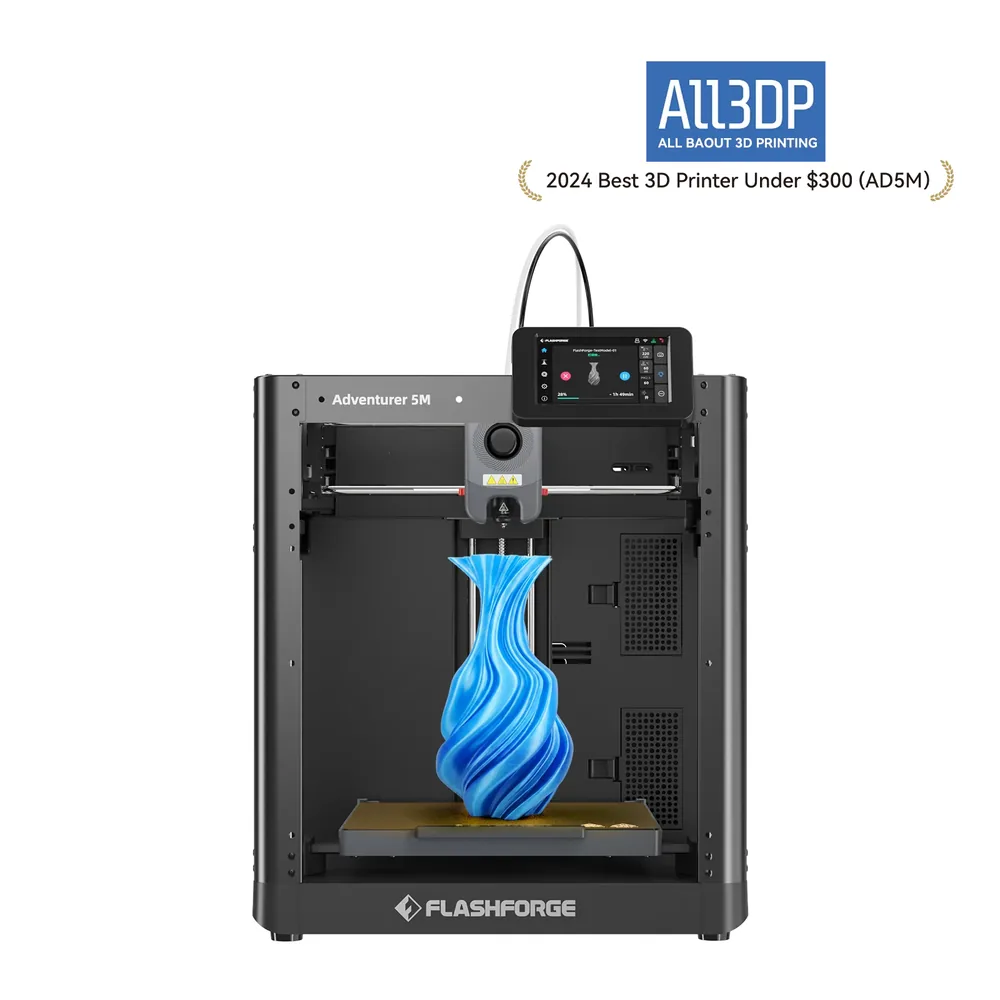 FDM · Open frame
Why consider it?
An open-frame all-metal CoreXY chassis, a nozzle advertised up to 280°C, four quick-swap nozzles (0.25/0.4/0.6/0.8mm), and a top speed advertised at 600 mm/s per Flashforge.
What to verify
The open frame doesn't help with ABS or ASA, reserved for the enclosed Pro version; the exact box contents should be checked on the retailer's listing.
Flashforge Adventurer 5M specifications
- Technology
- Filament (FDM)
- Build volume
- 220 × 220 × 220 mm (8.7 × 8.7 × 8.7 in)
- Printer dimensions
- 363 × 402 × 448 mm (14.3 × 15.8 × 17.6 in)
- Enclosure
- Open frame
- Claimed top speed
- 600 mm/s
- Claimed acceleration
- 20,000 mm/s²
- Max nozzle temperature
- 280 °C (536 °F)
- Max bed temperature
- 100 °C (212 °F)
- Multicolor
- Single extruder; no stock multicolor system per Flashforge.
- Materials
- PLA and PETG with the 0.4mm nozzle; TPU, PLA-CF, and PETG-CF with the 0.6mm nozzle per Flashforge.
- Screen
- 4.3-inch touchscreen
- Connectivity
- Wi-Fi, Ethernet, USB
- Listed features
- Auto bed leveling, filament runout sensor
How much space does it need?
The Flashforge Adventurer 5M measures 363 × 402 × 448 mm (14.3 × 15.8 × 17.6 in) for a 220 × 220 × 220 mm (8.7 × 8.7 × 8.7 in) build volume: the dashed box is the printer, the solid cube the nominal build volume, about 16% of the machine’s volume. Add room for the spool or multicolor unit, cables and ventilation.
Source: official Flashforge pages (flashforge.com), checked September 28, 2026. Manufacturer claims, not our measurements. Build volume is nominal: orientation, supports and reserved zones can reduce the usable space.
Which projects is it for?
The Adventurer 5M is an open-frame CoreXY FDM printer with a 220 × 220 × 220 mm nominal build volume per Flashforge. It targets beginners and makers who want a simple setup (about 95% pre-assembled per the listing) for everyday PLA and PETG prints, without the constraints of an enclosed chassis.
The advertised top speed of 600 mm/s and acceleration up to 20,000 mm/s² let you get through parts faster than a typical entry-level printer, while keeping a compact footprint that fits on a desk.
Materials and setup
The nozzle heats up to 280°C per Flashforge and swaps in seconds thanks to the quick-detach 0.25/0.4/0.6/0.8mm nozzle system. The heated bed reaches 100°C, enough for PLA and PETG with the 0.4mm nozzle.
With the 0.6mm nozzle, the listing also mentions TPU, PLA-CF, and PETG-CF compatibility, but the chassis stays open: without an enclosure, ABS and ASA remain trickier to print without warping.
What the bundle includes or not
Per Flashforge, the printer ships 95% pre-assembled, with the screen and filament holder still to install. Auto bed leveling and filament run-out detection are part of the advertised base equipment.
The exact box contents (spare nozzles, an extra plate, a filament sample) aren't detailed on the manufacturer's listing: check the retailer's page before comparing two offers.
Alternatives to compare
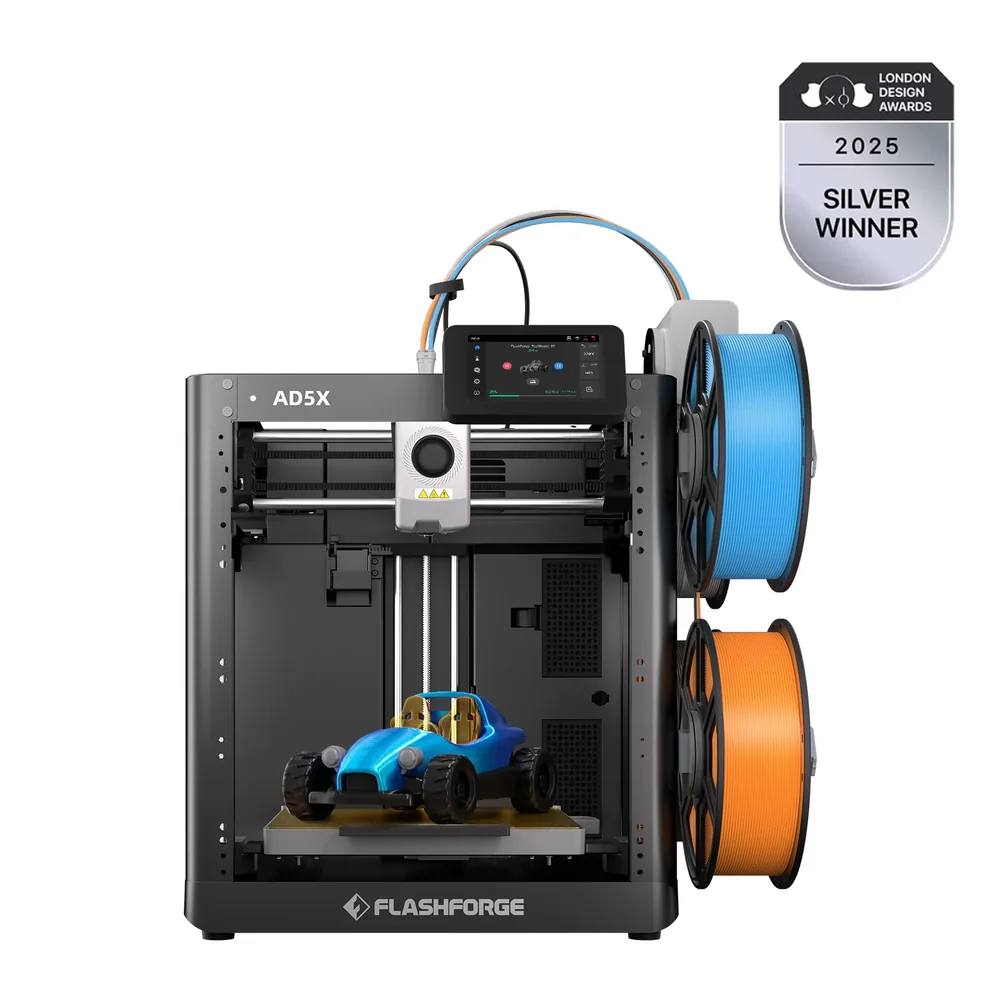
For an enclosed chassis with filtration at the same 220 × 220 × 220 mm, the Adventurer 5M Pro is the closest match within Flashforge's lineup. For built-in multicolor without an external box, the AD5X shares the same open-frame base with an integrated IFS system.
The beginner's buying guide helps decide between an open-frame model like this one and an enclosed chassis needed for ABS or ASA.
Similar printers to compare
Sources and limits
- Source: official Flashforge pages (flashforge.com), checked September 28, 2026. Manufacturer claims, not our measurements.
- How we assess specifications
We have not measured noise, real printing speed, accuracy or reliability, so none of these is rated here.